isp_filter2d: Architecture
1. Block diagram
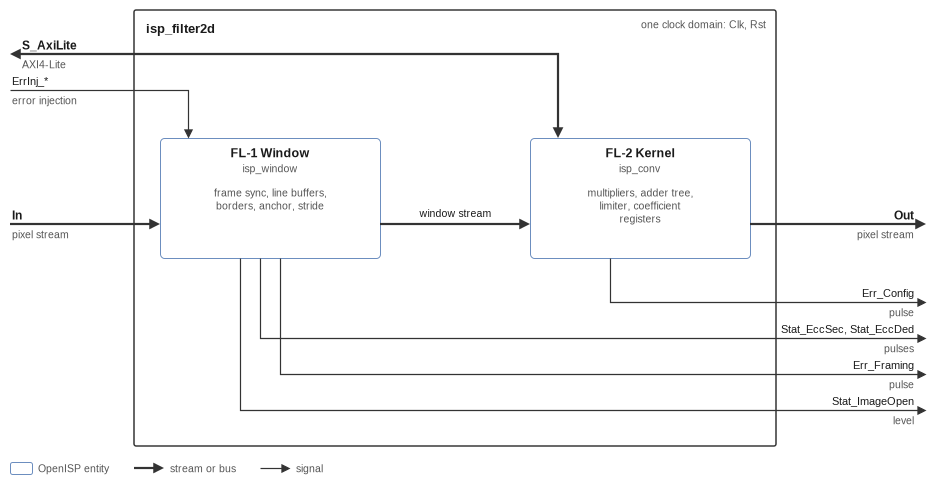
The module is the connection of two entities. The window generator (FL-1) forms the window of every reference pixel; the kernel (FL-2) reduces every window to one pixel. The window stream between them carries the packets of the output image, so the output of the kernel is a pixel stream without further logic.
2. Building blocks
| ID | Block | Function |
|---|---|---|
| FL-1 | Window | isp_window: frame sync, line buffers, borders, anchor, stride. |
| FL-2 | Kernel | isp_conv: multipliers, adder tree, limiter, coefficient registers on the AXI4-Lite slave. |
3. Ports
| Port | Direction | Width | From |
|---|---|---|---|
Clk, Rst |
in | 1 | both |
In_Valid, In_Ready, In_Data, In_Last, In_User |
pixel stream, PixelBits_g |
FL-1 | |
Out_Valid, Out_Ready, Out_Data, Out_Last, Out_User |
pixel stream, B bits | FL-2 | |
S_AxiLite_* |
12 address bits, 32 data bits | FL-2 | |
Err_Framing, Stat_ImageOpen, Stat_EccSec, Stat_EccDed |
out | 1 | FL-1 |
ErrInj_BitFlip, ErrInj_Valid |
in | as isp_window |
FL-1 |
Err_Config |
out | 1 | FL-2 |
4. Connection
The window stream of FL-1 (Out_Valid, Out_Ready, Out_Data, Out_Last, Out_User) is the input of FL-2. The
generics PixelBits_g, WinX_g and WinY_g go to both parts, so the widths of the window agree by construction.
The image start that FL-2 uses for its coefficient set is the first window of the output image. Its ready output is
the common enable of its pipeline; the ready path from Out_Ready ends at the event control of FL-1 and at the
input stage of the frame sync inside it.
5. Timing and throughput
| Property | Value | Requirement |
|---|---|---|
| Pixel rate, image period | Those of FL-1; FL-2 takes one window per clock cycle | FLT-PF-01 |
| Latency | 3 clock cycles in FL-1 and 3 + log2ceil(T) in FL-2: log2ceil(T) + 6 clock cycles | FLT-PF-02 |
6. Fault tolerance and resources
Both follow from the parts: ECC-protected line buffers in FL-1, parity-protected coefficient registers in FL-2, flip-flops elsewhere. The resources are the sum of the two parts (their architecture documents); for a 5 x 5 kernel on 12-bit pixels of a line of 2048 pixels with run-time coefficients: four line buffers (147 kbit with check bits), 25 multipliers and about 3500 flip-flops.