odma_mm2s: Architecture and Design Description
1. Block diagram
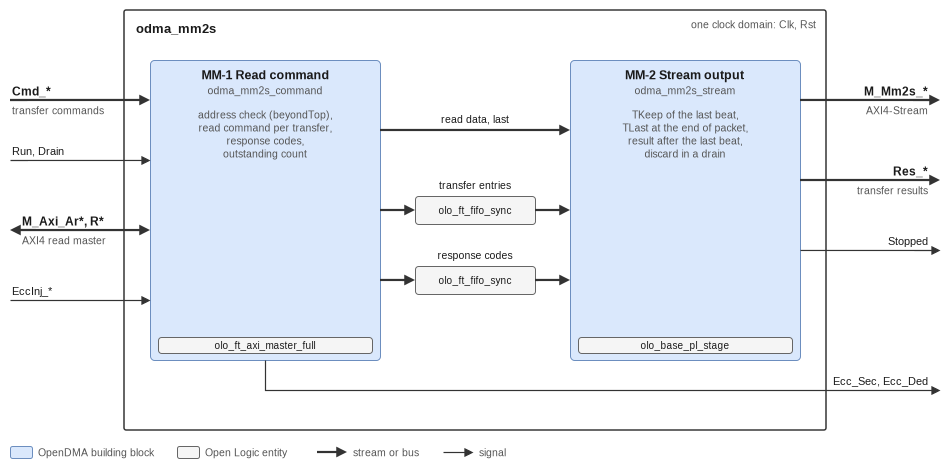
2. Entities
| Entity | Block | Content |
|---|---|---|
odma_mm2s |
Module top | Instances of the blocks below and of the read master, the stopped level |
odma_mm2s_command |
MM-1 | Command acceptance, address and length check, read commands, transfer entries, response codes |
odma_mm2s_stream |
MM-2 | Stream output with TKeep and TLast, transfer results, discard during a drain; with Join_g the closing beat of a packet ended by a halt |
olo_ft_axi_master_full |
MM-1 | AXI4 read master with the ECC-protected read data buffer (write side not implemented) |
olo_ft_fifo_sync (two) |
MM-1 to MM-2 | Transfer buffer {length, end of packet, code} and response buffer {error code}, 8 entries each |
olo_base_pl_stage |
MM-2 | Register stage of the stream output (without Join_g) |
olo_base_stream_join |
MM-2 | Stream join of the buffers of a packet (with Join_g, in place of the register stage) |
3. Ports of odma_mm2s
| Port | Width | Direction | Description |
|---|---|---|---|
Clk, Rst |
1 | in | Clock, reset (the core reset CoreRst) |
Cmd_Valid, Cmd_Ready |
1 | in, out | Transfer command |
Cmd_Addr, Cmd_Length |
AddrWidth_g, LengthWidth_g |
in | Buffer address and length |
Cmd_Sof, Cmd_Eof, Cmd_Keyhole |
1 | in | Start and end of packet, keyhole (phase b) |
Res_Valid, Res_Ready |
1 | out, in | Transfer result |
Res_Bytes, Res_Eof, Res_Err |
LengthWidth_g, 1, 2 |
out | Transferred bytes, end of packet, error code |
Run, Drain, Stopped |
1 | in, in, out | Channel control |
M_Axi_Ar*, M_Axi_R* |
out/in | AXI4 read master (ArAddr, ArLen, ArSize, ArBurst, ArLock, ArCache, ArProt, ArValid, ArReady, RData, RResp, RLast, RValid, RReady) |
|
M_Mm2s_Data, _Keep, _Last, _Valid, _Ready |
out/in | MM2S stream | |
Ecc_Sec, Ecc_Ded |
3 | out | ECC events of the read data buffer (bit 0, index 0 of the extension window), the transfer buffer (bit 1, index 4) and the response buffer (bit 2, index 5); one pulse per word read from the buffer |
EccInj_Valid |
3 | in | Error injection per buffer, same order |
EccInj_Double |
1 | in | '1': flip two bits, '0': flip one bit of the next codeword written to the buffer |
EccInj_Data |
1 | in | '1': flip data bits, '0': flip parity bits (section 6) |
Generics as in section 6 of the specification. The core sets Join_g = IncludeSg_g.
4. Read command (MM-1, odma_mm2s_command)
A command is accepted when Run = '1', Drain = '0' and the transfer buffer has a free entry. For an accepted
command the block
- checks the length and the buffer with
beyondTop(Cmd_Addr, Cmd_Length)(odma_pkg); a keyhole command skips the buffer check, because all its beats access the memory word at the address (MM-SG-03); - if the length is not 0 and the buffer fits: writes the entry {length, end of packet,
ErrNone_c} into the transfer buffer and issues one read command toolo_ft_axi_master_full(CmdRd_Addr=Cmd_Addr,CmdRd_Size=Cmd_Length,CmdRd_Fixed=Cmd_Keyhole,CmdRd_LowLat= '0'); for a FIXED command the master ignores the address bits below the memory width and packs the bytes from lane 0, so the stream output needs no change; - otherwise writes the entry {length, end of packet, code} only, without a read:
ErrInt_cfor the length 0 (MM-RD-06),ErrDec_cfor a buffer beyond the top of the address space (MM-RD-04).
The read master splits the command into bursts of at most BurstBeats_g beats that stay within 4 KB, issues a burst
only when its internal FIFO can take it (high-latency mode, MM-RD-03) and returns Rd_Done or Rd_Error with the
response code of the first failing beat (Rd_ErrorResp) per command; the block writes the error code of each
response into the response buffer: ErrNone_c for Rd_Done, for Rd_Error ErrDec_c when Rd_ErrorResp is
DECERR ("11") and ErrSlv_c otherwise (SLVERR, and EXOKAY, interpretation I14; MM-ER-03). A command accepted before a
drain is still issued to the master; its data
is discarded by MM-2. The response buffer never overflows: every response belongs to an entry of the transfer buffer,
which has the same depth.
The read master runs with UserTransactionSizeBits_g = LengthWidth_g + 1 (the setting of the write master of
odma_s2mm, gap G14 of the architecture), AxiMaxBeats_g = the smaller of BurstBeats_g and the beats of 4 KB
(4096 / (MemWidth_g / 8); no AXI burst crosses 4 KB, so the bursts are the same, gap G13),
AxiMaxOpenTransactions_g = 8, DataFifoDepth_g = BufferBeats_g (in stream beats), IntFifoDepth_g =
ReadBursts_g x AxiMaxBeats_g (in memory words), UserDataWidth_g = StreamWidth_g, AxiDataWidth_g =
MemWidth_g, ImplWrite_g = false. Its fixed ArCache 0011 and ArProt 000 are the values of MM-IF-01. In
olo_ft_axi_master_full, DataFifoDepth_g is the depth of its ECC-protected read buffer in words of
UserDataWidth_g bits (stream beats, with Rd_Last); the wrapped olo_axi_master_full has an internal read FIFO of
ReadBursts_g bursts of AxiDataWidth_g + 1 bits (registers), and its high-latency mode requests a burst only when
this FIFO can take it, so at most ReadBursts_g bursts are in flight: with T stream beats per burst and a read
latency L the channel sends about min(1, ReadBursts_g x T / (L + T + 5)) beats per clock cycle, one per clock cycle
up to L = (ReadBursts_g - 1) x T - 8 (MM-RD-07). A stream peer that holds TReady low therefore fills the read
buffer and then the internal FIFO and stops further bursts, but never holds the R channel (MM-RD-03).
5. Stream output (MM-2, odma_mm2s_stream)
The block takes the head entry of the transfer buffer.
- Entry without a read (code not
ErrNone_c): result {0 bytes, end of packet of the entry, code of the entry}, no beat. - Read entry: every read data word of the master (
Rd_Data,Rd_Valid,Rd_Last) becomes one stream beat into the register stage with the handshake passed through (stageIn_Valid=Rd_Valid,Rd_Ready= stageIn_Ready).TKeepis all ones except on the beat withRd_Last, where it islastKeep(length, StreamWidth_g / 8), computed when the entry is taken;TLastisRd_Lastand the end of packet of the entry (MM-ST-01, MM-ST-02). After the beat withRd_Lastthe block waits until the register stage is empty, so that the stream peer has accepted the last beat, and for the head of the response buffer (the response can arrive before or after the last beat), then returns the result {length, end of packet, error code} (MM-ST-03) and pops both entries.
The output path has an olo_base_pl_stage (one register stage) so that the stream interface starts at flip-flops;
with the stage the path keeps one beat per clock cycle (MM-RD-05).
Drain (Drain = '1'): the register stage is held in reset, so M_Mm2s_Valid is low; read data is taken
(Rd_Ready = '1') and discarded, and the entries and responses are popped without results as their data and
responses arrive. Halt (Run = '0'): no change of this block; MM-1 accepts no new command.
5.1 Stream join (Join_g)
With Join_g the register stage is replaced by olo_base_stream_join (Width_g = StreamWidth_g), whose outputs
are registered, so the stream interface still starts at flip-flops. The read beats enter the join with In_Be =
the TKeep above (all '1', lastKeep on Rd_Last) and In_Last = Rd_Last and the end of packet of the entry. The
join closes the gap after the last byte of every buffer without the end of packet, so the bytes of the next buffer
follow without gap (MM-SG-01); TKeep of the output is Out_Be.
| Situation | Behaviour |
|---|---|
| Entry without the end of packet | The result is returned when the beat with Rd_Last has entered the join and the response is in (MM-SG-02); its last bytes may still wait in the join for the next buffer. The flag InPkt records that a packet is open in the join |
| Entry with the end of packet | The result is returned when the output beat with TLast has been accepted by the stream peer (flag LastOut, set by that output handshake in Result_s) and the response is in (MM-ST-03); InPkt is cleared with its last input beat |
| Entry without a read (length 0, buffer beyond the top) | Result at once, as without the join; InPkt keeps its value |
Run = '0', MM-1 idle, transfer buffer empty, InPkt = '1' |
Close_s: the block sends the closing beat {In_Be all '0', In_Last '1'}; the join sends the bytes it holds with TLast on the last of them (MM-SG-04, interpretation M4). Close_s ends when that output beat has been accepted. A halt and an error (the engine halts the channel after an error) take this path |
Drain = '1' |
The join is held in reset, which clears the bytes it holds; InPkt is cleared; Close_s ends |
Stopped with Join_g (section 6) also requires InPkt = '0' and the block not in Close_s, so a halt ends only
when the stream peer has taken the last beat of the open packet.
ECC: Ecc_Sec and Ecc_Ded of a buffer are its flags of the output word (time-aligned with the data) qualified
with the output handshake of the buffer, so every word read gives at most one pulse. The error injection drives the
ErrInj_BitFlip input of the selected buffer. In parity mode (EccInj_Data = '0') it flips bit 0 (single error) or
bits 0 and 1 (double error) of the codeword, the overall parity bit and the first Hamming parity bit of the code of
olo_ft_pkg_ecc, so an injected error never changes the data: a single error is corrected, a double error is detected
and the word is still delivered unchanged. In data mode (EccInj_Data = '1') it flips data bit 0 (codeword bit 3) or
data bits 0 and 1 (codeword bits 3 and 5): a single error is corrected, so the channel passes only when it uses the
corrected output of the buffer, and a double error corrupts the word, which is delivered as read (the destructive test
of the consequence of a double error).
6. Stopped
Stopped = '1' when the command block is idle, the transfer buffer is empty and the response buffer is empty, and,
with Join_g, no packet is open in the join and no closing beat is pending (section 5.1). A transfer entry with a
read is popped only after the response of the read, so an empty transfer buffer also means that no read command is
outstanding at the read master. During a halt this happens after the last result (with Join_g after the closing
beat); during a drain after the last response.
7. State machines
odma_mm2s_command: Idle_s (wait for a command; the command is taken into registers), Entry_s (the transfer
entry is written, the code is computed from the registered address and length) and Issue_s (read command handshake
with the master, for a read entry only).
odma_mm2s_stream: Head_s (wait for a transfer entry), Data_s (beats of a read entry), Result_s (wait for
the empty register stage, with Join_g for the conditions of section 5.1, and the response, result handshake; during
a drain the entries are popped without a result), Close_s (with Join_g: closing beat, then wait for the output
beat with TLast). Every when others returns to the first state.
8. Timing
- Command to the read command of the master:
CmdRd_Validrises 2 clock cycles after the command handshake (entry written in between); the first AR handshake follows after the command time of the read master (at least four cycles). - Read data to the stream: the fall-through of the read data buffer plus one register stage. With
Join_gthe join holds up to one beat of bytes until the next input beat, so an output beat follows its input beat one beat later on an aligned stream, and the end of a packet whose last bytes need two output beats inserts one clock cycle; the throughput stays one beat per clock cycle otherwise. - Last beat to the result:
Res_Validrises in the clock cycle after the stream handshake of the last beat when the response is already buffered. - Throughput: one stream beat per clock cycle when a burst carries at least 8 stream beats (
BurstBeats_gxMemWidth_g/StreamWidth_g) and the memory answers without wait states (MM-RD-05). The read master requests a burst only when its internal read FIFO ofReadBursts_gbursts can take it (section 4), so with fewer stream beats per burst the read latency of the memory is no longer hidden: with the memory model of the bench, 2 stream beats per burst give 128 beats in 252 clock cycles. With a read latency of L clock cycles and T >= 8 stream beats per burst the channel keeps one beat per clock cycle up to L = (ReadBursts_g- 1) x T - 8 (MM-RD-07).