odma_sg: Architecture and Design Description
1. Block diagram
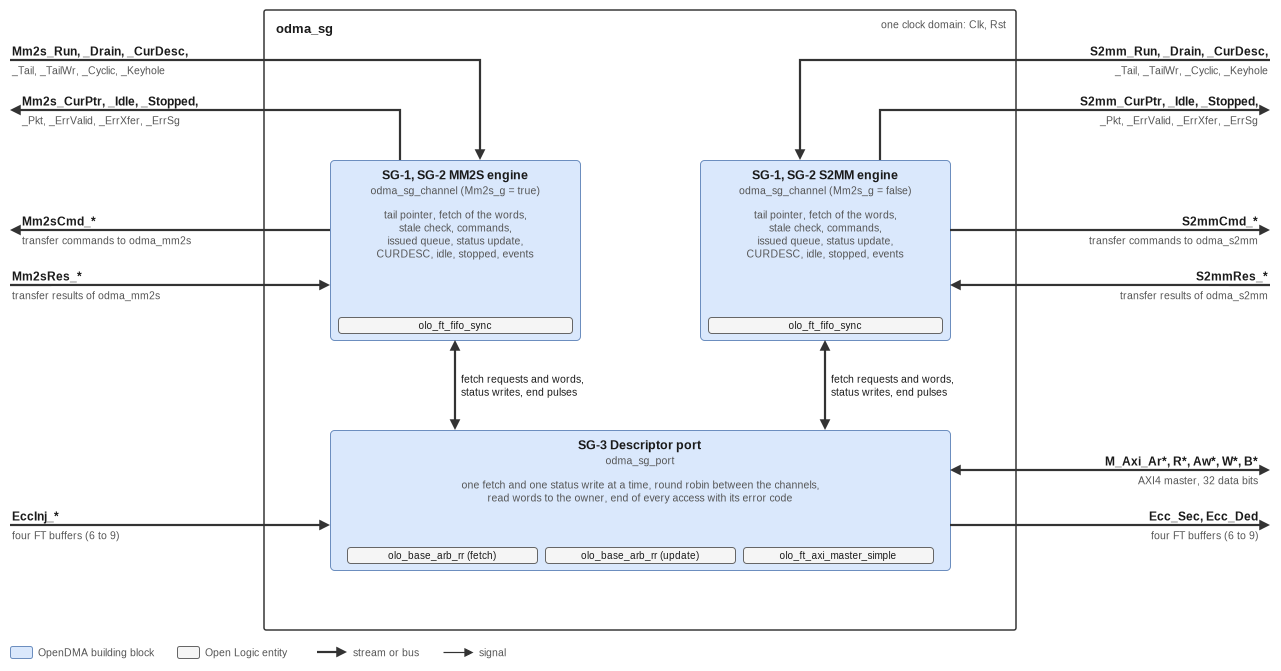
2. Entities
| Entity | Block | Content |
|---|---|---|
odma_sg |
Module top | One channel engine per included channel, the descriptor port, the ECC signals of the four FT buffers |
odma_sg_channel |
SG-1, SG-2 | One per channel (generic Mm2s_g): tail pointer handling, fetch requests and the assembly of the fetched words, the descriptor buffer, the checks of a descriptor, transfer commands, the queue of the commands without result, the status update, the current descriptor pointer, idle, stopped, the events towards the register interface |
odma_sg_port |
SG-3 | Arbitration of the fetches and of the updates of both channels, the AXI4 master, the routing of the read data, the end of every access with its error code |
olo_ft_fifo_sync (one per channel) |
SG-1 | Descriptor buffer: the fields of up to two fetched descriptors that have not been issued |
olo_base_arb_rr (two) |
SG-3 | Fetch arbiter and update arbiter, two requesters each |
olo_ft_axi_master_simple |
SG-3 | AXI4 master with the ECC-protected read and write data buffers, 32 data bits |
The descriptor port uses olo_ft_axi_master_simple, not olo_ft_axi_master_full: every descriptor access is a
burst of whole 32-bit words at an address aligned to 64 bytes, which needs no alignment logic, and the simple master
takes a command in fewer clock cycles (architecture gap G7). Its read and write data buffers are the FT buffers 8
and 9.
3. Ports of odma_sg
| Port | Width | Direction | Description |
|---|---|---|---|
Clk, Rst |
1 | in | Clock, reset (the core reset CoreRst) |
Mm2s_Run |
1 | in | MM2S_DMACR.RS of the register interface: the channel runs; a rising edge starts the channel |
Mm2s_Drain |
1 | in | Drain of a soft reset |
Mm2s_CurDesc |
AddrWidth_g |
in | MM2S_CURDESC and MM2S_CURDESC_MSB as written by software, taken at the start |
Mm2s_Tail, Mm2s_TailWr |
AddrWidth_g, 1 |
in | MM2S_TAILDESC and MM2S_TAILDESC_MSB; a pulse at the triggering write while the channel runs (interpretation SGI-01) |
Mm2s_Cyclic, Mm2s_Keyhole |
1 | in | MM2S_DMACR.CyclicBD, MM2S_DMACR.Keyhole |
Mm2s_CurPtr |
AddrWidth_g |
out | Current descriptor pointer (SG-FE-07), bits 5 to 0 zero |
Mm2s_Idle |
1 | out | The engine has reached the tail and nothing is pending (MM2S_DMASR.Idle) |
Mm2s_Stopped |
1 | out | Nothing outstanding (section 8) |
Mm2s_Pkt |
1 | out | Pulse: a packet completed, its status written (SG-UP-04, SG-UP-05) |
Mm2s_ErrValid |
1 | out | Pulse: an error of the channel |
Mm2s_ErrXfer, Mm2s_ErrSg |
2, 2 | out | With Mm2s_ErrValid: the transfer error (XferErr_t: DMAIntErr, DMASlvErr, DMADecErr) and the engine error (the same codes for SGIntErr, SGSlvErr, SGDecErr), ErrNone_c where none |
Mm2sCmd_Valid, Mm2sCmd_Ready |
1 | out, in | Transfer command to odma_mm2s |
Mm2sCmd_Addr, Mm2sCmd_Length |
AddrWidth_g, LengthWidth_g |
out | Buffer address and buffer length of the descriptor |
Mm2sCmd_Sof, Mm2sCmd_Eof, Mm2sCmd_Keyhole |
1 | out | TXSOF, TXEOF of the descriptor, keyhole |
Mm2sRes_Valid, Mm2sRes_Ready |
1 | in, out | Transfer result of odma_mm2s |
Mm2sRes_Bytes, Mm2sRes_Eof, Mm2sRes_Err |
LengthWidth_g, 1, 2 |
in | Transferred bytes, end of packet (the TXEOF of the command), error code |
S2mm_* |
as MM2S | The same control interface for the S2MM channel | |
S2mmCmd_Valid, S2mmCmd_Ready, S2mmCmd_Addr, S2mmCmd_Length, S2mmCmd_Keyhole |
as MM2S | Transfer command to odma_s2mm, without start and end of packet |
|
S2mmRes_Valid, S2mmRes_Ready, S2mmRes_Bytes, S2mmRes_Eof, S2mmRes_Err |
as MM2S | Transfer result of odma_s2mm: bytes written, the packet ended in the buffer, error code |
|
S2mmRes_Sof |
1 | in | The buffer is the first buffer of a packet (odma_s2mm S2-SG-02, interpretation SGI-13) |
M_Axi_Ar*, M_Axi_R*, M_Axi_Aw*, M_Axi_W*, M_Axi_B* |
AddrWidth_g address, 32 data bits |
out/in | Descriptor port: AXI4 master without ID signals (ArAddr, ArLen, ArSize, ArBurst, ArLock, ArCache, ArProt, ArValid, ArReady, RData, RResp, RLast, RValid, RReady, AwAddr, AwLen, AwSize, AwBurst, AwLock, AwCache, AwProt, AwValid, AwReady, WData, WStrb, WLast, WValid, WReady, BResp, BValid, BReady) |
Ecc_Sec, Ecc_Ded |
4 | out | ECC events of the MM2S descriptor buffer (bit 0, index 6 of the extension window), the S2MM descriptor buffer (bit 1, index 7), the read data buffer (bit 2, index 8) and the write data buffer (bit 3, index 9) of the descriptor port; one pulse per word read from the buffer |
EccInj_Valid |
4 | in | Error injection per buffer, same order |
EccInj_Double, EccInj_Data |
1 | in | Error type and mode of the injection, as in the channels |
Generics: IncludeMm2s_g, IncludeS2mm_g, AddrWidth_g and LengthWidth_g as in section 6 of the specification.
The ports of a channel that is not included keep their idle values (CurPtr 0, Idle '0', Stopped '1', no
event, Cmd_Valid '0', Res_Ready '0'), and its buffer counts nothing.
4. Channel engine (SG-1, SG-2, odma_sg_channel)
4.1 State of a channel
| Register | Width | Content |
|---|---|---|
NextPtr |
AddrWidth_g - 6 |
Address of the next descriptor to fetch: CurDesc at the start, then NXTDESC of the last fetched descriptor |
LastPtr |
AddrWidth_g - 6 |
Address of the last fetched descriptor |
TailPtr |
AddrWidth_g - 6 |
Tail pointer of the engine, taken from Tail at every TailWr |
Started |
1 | A tail pointer write has been taken since the start: fetching is enabled |
AtTail |
1 | The last fetched descriptor is the tail: no further fetch |
BufCnt, IssCnt |
2, 2 | Entries of the descriptor buffer and issued commands without result; with a fetch in progress they form Count, the descriptors in the window |
Issued |
2 entries of AddrWidth_g - 6 |
Queue of the descriptors whose command was accepted by the channel and whose result is outstanding, oldest first |
Update |
1 entry | The result being written back: descriptor address, status word, end of packet, transfer error |
ErrStop, ErrPtr |
1, AddrWidth_g - 6 |
An error occurred: no further fetch or command; the descriptor of the first error |
StaleHold |
1 | A stale descriptor was fetched: no further fetch (section 4.3) |
Halted |
1 | Run is '0' and no access, command or status update of the channel is outstanding: CurPtr is held, the descriptor buffer is emptied |
Descriptor pointers are held without their bits 5 to 0, which are ignored (SG-FE-01), and without the bits at or above
AddrWidth_g (SG-IF-03). The descriptors of a channel are processed strictly in order: they are fetched, issued,
completed and updated in the order of the chain. At every clock edge Count is at most 2: the buffer count
follows the push and pop of the buffer, the issued count the command handshakes and the results, one result per
accepted command.
4.2 Start and tail pointer
A rising edge of Run starts the channel: NextPtr := CurDesc, Started := '0', AtTail := '0', ErrStop
:= '0', Halted := '0'. The engine fetches nothing before the first tail pointer write after the start (SG-FE-02).
TailWr while |
Action |
|---|---|
Started = '0' |
TailPtr := Tail, Started := '1': fetching starts at NextPtr, the descriptor at CURDESC |
Idle = '1' |
TailPtr := Tail, AtTail := '0': fetching restarts at NextPtr, the NXTDESC of the tail, whatever the new value |
| otherwise | TailPtr := Tail; AtTail := AtTail and (LastPtr = Tail): when the tail has already been fetched and the new tail is another descriptor, fetching continues at NextPtr; otherwise only the pause point moves |
With 32 address bits TailWr is the write of TAILDESC, above 32 bits the write of TAILDESC_MSB; the register
interface decides it (interpretation SGI-01, odma_registers RG-SG-03) and gives no TailWr while the channel is
halted.
4.3 Fetch
A fetch is requested from the descriptor port when Run = '1', Drain = '0', ErrStop = '0', Started = '1',
AtTail = '0' and Count < 2. The window of two descriptors keeps the engine one descriptor ahead of the one in
progress (SG-FE-04): while descriptor n is being transferred, descriptor n + 1 is fetched and, for MM2S, issued to
the channel, whose transfer buffer queues it; descriptor n + 2 is fetched once the result of n has been taken.
Cyclic and Keyhole are taken when the fetch is requested (odma_registers RG-SG-09).
The request carries NextPtr; the port reads the 8 words at offsets 0x00 to 0x1C with one burst (SG-FE-01) and
passes them to the engine in order. The engine keeps the words it needs:
| Word | Offset | Taken |
|---|---|---|
NXTDESC, NXTDESC_MSB |
0x00, 0x04 | Bits AddrWidth_g - 1 to 6; the upper word only above 32 address bits (SG-IF-03) |
BUFFER_ADDRESS, BUFFER_ADDRESS_MSB |
0x08, 0x0C | Bits AddrWidth_g - 1 to 0; the upper word only above 32 address bits |
| Reserved | 0x10, 0x14 | Not used |
CONTROL |
0x18 | Bits LengthWidth_g - 1 to 0 the buffer length; MM2S: bit 27 TXSOF, bit 26 TXEOF; S2MM: bits 27 and 26 ignored (SG-TR-02) |
STATUS |
0x1C | Bit 31 Cmplt |
At the end of a fetch without error the engine writes the entry of section 6 into the descriptor buffer, LastPtr
:= the fetched address, NextPtr := NXTDESC, and AtTail := (fetched address = TailPtr) and not Cyclic
(SG-FE-03, SG-CY-01). A tail pointer write in the same clock cycle is taken first, so the comparison uses the new
TailPtr. A fetched stale descriptor (Cmplt = 1 outside cyclic mode) stops further fetch requests at once
(StaleHold); its error follows when it reaches the head of the buffer (section 4.4), so no descriptor behind it is
fetched.
A fetch that ends with an error writes nothing into the buffer; the engine sets ErrStop, ErrPtr := the fetched
address and reports the engine error of the access (SG-ER-02, section 4.7).
4.4 Issue
The head entry of the descriptor buffer is checked when it is at the output while Run = '1', Drain = '0' and
ErrStop = '0':
| Head entry | Action |
|---|---|
Stale = '1' (Cmplt = 1 outside cyclic mode) |
Not issued and not written: ErrStop, ErrPtr := its address, engine error SGIntErr (SG-FE-05, interpretation SGI-09) |
| Otherwise | Cmd_Valid = '1' while Run = '1', Drain = '0' and ErrStop = '0', with the buffer address, the buffer length, Sof, Eof (MM2S) and Keyhole of the entry; at the handshake the entry is popped and its address enters Issued |
A buffer length of 0 is issued like any other descriptor: both channels return the internal error without
transferring anything (odma_mm2s MM-RD-06, odma_s2mm S2-WR-06), and the result path writes DMAIntErr into the
status and reports it (SG-FE-06). A buffer beyond the top of the address space returns the decode error in the same
way (architecture D7).
Cmd_Valid is qualified with Run: both channels accept a command only while Run = '1', so a command is withdrawn
exactly when it can no longer be accepted, and a halt never forces a command into the channel. A descriptor whose
command was not accepted stays in the buffer and has not been started.
4.5 Result and status update
Res_Ready = '1' while the Update stage is empty. At the result handshake the head of Issued is popped and the
result is classified:
| Result | Action |
|---|---|
0 bytes, no end of packet, no error, Run = '0' (an S2MM transfer halted before any byte arrived, odma_s2mm S2-HA-01) |
Not started: no status write; CurPtr is held at this descriptor until the stop, like the descriptors not issued (SG-HA-01, interpretation SGI-10) |
| Any other | Into the Update stage with the status word below; a write of one word at offset 0x1C of the descriptor is requested |
| Status bits | Content |
|---|---|
| 25 to 0 | Res_Bytes, zero-extended from LengthWidth_g bits (SG-UP-01 to SG-UP-03) |
| 26, 27 | S2MM: RXEOF = Res_Eof, RXSOF = Res_Sof; MM2S: 0 |
| 28 | DMAIntErr: error code ErrInt_c; S2MM also ErrSlv_c and ErrDec_c, as in Direct Register Mode (interpretation I13) |
| 29 | DMASlvErr: ErrSlv_c |
| 30 | DMADecErr: ErrDec_c |
| 31 | Cmplt: '1' when the error code is ErrNone_c (interpretation SGI-02) |
An S2MM transfer that a halt ended inside a packet gets the bytes written and Cmplt = '1' without RXEOF
(interpretation SGI-11). A result
with an error sets ErrStop at the handshake, so that no further command is issued, and ErrPtr := its descriptor
unless an earlier error is stored.
When the write of the status ends, the engine raises at most one event in the same clock cycle and empties the
Update stage:
| End of the status write | Event |
|---|---|
No error, transfer error ErrNone_c, end of packet |
Pkt (SG-UP-04, SG-UP-05) |
No error, transfer error ErrNone_c, no end of packet |
None |
| Transfer error or write error | ErrValid with ErrXfer = the transfer error and ErrSg = the engine error of the write (SG-ER-01, SG-ER-02); a write error also sets ErrStop and ErrPtr |
So the register interface sets an error flag of a transfer only when software can already read the status of its
descriptor (interpretation SGI-12). The end of packet is Res_Eof: for MM2S the TXEOF of the command, for S2MM
the end of the packet in the buffer.
4.6 Current descriptor pointer and idle
CurPtr is a register, loaded from the first matching row in every clock cycle while Halted = '0':
| Condition | CurPtr (SG-FE-07) |
|---|---|
ErrStop = '1' |
ErrPtr: the descriptor of the first error |
| A result classified as not started was taken (section 4.5) | That descriptor |
Issued not empty |
The oldest issued descriptor: its transfer is in progress |
| Descriptor buffer not empty | Its head: the next descriptor to be processed |
AtTail = '1' |
LastPtr: the tail |
| Otherwise | NextPtr: the next descriptor to be fetched, also while it is being fetched |
Idle = Started and AtTail and Count = 0 and the Update stage empty: the tail has been completed and its
status written (SG-FE-03). In cyclic mode AtTail stays '0', so Idle stays '0'.
4.7 Errors, halt and drain
| Situation | Behaviour |
|---|---|
| Error (stale descriptor, fetch error, transfer error, write error) | ErrStop: no further fetch request and no further command; the issued commands complete, their results are taken and written back (SG-ER-03, interpretation SGI-08); the register interface sets the flags, clears DMACR.RS and so lowers Run |
Run falls (halt or after an error) |
No further fetch request, no command (Cmd_Valid qualified with Run); a fetch already granted completes and its entry is written into the buffer; the issued commands complete as the channel ends them, and their results are written back (SG-HA-01) |
Run = '0', Issued and the Update stage empty, no access of the channel outstanding at the port |
Halted := '1': CurPtr keeps its value, the first descriptor that was not started; the descriptor buffer is emptied (one entry per clock cycle, without commands), the entries keep their status in memory |
Drain = '1' |
No fetch request, no command, no status write requested; a fetch or a write that the port has already granted completes, read data is discarded; the channels return no result during a drain, so Issued keeps its entries until the core reset (SG-HA-02) |
The engine error of a descriptor access is the code of the port (section 5): SGSlvErr for SLVERR and SGDecErr for
DECERR (SG-ER-04). Every descriptor pointer is aligned to 64 bytes and a descriptor has at most 52 bytes (with the user
application fields of phase c), so no descriptor reaches beyond the top of the address space and no address check is
needed for the descriptor accesses.
5. Descriptor port (SG-3, odma_sg_port)
The port serves one fetch and one status write at a time; fetches and writes run independently of each other on the read and write channels of the master.
| Side | Arbiter | Sequence |
|---|---|---|
| Fetch | olo_base_arb_rr over the fetch requests of the MM2S engine (bit 1) and the S2MM engine (bit 0) |
The grant is registered with its owner; read command of 8 beats at the descriptor address (CmdRd_LowLat = '0'); the 8 read words go to the owner (Rd_Ready = '1'); after the word with Rd_Last and the response (Rd_Done or Rd_Error, which can come before or after the last word), an end pulse with the error code goes to the owner, at least one clock cycle after the last word, and the arbiter takes the next request |
| Status write | olo_base_arb_rr over the write requests of both engines, same order |
Write command of 1 beat at the descriptor address + 0x1C (CmdWr_LowLat = '0'), the status word with all write strobes; after Wr_Done or Wr_Error an end pulse with the error code goes to the owner |
The round-robin arbiters give both channels the same share when both request (SG-IF-01); a channel that requests alone is served at once. During a drain the arbiters grant nothing and the engines withdraw their requests; an access granted before the drain completes.
olo_ft_axi_master_simple generics: AxiAddrWidth_g = AddrWidth_g, AxiDataWidth_g = 32, AxiMaxBeats_g = 16,
AxiMaxOpenTransactions_g = 2, UserTransactionSizeBits_g = 5 (commands of up to 31 beats: 8 beats for a fetch and
1 for a status write, 13 and 6 with the user application fields of phase c), DataFifoDepth_g = 32 (2 x
AxiMaxBeats_g, the suggestion of Open Logic), ImplRead_g and ImplWrite_g true. A descriptor access never
crosses a 4 KB boundary and never exceeds AxiMaxBeats_g, so each access is one AXI burst: INCR, AxSize 4 bytes,
AxCache 0011, AxProt 000, the fixed values of the master (SG-IF-01). With CmdWr_LowLat = '0' the master issues
the burst only when its data is in its write buffer.
The error code of a failed access comes from the response code of the master (Rd_ErrorResp with Rd_Error,
Wr_ErrorResp with Wr_Error): DECERR ("11") gives ErrDec_c, SLVERR and EXOKAY give ErrSlv_c (SG-ER-04,
interpretation I14). The end pulse carries the code of its access.
6. Descriptor buffer
One olo_ft_fifo_sync per channel, Depth_g = 2 (the window, section 4.3), one entry per fetched descriptor, the
fields from bit 0 upwards:
| Field | Width | Content |
|---|---|---|
Length |
LengthWidth_g |
Buffer length |
Buffer |
AddrWidth_g |
BUFFER_ADDRESS (and BUFFER_ADDRESS_MSB) |
Addr |
AddrWidth_g - 6 |
Address of the descriptor |
Sof, Eof |
1, 1 | MM2S: TXSOF, TXEOF; S2MM: '0' |
Stale |
1 | Cmplt = 1 and not Cyclic at the fetch |
Keyhole |
1 | Keyhole at the fetch |
The width is 2 x AddrWidth_g + LengthWidth_g - 2 bits: 76 bits at 32 address bits and 14 length bits, 152 bits
at 64 and 26. NXTDESC is not stored: it is needed only for the next fetch and is held in NextPtr.
7. ECC and error injection
Ecc_Sec and Ecc_Ded of a descriptor buffer are its flags of the output word qualified with the output handshake
(a pop, also when the buffer is emptied after a halt); the master qualifies the events of its read and write data
buffers itself. The error injection drives the ErrInj_BitFlip input of the selected buffer with the pattern of
flipPattern (odma_pkg): parity bits in parity mode (EccInj_Data = '0'), data bit 0 or data bits 0 and 1 in
data mode, as in the channels. The function moves from the two channels into odma_pkg with this module, unchanged.
A double error in data mode corrupts the word it hits: in a descriptor buffer bits 0 and 1 of the buffer length, in
the read data buffer bits 0 and 1 of the first word of the fetch (NXTDESC, bits the engine ignores), in the write
data buffer bits 0 and 1 of the status word (the transferred bytes) in memory.
8. Stopped
Stopped = '1' when the port has no access of the channel outstanding and either Drain = '1', or Halted = '1'
and the descriptor buffer is empty, or Run = '1', Issued, the Update stage and the descriptor buffer are
empty and no fetch is requested. During a halt it rises after the last status write and the emptying of the buffer;
during a drain after the last access given to the master. The core combines
it with Stopped of the channel for the register interface (odma_registers RG-SG-10, RG-RS).
9. State machines
odma_sg_channel: the fetch part has Idle_s (wait for the conditions of section 4.3), Request_s (request until
the port grants it), Words_s (take the 8 words until the end pulse); issue and result have no state machine of
their own (the descriptor buffer, Issued and the Update stage hold the state); the update part has Idle_s,
Request_s and Wait_s (until the end pulse of the write). odma_sg_port: one state machine per side with
Idle_s (arbitration), Command_s (command handshake with the master; for a write also the data word), Data_s
(fetch: read words to the owner) and End_s (wait for the response, end pulse). Every when others returns to
Idle_s (architecture D15).
10. Timing
- Fetch: the request is granted in the next clock cycle when the read side is free; the read command reaches the master one clock cycle later, and the first AR handshake follows after the command time of the master. The 8 words follow the memory latency L at one word per clock cycle; the entry is in the descriptor buffer one clock cycle after the end pulse. A fetch takes about 22 + L clock cycles from the request to the command (verification report).
- Issue:
Cmd_Validrises in the clock cycle after the entry is written (fall-through of the buffer). - Update: the write request follows the result handshake by one clock cycle; the status write takes about 6 clock
cycles plus the latency of the write response.
PktandErrValidare pulses in the clock cycle after the end of the write. - Descriptor rate: with the window of two, one channel processes at most one descriptor per fetch time; with buffers that take longer to transfer than a fetch, the transfers of a chain follow each other without a gap on the MM2S stream, because the next command is queued in the channel. With both channels active the fetches share the read side. The verification report has the measured values.
11. Integration
The engine is integrated with three neighbouring modules:
odma_registers: the requirements of its section "Requirements of phase b" (register map of Scatter/Gather Mode,CURDESCfollowingCurPtrwhile the channel is not halted,TailWrper interpretation SGI-01,Idlefrom the engine, the engine errors, the interrupt threshold counter and delay timer driven byPkt,CyclicBDandKeyhole), and the FT buffer indices 6 to 9 of section 3.odma_s2mm: the result flagRes_Sof(S2-SG-02) of its stream split, '1' for the first buffer of a packet.odma_core: withIncludeSg_gthe engine between the register interface and the channels, the descriptor portM_AxiSg_*,Stoppedof each channel combined withStoppedof its engine, the indices 6 to 9 in the ECC index map.