ofb_ni: Architecture and Design Description
1. Block diagram
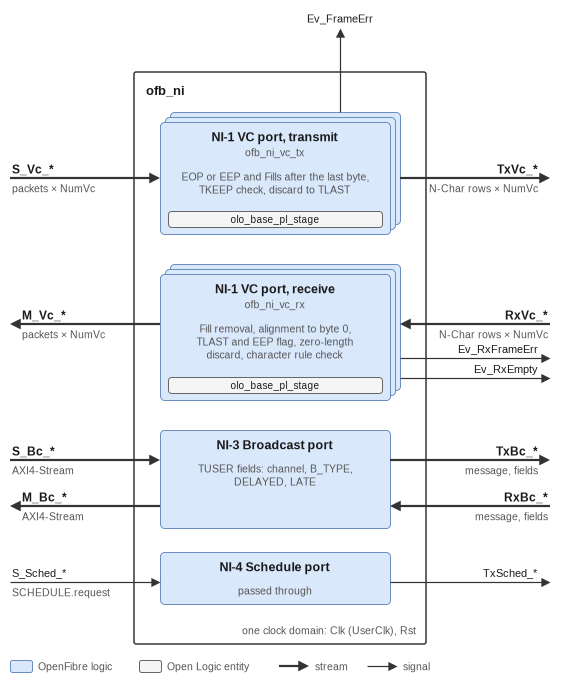
B = 4 x NumLanes_g is the number of bytes of a beat. Character c of a beat of the Data Link layer is character
c mod 4 of word c / 4; it holds byte c of the beat of the user port (TDATA(8c+7:8c)), and TKEEP(c) and the
K flag of the character have the same index. The conversion therefore moves no byte inside a beat on the transmit side,
and on the receive side only by the offset of a packet that starts after Fills.
2. ofb_ni_vc_tx (NI-1, transmit)
A combinational conversion of the input beat followed by an olo_base_pl_stage of the beat (36 x NumLanes_g bits):
- Valid beat: character
cis data bytec(K flag clear) whereTKEEP(c)is set. In the last beat of a packet the first character without a byte is the EOP, or the EEP whenTUSER(0)is set, and the characters after it are Fills, so the end marker word and the further words of the beat end the packet (NI-TX-02). - Full last beat (
TKEEPall ones withTLAST): the beat is passed as data, and the stateEndPendsends an additional beat with the end marker in character 0 and Fills; the input is not ready during that cycle. TKEEPcheck (NI-TX-03): bit 0 set, no set bit above a clear bit, and all bits set in a beat withoutTLAST. A beat that fails it raisesEv_FrameErr. When the packet has passed bytes before (Started), the beat is replaced by an EEP followed by Fills; otherwise nothing is passed, so no packet of zero length is sent (ECSS 5.3.9h). WithoutTLASTthe stateSpilldiscards the further beats of the packet up to and including the beat withTLAST.
In_Ready depends only on the state (EndPend, Spill) and on the ready of the pipeline stage, not on TKEEP or
TDATA. A beat discarded without output (first beat with a framing error, beats in Spill) is accepted in one
cycle.
3. ofb_ni_vc_rx (NI-1, receive)
The input VC buffer of the Data Link layer delivers beats of NumLanes_g words that end after the word with an EOP
or EEP (DL-RW-06). An olo_base_pl_stage registers the beat; the conversion works on this register (timing, and the
ready of the buffer is a register).
3.1 Classification
Every character of the beat is classified as data (K flag clear), end marker (EOP or EEP), Fill or other K-code. Three prefix and suffix terms per character position decide the beat without arithmetic:
| Term | Meaning |
|---|---|
PreD(c) |
a data character before position c |
PreE(c) |
an end marker before position c |
SufF(c) |
only Fills after position c |
- Character rule violation (NI-RX-03): another K-code; a data character or end marker after an end marker; a Fill that follows a data character, or any Fill in a beat that continues a packet, before the first end marker.
- Clean end: an end marker followed by Fills only (
E(c)andSufF(c)). - First data character:
FirstD(c)= data atcand notPreD(c)(one-hot).
3.2 Alignment
A conforming packet is F* D+ (EOP | EEP): leading Fills, a contiguous run of data characters and the end marker
(ECSS 5.3.7.2c). The data of the packet therefore keep one offset Off (the position of the first data character in
its first beat) relative to the beats of the input, and one rotation of every input beat by Off aligns the packet to
byte 0 of the output:
Rot(i) = In((i + Off) mod B)            rotation, AND-OR over the one-hot offset
Mix(i) = Rot(i) when SelMask(i) = '1' else Hold(i)     SelMask(i) = '1' for i >= B - Off
Hold keeps the rotated previous beat of the packet, whose first B - Off bytes belong to the next output beat; the
current beat completes it with its first Off bytes. OffSel (one-hot) and SelMask are registered at the first beat
of a packet and stay constant up to its end. A packet that starts at character 0 (every packet of an OpenFibre
transmitter) has Off = 0: Hold holds a whole beat and Mix = Hold.
| Beat | Action |
|---|---|
| Fills only, between packets | Accepted, nothing passed |
| End marker without data, between packets | Packet of zero length: discarded, Ev_Empty (NI-RX-02) |
| First beat with data, no end | Hold := rotated beat, OffSel and SelMask registered, packet open |
| First beat with data and end | One output beat: rotated beat, TKEEP = rotated data mask, TLAST, TUSER = EEP |
| Beat of an open packet, no end | Output Mix (all bytes valid), Hold := rotated beat |
| Beat of an open packet with end | Output Mix with TKEEP = not SelMask or the rotated data mask; when data of the beat remain at positions below B - Off (Tail), Mix is a full beat without TLAST and the tail follows from Hold in the next cycle with TLAST; otherwise Mix has TLAST |
The output beat of a packet waits for the next input beat of the packet (look-ahead): only then is it known whether
the next characters are data or the end marker, so that a packet that ends with a word holding only its EOP or EEP
still ends with TLAST on its last data byte.
3.3 Violations and discard
A beat with a violation raises Ev_FrameErr. An open packet is ended with the bytes of its earlier beats (Hold,
TKEEP = not SelMask) and TUSER = '1'; the bytes of the violating beat are not passed. A packet that starts in
the violating beat is not passed. Without a clean end in the beat, the state Discard drops the following beats up to
and including a beat with a clean end. After a link reset the input VC buffer adds an EEP when the last character read
was not an end marker or Fill (DL-VI-04); that EEP is a clean end and ends Discard as well.
3.4 Output
The output register (Out_*) and the pending tail (TailVld, data in Hold) form the output. The input stage is read
when the output register is free or read in this cycle and no tail is pending, so one beat per cycle passes inside a
packet and a packet with a tail costs one cycle (NI-IF-03). Ev_FrameErr and Ev_Empty are registered one-cycle
events.
4. Broadcast port (NI-3)
Field mapping only: TUSER bits 7:0 channel, 15:8 B_TYPE, 16 DELAYED, 17 LATE (receive direction).
5. Timing and resources
- Transmit latency one cycle (pipeline stage), receive latency two cycles (input stage, output register) plus the look-ahead of one input beat inside a packet.
- Logic depth: the receive path from the input stage to the output register is the classification (K flag and value
of a character), a prefix term over
Bcharacters and an AND-OR ofBinputs for the rotation; the transmit path is theTKEEPcheck and a 3-input selection per character. - Registers per VC: transmit 36 x
NumLanes_g(stage); receive 36 xNumLanes_g(stage) plus about 2 x 36 xNumLanes_g(Hold, output register) and the masks.