ocp_entropy_coder: Architecture
1. Common structure
Every coder takes one item of the entropy coder input sequence per clock cycle and produces codewords (Cw_Data,
right-aligned, Cw_Length bits, Cw_Last) of up to 96 bits (CwWidth_c). The sample-adaptive and the hybrid
coder are pipelines without internal stalls: an item enters only when the output buffer has room for every item in
flight. Error limit values and the uncoded first index of a band pass through as codewords of DA, DR or D bits.
All three coders end in the codeword buffer ocp_cw_buffer: a register concatenates consecutive codewords into one
codeword of up to 96 bits before it enters a SECDED-protected FIFO (olo_ft_fifo_sync, 16 entries). A FIFO entry
therefore holds several short codewords. While the bit packer takes the header of the next image, the coder keeps
running into the buffer, and afterwards the bit packer takes several codewords per clock cycle until the backlog is
gone. A codeword with the last flag ends a concatenation. The error flags of the FIFO count once per word, with the
handshake at its output.
The statistics of a band (accumulator and counter) live in a SECDED-protected memory (olo_ft_ram_sdp, read latency
two cycles). An item reads the memory when it enters the pipeline; when one of the three items ahead of it belongs to
the same band and has not yet written its updated statistics, the item takes them from that item's pipeline register
instead (newest first). Consecutive indexes of one band (BSQ order) therefore cost no extra cycles. The error flags
of the memory count only when an item (or the tail of the hybrid coder) takes the read statistics.
2. Sample-adaptive coder (ocp_sample_adaptive_coder)
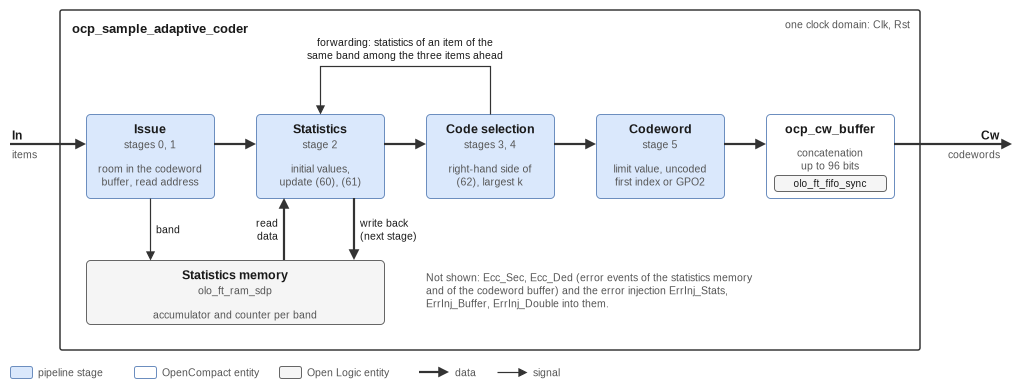
| Stage | Function | CCSDS |
|---|---|---|
| 0 | Accept an item, read the statistics of its band | |
| 1 | Memory latency | |
| 2 | Accumulator and counter (memory, forwarded or initial values at t = 1 (57) to (59)); update (60), (61); write back from the next stage | 5.4.3.2.3 |
| 3 | Right-hand side Sigma + floor(49 Gamma / 2^7) of (62) | 5.4.3.2.4.3 |
| 4 | Largest k <= D - 2 with Gamma 2^k <= right-hand side | 5.4.3.2.4.3 |
| 5 | Codeword: error limit value, uncoded first index or length-limited GPO2 codeword | 5.4.3.2.2, 5.4.3.2.4 |
The statistics memory holds per band the accumulator (D + gamma* + 2 bits) and the counter (gamma* + 1 bits). The initial accumulators are a constant table of the generics.
3. Hybrid coder (ocp_hybrid_coder)
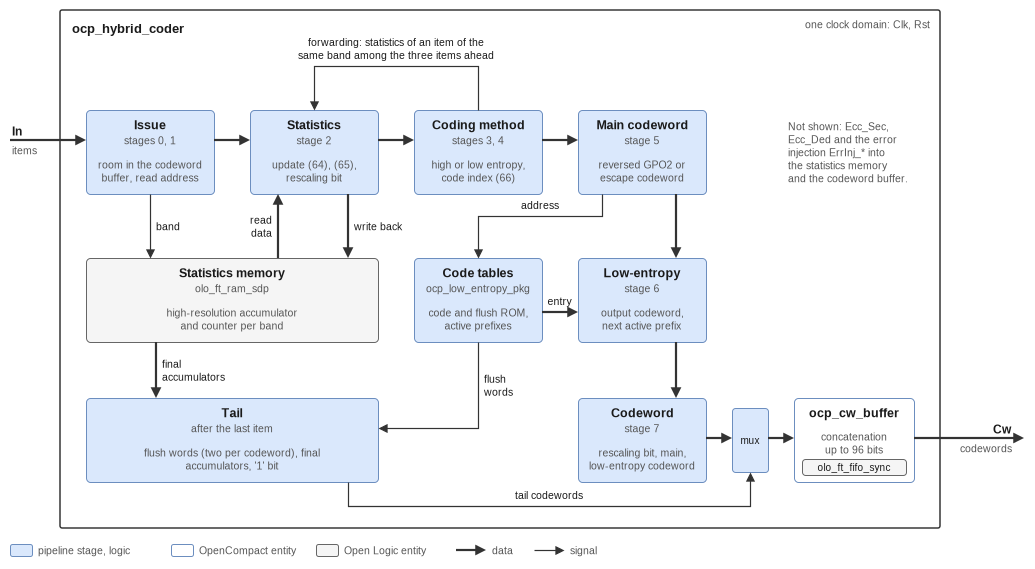
| Stage | Function | CCSDS |
|---|---|---|
| 0, 1 | Accept an item, read the statistics of its band | |
| 2 | Statistics update (64), (65); with rescaling the least significant bit of the accumulator is kept for the output | 5.4.3.3.4, 5.4.3.3.5.1.2 |
| 3 | Products of the counter with the 16 thresholds of table 5-16, right-hand side of (66); comparison of the index with the input symbol limit of every low-entropy code | 5.4.3.3.5.1.4, 5.4.3.3.5.3.4 |
| 4 | High or low entropy, code index of a high-entropy index (66), low-entropy code | 5.4.3.3.5.1.4, 5.4.3.3.5.3.1 |
| 5 | High entropy: reversed GPO2 codeword; low entropy: escape codeword above the input symbol limit (67), address of the code table entry | 5.4.3.3.5.2, 5.4.3.3.5.3 |
| 6 | Code table entry: output codeword of a complete input codeword or extended active prefix; rescaling bit in front of the main codeword | 5.4.3.3.5.3.4, 5.4.3.3.5.3.5 |
| 7 | Codeword of the sample: rescaling bit, main codeword, low-entropy output codeword (at most 86 bits) | 5.4.3.3.5.1 |
The 16 low-entropy codes are state machines whose states are the active prefixes (proper prefixes of the input
codewords, state 0 is the null prefix). ocp_low_entropy_pkg holds one transition entry per state and input symbol
(3004 entries of 41 bits), generated from the tables of annex B by tools/gen_low_entropy_pkg.py. An entry that extends
the active prefix holds the table address of the new prefix, an entry that completes an input codeword the output
codeword; every entry holds the flush word of the resulting prefix. The state of a code is therefore the table address
of its active prefix. The rows of a code have a power of two of entries, so the next address is the address in the entry
just read ORed with the next input symbol: the loop of one clock cycle holds two multiplexers and the table, no adder,
and when consecutive samples use the same code the entry read in the previous cycle is used directly. The input symbol
is selected from comparisons made one stage earlier. The flush words of the 16 codes are registers that follow the table
entries.
After the last item the tail follows (5.4.3.3.5.4): the flush words of the 16 codes, two per codeword, then the final accumulator of every band (2 + D + gamma* bits, read from the statistics memory one band per clock cycle) and the final '1' bit together with the last accumulator. The next image enters only after the tail; the active prefixes return to the null prefix.
4. Block-adaptive coder (ocp_block_adaptive_coder)
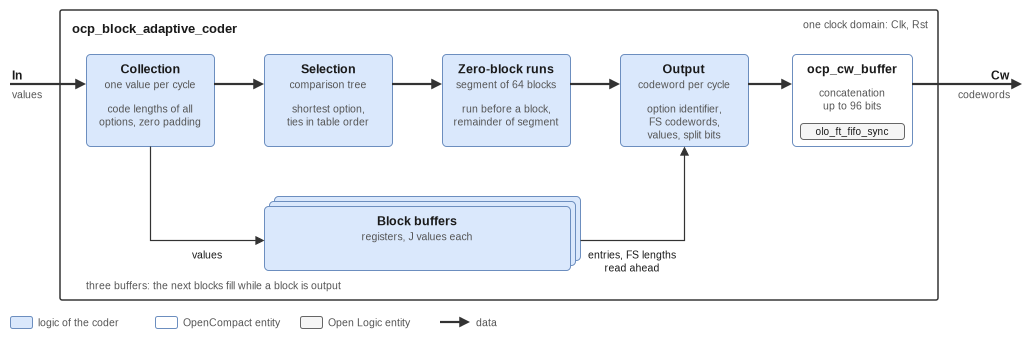
| Part | Function | Reference |
|---|---|---|
| Collection | One value per cycle into one of three block buffers; the code lengths of all options accumulate as the values arrive; zeros after the last value up to the end of the block | LDC 3; CCSDS 5.4.3.4.2.7 |
| Selection | Lengths of the no-compression, second-extension and split-sample options of a complete block; comparison tree in two stages that keeps the order of the ties (no compression, second extension, smallest k) | LDC 3.7 |
| Zero-block runs | All-zeros blocks extend a run that ends at the end of a segment (64 blocks or the end of the reference sample interval) or of the input, or before a block of another option | LDC 3.5 |
| Output | Zero-block coded data set (option identifier and fundamental sequence codeword of the run or remainder of segment), then the block: option identifier in front of the first part, up to two fundamental sequence codewords, up to four uncoded values or up to four sets of split bits per codeword; fundamental sequence codewords longer than 88 bits in parts | LDC 3.2 to 3.6, 5.2 |
The code lengths are accumulated with saturation at 8191 bits, far above the length of the no-compression option (at most 32 * 64 + 5 bits), so a saturated length never wins. The option identifiers and the largest split-sample parameter follow table 5-1 of CCSDS 121.0-B-3: identifiers of 1 (restricted, n <= 2), 2 (restricted, n <= 4), 3 (n <= 8), 4 (n <= 16) and 5 bits, split-sample options up to k = 1, 5, 13 and 29. The output of a block takes fewer clock cycles than its collection (for J = 8 at most six), so the three buffers let the next blocks fill while a block is output. The lengths of the fundamental sequence codewords of the next two entries are registers: they are read from the block buffer one cycle ahead (the first two entries when the output of a block starts, then the entries two and three positions ahead), so that the decision between one and two codewords per cycle starts from registers and not from the buffer. The block buffers are registers: synthesis attributes keep the tools from inferring memories without ECC from them.
4a. Runtime configuration
With RuntimeConfig_g (ocp_core architecture, section 6) the statistics memories keep ZSize_g entries; the
sample-adaptive coder takes the band of every item from the predictor and needs no dimensions. The hybrid coder
takes the NZ of the image whose tail comes next (Cfg_ZSize, from the configuration queue of the core): the tail
steps through the bands 0 to NZ - 1 of the image instead of the index modulo ZSize_g, and Cfg_Done pulses at
its end. A band without statistics in the image ends with its initial accumulator, which covers the single-pixel
case NX = NY = 1 as well. The block-adaptive coder does not depend on the image dimensions.
With RuntimeParams_g (ocp_core architecture, section 6.3) every coder takes the parameters of an image from the
configuration queue of the core with the first item of the image and holds them up to its last item (the hybrid
coder up to the end of its tail), decoded from the encoding of their header fields. The widths stay those of the
maxima: the accumulators and counters of the sample-adaptive and the hybrid coder those of RescaleCounterSize_g,
the codeword width that of the largest Umax (a constant of ocp_pkg), the reference sample counter of the
block-adaptive coder that of RefInterval_g. What changes per image: the comparison with Umax and the length of the
escape codeword, the initial counter value 2^gamma0, the rescaling threshold 2^gamma* - 1, the initial accumulator
from K, and the limit of the reference sample counter.
How each coder holds the values of its image:
- Sample-adaptive coder: the items of two images can share its pipeline, so the parameters enter with every item
(
In_UnaryLimit,In_InitCountExp,In_RescaleSize,In_AccuInit; the core gives the entry of the image of the item) and travel with it. Stage 1 computes the initial accumulator (58) of the band as (3 2^(K' + 6) - 49) shifted by gamma0 and by -7, from a table of the first factor per K (or per band withAccuInitBandVarying_g), so that the statistics stage only selects it. - Hybrid coder: after the last item of an image it takes no item until the tail is out, so one image at a time is in
the coder, and the core keeps the entry of that image on
Cfg_UnaryLimit,Cfg_InitCountExpandCfg_RescaleSizefrom its first item to the end of its tail (the tail read pointer of the queue). The final accumulators of the tail have 2 + D + gamma* bits of the image (CCSDS 5.4.3.3.5.4.3). - Block-adaptive coder: r enters with every value (
In_RefInterval), is taken with the values of a block and travels with the block through the selection stages to the output, where it limits the reference sample counter.
5. Interfaces
| Port | Direction | Description |
|---|---|---|
In_Valid, In_Ready, In_Data, In_Kind, In_Band, In_First, In_Init, In_Last |
in | Entropy coder input sequence (the block-adaptive coder uses value and last flag only) |
Cw_Valid, Cw_Ready, Cw_Data, Cw_Length, Cw_Last |
out | Codewords of up to CwWidth_c bits |
Ecc_Sec, Ecc_Ded |
out | Memory error events (statistics memories, codeword buffer) |
ErrInj_Stats, ErrInj_Buffer, ErrInj_Double |
in | Error injection into the next write of the statistics memory or of the codeword buffer (the block-adaptive coder has no statistics memory) |
Cfg_ZSize |
in | Hybrid coder with RuntimeConfig_g: NZ of the image whose tail comes next (17 bits) |
Cfg_Done |
out | Hybrid coder with RuntimeConfig_g: pulse at the end of the tail of an image |
In_UnaryLimit, In_InitCountExp, In_RescaleSize, In_AccuInit |
in | Sample-adaptive coder with RuntimeParams_g: Umax (6 bits), gamma0, gamma*, K (4 bits each) of the image of the item, with every item |
Cfg_UnaryLimit, Cfg_InitCountExp, Cfg_RescaleSize |
in | Hybrid coder with RuntimeParams_g: Umax (6 bits), gamma0, gamma* (4 bits each) of the image in coding, stable from its first item to the end of its tail |
In_RefInterval |
in | Block-adaptive coder with RuntimeParams_g: r (13 bits) of the image of the value, with every value |