ocp_mib: Architecture
1. Structure
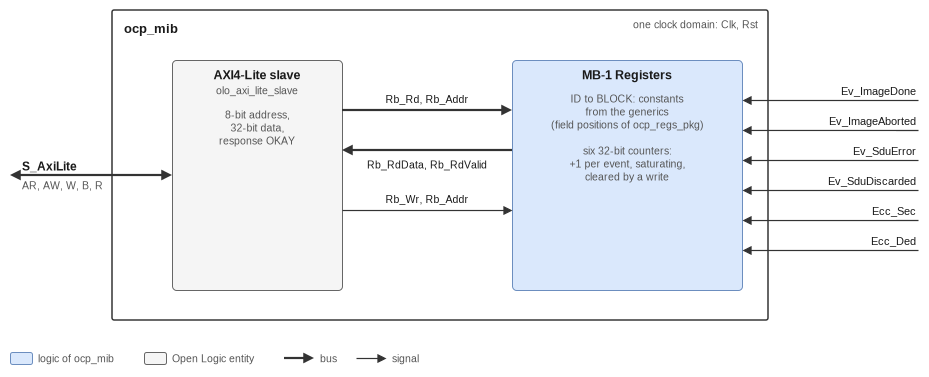
olo_axi_lite_slave turns the AXI4-Lite accesses into a simple register bus (Rb_*). Every read is answered in the
clock cycle after Rb_Rd with Rb_RdValid, so the read timeout of the slave never expires. The registers GENERICS
to BLOCK are constants computed during elaboration from the generics with the field positions of ocp_regs_pkg; the
synthesis tool reduces them to the read multiplexer. The register map is in register_map.md.
2. Counters
Each counter is a 32-bit register with its event input:
| Condition in a clock cycle | Next value |
|---|---|
| Write to its address, event | 1 |
| Write to its address, no event | 0 |
| Event, value below 2^32 - 1 | value + 1 |
| Otherwise | value |
A read returns the value before the clock edge of the read cycle. The counters are registers that rely on the TMR of the synthesis tool, like all logic outside the memories (user guide, section "Protection scope").
3. Ports
| Port | Direction | Width | Description |
|---|---|---|---|
Clk |
in | 1 | Clock |
Rst |
in | 1 | Synchronous reset, high-active |
S_AxiLite_* |
AXI4-Lite slave: ArAddr, AwAddr 8 bits, WData, RData 32 bits, WStrb 4 bits, BResp, RResp 2 bits, handshakes |
||
Ev_ImageDone |
in | 1 | Pulse: a compressed image without error has left the core |
Ev_ImageAborted |
in | 1 | Pulse: a compressed image with an error has left the core |
Ev_SduError |
in | 1 | Pulse: faulty SDU forwarded |
Ev_SduDiscarded |
in | 1 | Pulse: SDU discarded |
Ecc_Sec, Ecc_Ded |
in | 1 | Pulses: corrected and detected memory errors of the core |
Cfg_XSize, Cfg_YSize, Cfg_ZSize |
out | 17 | With RuntimeConfig_g: committed NX, NY, NZ for the core |
Cfg_AbsLimit, Cfg_RelLimit |
out | 16 | With RuntimeConfig_g: committed band-independent error limit values for the core |
Cfg_Taken |
in | 1 | Pulse from the core: it takes the configuration outputs for an image in this clock cycle |
Act_XSize, Act_YSize, Act_ZSize |
in | 17 | With RuntimeConfig_g: NX, NY, NZ that the core took for the last image |
Act_AbsLimit, Act_RelLimit |
in | 16 | With RuntimeConfig_g: error limit values that the core took for the last image |
Cfg_UserData, Cfg_M, Cfg_WeightInterval, Cfg_WeightVmin, Cfg_WeightVmax, Cfg_UnaryLimit, Cfg_InitCountExp, Cfg_RescaleSize, Cfg_AccuInit, Cfg_RefInterval |
out | 8, 17, 4, 5, 5, 6, 4, 4, 4, 13 | With RuntimeParams_g: committed runtime parameters for the core (zero for a parameter not in use) |
Act_UserData to Act_RefInterval |
in | as Cfg_ |
With RuntimeParams_g: runtime parameters that the core took for the last image |
4. Generics
The generics listed in the specification (section 4), with the names, defaults and ranges of ocp_channel; the
channel passes its own values. AccuInit_g gives the constant of the sample-adaptive coder (the first element; 15
when AccuInitBandVarying_g is true, as in the header). HybridAccuInit_g and HybridAccuInitHigh_g give the
lower bound of gamma0 that the COMMIT checks with the runtime parameters and the hybrid coder (hybridG0Min of
ocp_pkg, the function the core uses for its range limitation).
5. Runtime configuration
With RuntimeConfig_g three sets of values describe the configuration; the MIB holds the first two, the core the third:
| Set | Registers | Written by | Read by |
|---|---|---|---|
| Pending | NEXT_X, NEXT_Y, NEXT_Z, NEXT_LIMITS (RW) | Software | Software (readback before COMMIT), the range check |
| Committed | Outputs Cfg_* |
A valid COMMIT, all fields in one clock cycle | The core at every image start |
| Active | IMAGE_X, IMAGE_Y, IMAGE_Z, ORDER.SUB_FRAME_DEPTH, LIMITS (RO) | The core at every image start, after its range limitation (Act_ inputs) |
Software |
The range check is combinational on the pending registers and is evaluated in the cycle of the COMMIT write (the
comparisons with the maxima are comparisons with constants). A COMMIT copies the pending set into the committed set
only when every field is in range; otherwise it sets CFG_ERROR. Because the core takes the committed outputs in one
clock cycle and a COMMIT changes all five in the same clock cycle, an image never sees a mix of two
configurations. A COMMIT written in the clock cycle of Cfg_Taken changes the outputs at the end of that cycle,
after the core has taken the previous values.
CFG_PENDING is set by a valid COMMIT and cleared by Cfg_Taken (a COMMIT and Cfg_Taken in the same cycle leave it
set: the new values are not yet taken). SUB_FRAME_DEPTH reads min(SubFrameDepth_g, Act_ZSize). Because the
active registers show what the core took, they also show the values of an image whose configuration reached the
core out of range (CO-RC-07).
New registers (offsets for ocp_regs.yml; the existing registers keep their offsets):
| Offset | Register | Fields |
|---|---|---|
| 0x060 | CONTROL | COMMIT (bit 0, W1, reads 0) |
| 0x064 | STATUS | CFG_PENDING (bit 0, RO), CFG_ERROR (bit 1, W1C) |
| 0x068 | NEXT_X | SIZE (bits 16:0, RW) |
| 0x06C | NEXT_Y | SIZE (bits 16:0, RW) |
| 0x070 | NEXT_Z | SIZE (bits 16:0, RW) |
| 0x074 | NEXT_LIMITS | ABS (bits 15:0, RW), REL (bits 31:16, RW) |
| 0x078 | LIMITS | ABS (bits 15:0, RO), REL (bits 31:16, RO) |
GENERICS gets the field RUNTIME_CONFIG (bit 18, RO), and the ID the version 2 (0x4F435002; version 3 with the runtime parameters of section 6). These registers rely on the TMR of the synthesis tool, like the counters.
6. Runtime parameters (register map version 3)
With RuntimeParams_g the runtime parameters join the three sets of section 5. The pending registers mirror the
layout of the read-only registers that show the parameters, so software uses one field definition for both: SAMPLES
and NEXT_SAMPLES, ORDER and NEXT_ORDER, and so on. The range check of a COMMIT covers the parameters of the options in
use, the dependent ranges against the pending values they depend on, and the copy into the committed set takes the
dimensions, the error limit values and the parameters in one clock cycle.
| Set | Registers | Written by | Read by |
|---|---|---|---|
| Pending | NEXT_SAMPLES, NEXT_ORDER, NEXT_WEIGHTS, NEXT_ADAPTIVE, NEXT_BLOCK (RW) | Software | Software, the range check |
| Committed | Outputs Cfg_UserData, Cfg_M, Cfg_Weight*, Cfg_UnaryLimit, Cfg_InitCountExp, Cfg_RescaleSize, Cfg_AccuInit, Cfg_RefInterval |
A valid COMMIT, with the dimensions | The core at every image start |
| Active | The parameter fields of SAMPLES, ORDER, WEIGHTS, ADAPTIVE, BLOCK (RO) | The core at every image start, after its range limitation (Act_ inputs) |
Software |
New registers (offsets of ocp_regs.yml; the registers of version 2 keep their offsets and fields):
| Offset | Register | Fields (as in the read-only register of the same name without NEXT_) |
|---|---|---|
| 0x07C | NEXT_SAMPLES | USER_DATA (bits 15:8, RW) |
| 0x080 | NEXT_ORDER | SUB_FRAME_DEPTH (bits 24:8, RW; BI order only) |
| 0x084 | NEXT_WEIGHTS | VMAX (bits 21:17, RW), VMIN (bits 16:12, RW), UPDATE_INTERVAL (bits 11:8, RW) |
| 0x088 | NEXT_ADAPTIVE | ACCU_INIT (bits 19:16, RW; sample-adaptive coder), INITIAL_COUNT (bits 15:12, RW), RESCALE_SIZE (bits 11:8, RW), UNARY_LIMIT (bits 5:0, RW); zero with the block-adaptive coder |
| 0x08C | NEXT_BLOCK | REF_INTERVAL (bits 20:8, RW); zero with the other coders |
GENERICS gets the field RUNTIME_PARAMS (bit 19, RO), and the ID the version 3 (0x4F435003). The fields
SAMPLES.USER_DATA, ORDER.SUB_FRAME_DEPTH, WEIGHTS.VMAX, VMIN and UPDATE_INTERVAL, ADAPTIVE.ACCU_INIT, INITIAL_COUNT,
RESCALE_SIZE and UNARY_LIMIT and BLOCK.REF_INTERVAL read the Act_ inputs with RuntimeParams_g. Like the
registers of section 5 the new registers rely on the TMR of the synthesis tool.