spp_apid_table: Architecture
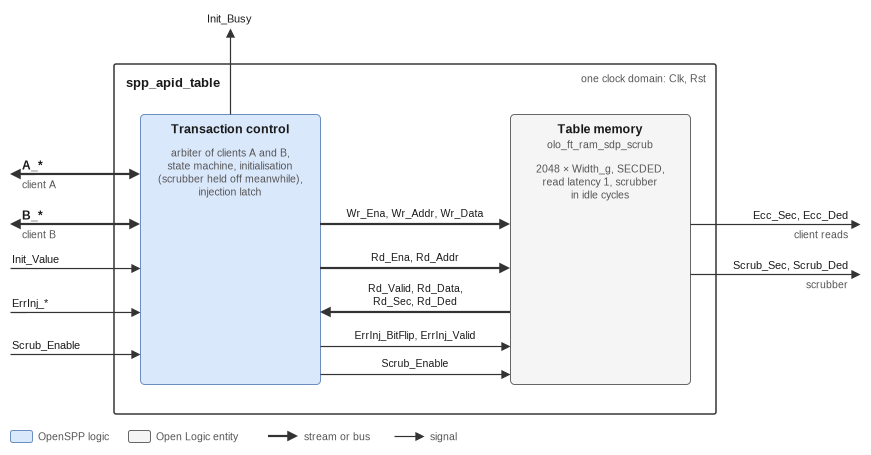
1. Block diagram
2. Ports
| Port | Width | Direction | Description |
|---|---|---|---|
Clk, Rst |
1 | in | Clock, synchronous high-active reset |
Init_Value |
Width_g |
in | Value written into every entry after the reset |
Init_Busy |
1 | out | Initialisation in progress |
A_Valid, A_Ready |
1 | in, out | Request of client A and its grant |
A_Apid |
11 | in | APID of the request |
A_RdValid, A_RdData, A_RdDed |
1, Width_g, 1 |
out | Entry of the transaction, one cycle after the grant, with the double error flag |
A_WrEna, A_WrData |
1, Width_g |
in | Write back and end the transaction |
A_Release |
1 | in | End the transaction without a write |
B_* |
as A_* |
Client B | |
Ecc_Sec, Ecc_Ded |
1 | out | Single or double error in a client read (one-cycle pulses) |
Scrub_Sec, Scrub_Ded |
1 | out | Single or double error found by the scrubber |
Scrub_Enable |
1 | in | Scrubber enabled (suspended during the initialisation) |
ErrInj_BitFlip, ErrInj_Valid |
codeword, 1 | in | Error injection pattern, latched by the strobe |
3. State machine

Init_s writes Init_Value to the addresses 0 to 2047, one per cycle; the scrubber is held off meanwhile. Idle_s
grants one request: client A unless client B also requests and A was served last. The grant (Ready) and the RAM
read happen in the same cycle; the read data returns in Read_s one cycle later. Hold_s waits for the write or the
release of the owner of the transaction; a write in this state also applies a latched error injection pattern. The
when others branch returns to Idle_s.
A transaction takes three cycles when the client answers in the cycle after the read data. Both clients therefore see at most one transaction of the other between two of their own.
4. Fault tolerance
The RAM is olo_ft_ram_sdp_scrub with a read latency of one cycle and no ECC pipeline. User reads and writes have
priority over the scrubber, which uses the idle cycles; a scrubber write-back is abandoned when a client writes the
same address. A double error is not repaired: the client sees the flag and the register file reports it, the entry is
repaired by the next write.