owr_data_link: Architecture and Design Description
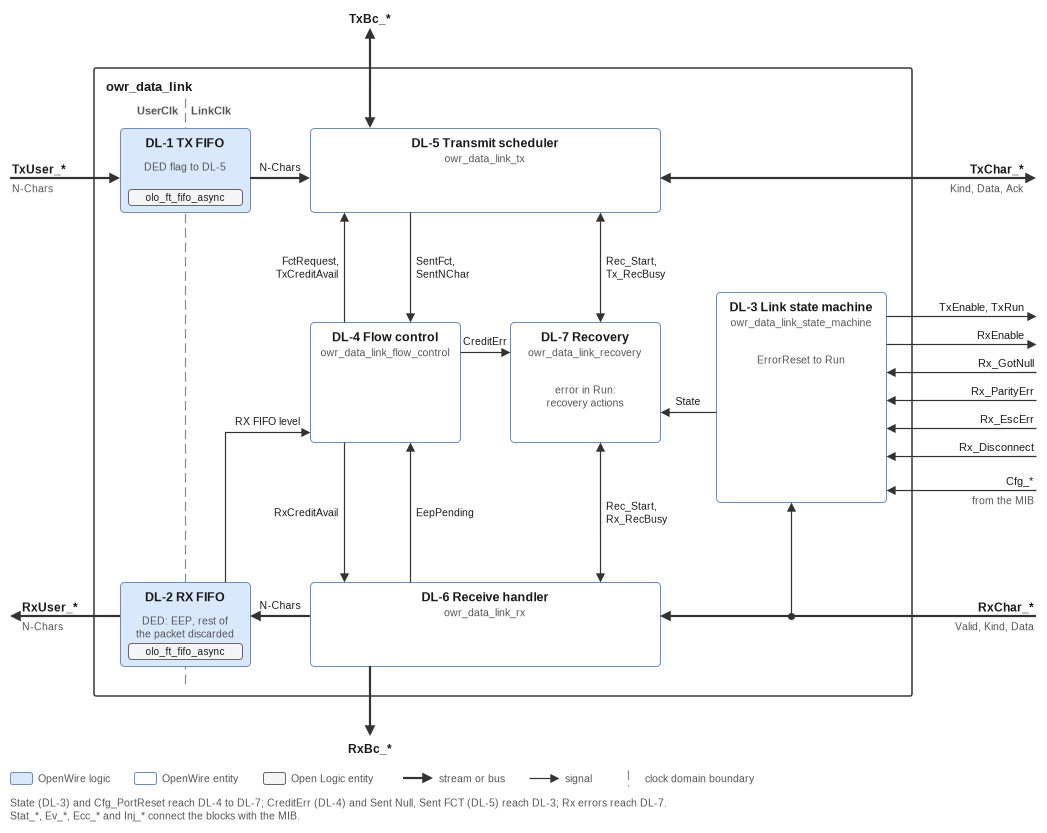
1. Block diagram
2. Link state machine (DL-3, owr_data_link_state_machine)
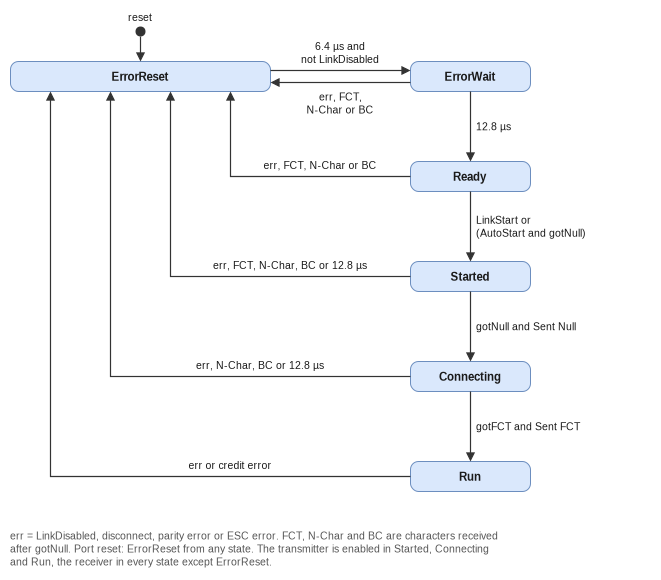
| State | Transmit Enable | Receive Enable | Characters sent | Timer |
|---|---|---|---|---|
| ErrorReset | 0 | 0 | none | 6.4 us from entry |
| ErrorWait | 0 | 1 | none | 12.8 us from entry |
| Ready | 0 | 1 | none | none |
| Started | 1 | 1 | Nulls | 12.8 us from entry |
| Connecting | 1 | 1 | FCTs and Nulls | 12.8 us from entry |
| Run | 1 | 1 | Broadcast codes, FCTs, N-Chars, Nulls | none |
One down-counter serves all timers; it is loaded on entry to ErrorReset (6.4 us), ErrorWait, Started and Connecting
(12.8 us). With ClkFreq_g = 100 MHz the timers are 640 and 1280 cycles. The exit conditions of each state are
evaluated in the order of the standard (an error before a received character before the normal exit). gotFCT, Sent
Null and Sent FCT are flags: gotFCT is set by an FCT received in Connecting and cleared in ErrorReset, Sent Null is
cleared on entry to Started, Sent FCT on entry to Connecting. FCT, N-Char and broadcast code "received" are the
one-cycle events of EN-2; EN-2 passes characters only after gotNull. The when others branch returns to ErrorReset.
3. Flow control manager (DL-4, owr_data_link_flow_control)
| Counter | Increment | Decrement | Zero |
|---|---|---|---|
| Transmit credit (0 to 56) | +8 per FCT received in Connecting or Run; above 56: credit error, saturates | -1 per N-Char sent | In ErrorReset |
| Receive credit (0 to 56) | +8 per FCT sent | -1 per N-Char received in Run; at zero: credit error, the N-Char is not stored | In ErrorReset |
FctRequest = (Connecting or Run) and receive credit <= 48 and room >= receive credit + 8, with room = depth - fill
level - 1 (an N-Char on its way into the FIFO) - pending EEP. The fill level is In_Level of the receive FIFO, which
counts read words only after their pointer has crossed back, so the room is never overestimated. CreditErr is a
registered event. A credit error caused by an N-Char is decided with the same registered credit that DL-6 uses to
store it.
With a receive FIFO of 64 N-Chars, the reserved place for the EEP of a recovery is always free: an FCT is only sent while fill level + credit <= 55, so the FIFO holds at most 63 N-Chars when all credit is used.
4. Transmit scheduler (DL-5, owr_data_link_tx)
The presented character is combinational from the state, the flow control and the FIFO head:
| State | Presented character |
|---|---|
| Started | Null |
| Connecting | FCT if FctRequest, otherwise Null |
| Run | Broadcast code if the slot holds one, otherwise FCT if FctRequest, otherwise the N-Char at the head of the transmit FIFO if there is credit and no discard is running (EEP if it has a double error), otherwise Null |
| Others | Null (transmitter disabled) |
On TxChar_Ack the slot is emptied (broadcast code), SentFct or SentNull is pulsed, or the N-Char is popped and
SentNChar pulsed. InPacket is set when a data character is sent and cleared by a marker.
| Register | Set | Cleared |
|---|---|---|
| Broadcast slot | Valid broadcast code in Run while the slot is empty (TxBc_Ready = slot empty); outside Run the code is accepted and TxBc_Discarded pulsed |
Code taken by the transmitter, ErrorReset, port reset |
Spill |
Rec_Start with InPacket; N-Char with double error sent as EEP |
Marker without double error popped, port reset |
RecSpill (Rec_Busy) |
Rec_Start with InPacket |
With Spill, port reset |
While Spill is set every valid FIFO word is popped and no N-Char is presented; Nulls, FCTs and broadcast codes are
still sent.
5. Receive handler (DL-6, owr_data_link_rx)
In Run a received N-Char with receive credit is loaded into the write register of the receive FIFO (data, EOP 0x100,
EEP 0x101); InPacket follows the last character loaded. A received broadcast code in Run is passed as a one-cycle
event. On Rec_Start with InPacket the EEP is pending and loaded as soon as the write register is free; it stays in
the register until the FIFO accepts it. Rec_Busy = EEP pending or write register full. An N-Char that finds the
write register full (impossible with correct credits) is dropped and reported by Ev_Overflow.
6. Link error recovery (DL-7, owr_data_link_recovery)
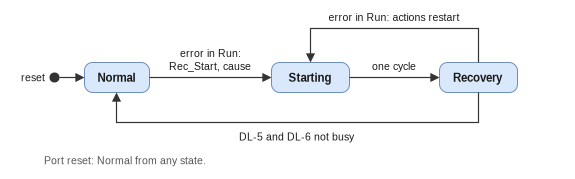
The cause is recorded in the order of ECSS 5.5.7.7b: LinkDisabled, disconnect, parity error, ESC error, credit
error. Starting waits one cycle because the recovery actions of DL-5 and DL-6 are registered.
7. FIFOs (DL-1, DL-2) and double error containment
Both FIFOs are olo_ft_fifo_async of 9-bit N-Chars with ReadyRstState_g = '0'. The LinkClk sides are reset by
Rst or port reset; the reset crossing inside the FIFO resets the user sides. ECC events count once per word read
(flag AND valid AND ready). On the user side of the receive FIFO a word with a double error is passed as an EEP;
after it is taken, the FIFO is read without passing words up to and including the next marker without double error.
8. Ports of owr_data_link
| Signal | Direction | Domain | Description |
|---|---|---|---|
Clk, Rst, UserClk, UserRst |
In | LinkClk and UserClk with their synchronous resets |
|
TxUser_Data/Valid/Ready |
In/In/Out | UserClk | N-Chars to send (bit 8 = marker, EOP 0x100, EEP 0x101) |
RxUser_Data/Valid/Ready |
Out/Out/In | UserClk | Received N-Chars |
TxBc_Data/Valid/Ready, TxBc_Discarded |
In/In/Out/Out | LinkClk | Broadcast codes from the Network layer |
RxBc_Data/Valid |
Out | LinkClk | Received broadcast codes (one-cycle event) |
TxEnable, RxEnable, TxRun |
Out | LinkClk | Encoding layer control |
TxChar_*, RxChar_*, Rx_* |
LinkClk | Encoding layer characters and status | |
Cfg_PortReset (pulse), Cfg_LinkDisabled, Cfg_LinkStart, Cfg_AutoStart |
In | LinkClk | Management parameters |
Stat_*, Ev_* |
Out | LinkClk | State, recovery, cause, credits, FIFO levels, discard, credit error, overflow |
Ecc_TxSec/Ded |
Out | LinkClk | ECC events of the transmit FIFO |
Ecc_RxSec/Ded |
Out | UserClk | ECC events of the receive FIFO |
Inj_TxBitFlip/Valid |
In | UserClk | Error injection into the transmit FIFO |
Inj_RxBitFlip/Valid |
In | LinkClk | Error injection into the receive FIFO |