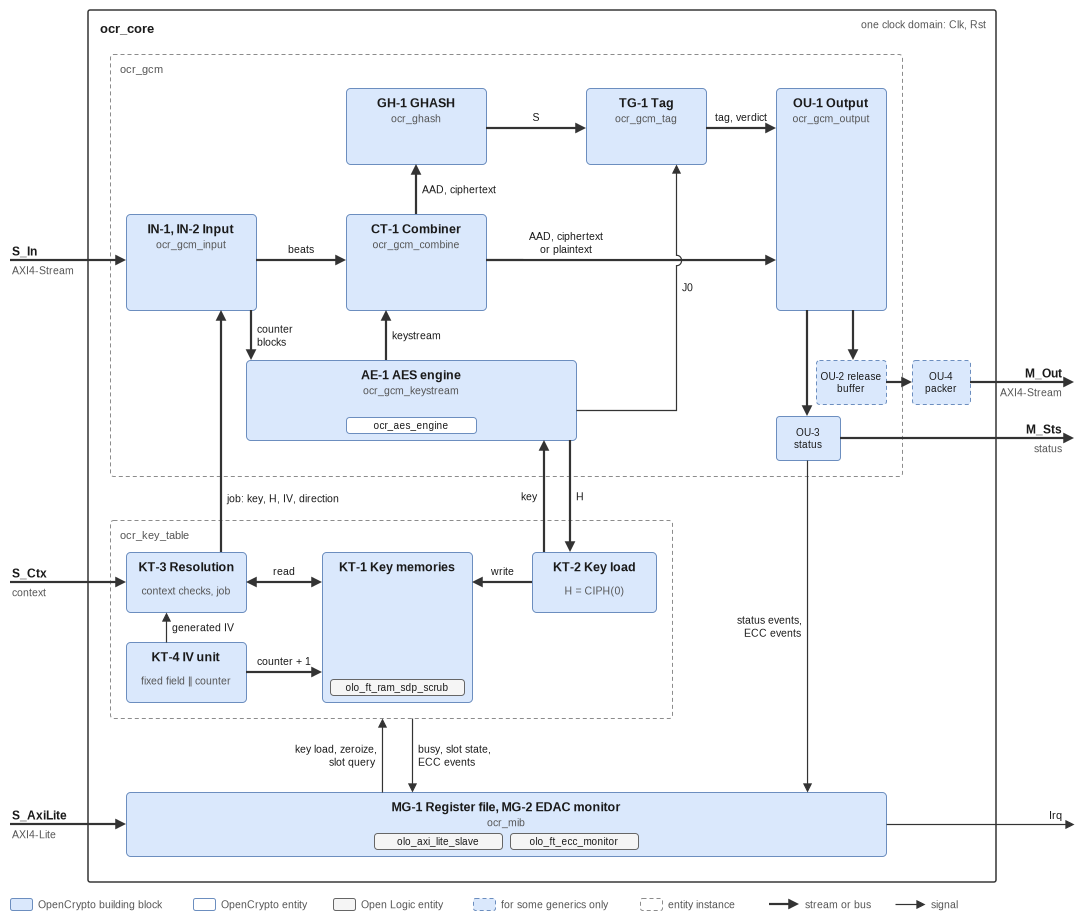
This document defines the architecture of OpenCrypto, an implementation of the authenticated encryption and
decryption functions of the Galois/Counter Mode (GCM) with the Advanced Encryption Standard (AES) for real-time data
streams. Together with FIPS 197, NIST SP 800-38D and CCSDS 352.0-B-2 it is the complete basis for the implementation:
it fixes the building blocks, their interfaces, the clauses each block owns and the Open Logic entities each block is
built from.
The AES forward cipher with 128-, 192- and 256-bit keys (AES 5.1, 5.2), selected by a generic.
GCM authenticated encryption (GCM-AE, GCM 7.1) and authenticated decryption (GCM-AD, GCM 7.2) of messages that
consist of additional authenticated data (AAD) and plaintext or ciphertext, including GMAC (messages without
plaintext, GCM 5.2, CCSDS 4.3.2). The direction is chosen per message.
96-bit initialisation vectors (IV), 128-bit authentication tags (CCSDS 3.4.2), AAD and data of up to
232 - 1 bytes each per message.
A key table with a configurable number of key slots: keys are loaded through the register file and can never be
read back, the hash subkey is computed when a key is loaded, every message selects its slot.
An IV generation unit per key slot with the deterministic construction (GCM 8.2.1), the enforcement of one IV
construction per key (GCM 8.2) and the limit of the number of invocations (GCM 8.3).
An optional release buffer that delivers a decrypted message only after its tag was verified (GCM 7.2 step 8).
An optional dense output that delivers every output message as one gapless byte string.
A framer in front of the core that cuts packets of any length (for example compressed images) into chunks of
bounded size and encrypts every chunk as one message, with the position of the chunk in its packet as AAD.
Streams with back-pressure everywhere, data widths of 16, 32, 64 and 128 bits and one beat per clock cycle;
management, counters and product information behind an AXI4-Lite port; fault tolerance; the verification
architecture.
The AES inverse cipher (AES 5.3): GCM uses only the forward cipher in both directions (GCM 5.1, 7.2).
IVs of other lengths than 96 bits (GCM 5.2.1.1 recommends restricting the support to 96 bits) and tag lengths other
than 128 bits (GCM 5.2.1.2 allows the restriction to one value; CCSDS 3.4.2 requires 128 bits).
The RBG-based IV construction (GCM 8.2.2): the core contains no random bit generator. A user who builds IVs with an
RBG supplies them as external IVs.
Key establishment and key management (GCM 8.1, CCSDS 1.2): keys are delivered to the register file by the user.
The other algorithms of CCSDS 352.0-B-2: HMAC (CCSDS 4.2), CMAC (CCSDS 4.3.1) and digital signatures (CCSDS 4.4).
Security protocols that use AES-GCM, for example the Space Data Link Security Protocol (CCSDS 355.0-B-2): the
framing of security headers and trailers belongs to the protocol layer. The message format of section 6 is chosen so
that such a layer maps its frames onto it without buffering. The framer (FR-1) is no such protocol: it only bounds
the size of the messages of a stream and marks the position of each chunk.
OpenCrypto contains no vendor code. All buffers and tables are Open Logic fault-tolerant entities, all data interfaces
are AXI4-Stream and the management interface is AXI4-Lite. The core runs on any FPGA.
OpenCrypto is an open AES-GCM implementation that is based on the Open Logic VHDL Library. The code lives in
open-space-hdl/opencrypto under the PSI HDL Library License, Version
1.0, the licence of Open Logic. Open Logic is pinned to the tag 4.8.0-ft.2 (1f4a6c3) of the branch fault-tolerant of
open-space-hdl/open-logic-ft, the fault-tolerant fork of Open Logic, based on Open Logic 4.8.0.
Clause references name the standard: AES for FIPS 197, GCM for NIST SP 800-38D and CCSDS for CCSDS 352.0-B-2, for
example AES 5.2, GCM 7.1 or CCSDS 3.4.2. A range such as AES 5.1.1 to 5.1.4 means all clauses in between.
Coding conventions: those of Open Logic (naming, two-process style, synchronous high-active resets, VSG rules),
entity prefix ocr_, VHDL library opencrypto; see conventions.md.
"FT" (fault-tolerant) means the Open Logic olo_ft_* entities: SECDED ECC on every buffer and table.
Term
Meaning
Block
128-bit string, the block size of AES (AES 3.1); its first byte is the leftmost byte of the string
Beat
One transfer of a stream of DataWidth_g = W bits; R = 128 / W beats form one block
Message
The input of one invocation of GCM-AE or GCM-AD and its output: AAD, data (plaintext or ciphertext), IV and tag
Section
The beats of one part of a message: IV, AAD, DATA or TAG (section 6)
Key slot
Entry of the key table: key, hash subkey, IV construction and IV generator state
J0
Pre-counter block IV ‖ 031 ‖ 1 of a 96-bit IV (GCM 7.1 step 2)
H
Hash subkey CIPHK(0128) (GCM 7.1 step 1)
Keystream block
CIPHK(CBi) of a counter block of GCTR (GCM 6.5)
Bottleneck side
The side of the core with more beats per message: the output for encryption (the tag is appended), the input for decryption (the tag is consumed)
AES is a block cipher with a block size of 128 bits and key lengths of 128, 192 or 256 bits (AES 5). The cipher
transforms a 16-byte State in Nr = 10, 12 or 14 rounds of SubBytes, ShiftRows, MixColumns and AddRoundKey; the last
round has no MixColumns (AES 5.1). The round keys come from the key expansion (AES 5.2), which derives 4 (Nr + 1)
words from the Nk = 4, 6 or 8 words of the key.
GCM combines the counter mode for confidentiality with the universal hash GHASH for authenticity (GCM 5.3). For a
96-bit IV the counter blocks are J0 = IV ‖ 031 ‖ 1 and its successors under inc32, the increment of the
rightmost 32 bits (GCM 6.2). The plaintext is XORed with the keystream of the counter blocks inc32(J0), inc32²(J0), ...
(GCTR, GCM 6.5); a partial last block uses the leftmost bytes of its keystream block. GHASH multiplies the blocks of
A ‖ 0v ‖ C ‖ 0u ‖ [len(A)]64 ‖ [len(C)]64 in GF(2128) with
the hash subkey H = CIPHK(0128) (GCM 6.3, 6.4), and the tag is the result XORed with
CIPHK(J0) (GCM 7.1 step 6). The decryption runs the same counter mode over the ciphertext, computes the tag
over the received ciphertext and returns the plaintext only when the computed tag equals the received one; otherwise
it returns FAIL (GCM 7.2).
CCSDS 352.0-B-2 selects AES as the encryption algorithm of all CCSDS missions (CCSDS 3.1), with 256-bit keys for new
missions and 128-bit keys allowed for existing ones (CCSDS 3.2), in counter mode (CCSDS 3.3), and GCM with a 128-bit
MAC when integrity and origin authentication are required (CCSDS 3.4). GMAC may replace CMAC when an authenticated
encryption implementation is used for authentication only (CCSDS 4.3.2).
Function
Clauses
Notation, bytes, State
AES 3
Arithmetic in GF(28)
AES 4
Cipher and key expansion
AES 5.1, 5.2
Key lengths and implementation freedom
AES 6
Block cipher requirements
GCM 5.1
GCM functions, input and output data
GCM 5.2
Counter mode and GHASH
GCM 5.3, 6
GCM-AE and GCM-AD
GCM 7
Uniqueness of IVs and keys
GCM 8, 9
Conformance
GCM 10
CCSDS algorithm selection
CCSDS 3, 4.3.2
Five properties of the standards shape the architecture more than any single feature:
The keystream does not depend on the data. Every counter block is known once the IV is known, so the AES works
on requests that the input side issues ahead of the data, and the data only waits for its keystream block.
GHASH is a sequential chain. Every block of GHASH depends on the previous result (GCM 6.4). The multiplier
finishes one block before the next starts; its digit size sets its throughput.
The tag follows the data. The tag is known only after the last block and the length block, and the decryption
verdict only after the received tag. Results that depend on the tag are therefore produced at the end of a message,
and the release of a plaintext after verification needs a buffer of the whole message.
The IV must never repeat for a key (GCM 8). A repeated IV reveals the XOR of two plaintexts and allows forgeries
(GCM Appendix A). The IV generator keeps its counter in protected memory and refuses to continue when it is
exhausted.
The key and H are secret (GCM 5.1, 5.3). No interface of the core can read a key, a round key or H.
Encryption of instrument data and telemetry at line rate
One beat per clock cycle at every width on every path, including message boundaries (P6)
Data widths of 16 to 128 bits for links of different speed
Resources scale with the width: the number of AES round units and the digit of the GHASH multiplier follow from the width (D4, D5)
Use in space: single event upsets in tables, buffers and registers
SECDED ECC on every table and buffer, scrubbing of the key table, round keys computed with every block instead of stored, state machines with a recovery state (P5)
Several security associations per link
A key table with a key slot per message and without a pause on a key change (D7)
IV uniqueness as a property of the core
IV generation unit inside the core with protected state and the enforcement of one construction per key (D8)
Integration with space link security protocols
Message format with sections that a protocol layer maps onto its frames, IV of generated messages delivered in front of the message (D2)
Technology independence
AXI4-Stream and AXI4-Lite interfaces, no vendor primitive (P11)
Verifiability
Every block verified through its ports against the AES-GCM implementation of pycryptodome (P9, section 9)
A block implements one function of the standards. Its specification names the clauses it owns; no clause is owned by two blocks.
P2
Streams everywhere
Every data path between blocks is a valid / ready stream (Open Logic AXI4-Stream conventions). A path into a pipeline that cannot stall uses credits: a request is issued only when the buffer behind the pipeline has room for its result.
P3
One clock domain
All blocks run in Clk.
P4
One management interface
Key loading, configuration, status and counters live in one register file behind one AXI4-Lite port, generated from a single register description (VHDL package, documentation, C header).
P5
Fault tolerance by construction
All buffers and tables are olo_ft_* entities (SECDED ECC); the key table is scrubbed. Round keys are computed from the key with every block. State machines have a defined recovery state. ECC events are counted; a double error is contained and reported in the status of the message. All other logic relies on the TMR of the synthesis tool (user guide, section 6).
P6
Line rate
Every path accepts one beat per clock cycle while its output is ready, and the bottleneck side of back-to-back messages transfers one beat per clock cycle (D3).
P7
Messages are self-describing
The section of every beat travels in TUser; lengths are not announced in advance.
P8
The direction is a property of the message
Encryption and decryption share the data path; the context of each message selects the direction, the key slot and the IV.
P9
Verifiable in isolation
Each module has a specification and a testbench that drives only its ports. Expected values come from pycryptodome, an implementation of AES-GCM that is independent of the RTL, and from the examples of the standards.
P10
Reuse before design
A function available in Open Logic (FIFO, packet FIFO, RAM, AXI4-Lite slave, ECC monitor) is instantiated, not rewritten.
The user hands over one context per message on S_Ctx (direction, key slot, IV or the request for a generated IV)
and the message itself on S_In. The key table resolves the context: it reads the key, the hash subkey and the IV
generator state of the slot, checks the slot and the IV construction, and passes a job to the GCM data path. The data
path parses the sections, requests the counter blocks of the message from the AES engine, XORs the data with its
keystream, hashes AAD and ciphertext, computes the tag and assembles the output message. Every message ends with one
status on M_Sts.
S_In and M_Out carry one message per packet of the stream: TLast marks the last beat of a message. A message is
a sequence of sections; the section of a beat is in TUser(1:0):
Code
Section
Input of the encryption
Output of the encryption
Input of the decryption
Output of the decryption
"11"
IV
not allowed
first, when the IV was generated
not allowed
not used
"01"
AAD
optional, first
AAD as received
optional, first
AAD as received
"00"
DATA
optional, after the AAD
ciphertext
optional, after the AAD
plaintext
"10"
TAG
not allowed
last, 16 bytes
required, last, 16 bytes
not used
A section starts with a new beat. Byte lane 0 (TData(7:0)) holds the first byte of a beat, and the first byte of a
section is the leftmost byte of its first block (AES 3.1, GCM 6.1).
All bytes of a beat are valid except in the last beat of a section, whose valid bytes are contiguous from byte lane
0 (TKeep). A section of one beat without a valid byte is an empty section; an empty message is one such beat.
The IV section has 12 bytes, the TAG section 16 bytes.
M_Out_User(2) is the error flag on the last beat of a message: '1' when the status of the message is not OK. A
failed decryption therefore ends with the flag, and a consumer that does not use the status discards the message.
An output message with no byte at all (decryption of an empty message, rejected message) is one beat without a
valid byte, with TLast and the error flag.
The format maps a space link frame without buffering: the protocol layer passes the header fields to be authenticated
as AAD (with the IV field masked, as SDLS 4.2.2.6 does), the frame data as DATA, and appends or checks the TAG. When
the core generates the IV, the IV section arrives in front of the AAD of the output, so the layer can insert it into
the frame header before it sends the header.
With DenseOutput_g the output packer (OU-4) removes the gaps that the sections leave at their ends: every output
message is one gapless byte string IV ‖ AAD ‖ DATA ‖ TAG (the sections that the message has), all bytes of a beat
are valid except in the last beat of the message, and M_Out_User(1:0) is the section of the first byte of the
beat. A consumer that takes the message as a byte string, for example a packet service, receives it without
reassembly. The section boundaries follow from the lengths: IV 12 bytes, TAG 16 bytes, AAD and DATA bytes in the
status.
The framer (FR-1, ocr_framer) feeds the core with the chunks of packets of any length. Every chunk of up to
ChunkBytes_g bytes is one message: a 4-byte AAD section with the position of the chunk in its packet (bits 7:6 of
the first byte, in the encoding of the CCSDS sequence flags: "01" first, "00" middle, "10" last, "11" the only
chunk), then the chunk as DATA section, with one context per chunk for an encryption with a generated IV. With the
dense output a chunk leaves as IV (12 bytes) ‖ position (4 bytes) ‖ ciphertext ‖ tag (16 bytes); IV and position
fill exactly one 128-bit block, so the ciphertext starts on a beat boundary at every data width.
S_Ctx (valid / ready, one transfer per message, in the order of the messages):
Signal
Width
Meaning
Clause
S_Ctx_Decrypt
1
'0' GCM-AE, '1' GCM-AD
GCM 5.2
S_Ctx_Slot
log2(NumKeys_g)
Key slot
GCM 5.1
S_Ctx_IvGen
1
'1' the IV generation unit of the slot supplies the IV (encryption only)
GCM 8.2.1
S_Ctx_Iv
96
IV of the message when S_Ctx_IvGen = '0'
GCM 5.2.1.1
M_Sts (valid / ready, one transfer per message, in the order of the messages): status code, direction, key slot,
the IV that was used, and the numbers of AAD and DATA bytes. Codes in order of precedence:
Code
Name
Meaning
0
OK
Message processed; for a decryption the tag was verified
7
ECC
Uncorrectable double error in a memory that holds data of the message
3
KEY
Key slot out of range or not loaded
4
IV_MODE
The IV source of the context is not the construction of the key slot, or a generated IV was requested for a decryption
5
IV_EXHAUSTED
The invocation counter of the slot has reached its last value (GCM 8.3)
2
FORMAT
Section order, byte enables, IV or TAG section on the wrong side, TAG section missing or not 16 bytes
6
LENGTH
AAD or DATA longer than 2LenBits_g - 1 bytes
1
AUTH
Decryption: computed tag differs from the received tag (FAIL of GCM 7.2)
8
OVERFLOW
Release buffer: message longer than the buffer, dropped
One clock domain Clk for all functions, including the register file
Clock domain crossings of the links stay in the link cores; a second domain adds latency and FT crossings without benefit
D2
One input and one output stream with sections in TUser, a context stream and a status stream per message; no lengths in advance (P7)
A link layer streams frames without buffering them; encryption output and decryption input have the same format, so two cores connect directly; the status reports every message, also dropped ones
D3
Throughput: within a message every interface transfers one beat per clock cycle while its partner is ready. For back-to-back messages the bottleneck side transfers one beat per clock cycle after the initial latency, with one exception: consecutive encryptions with generated IVs need at least three output beats per message
The core keeps up with any stream at its clock rate; the IV generator updates its counter in the key table memory once per message (D8)
D4
AES engine of AesUnits_g iterative round units (one round per clock cycle each), dispatched in round robin; every request carries its key, the units expand the round keys on the fly. Default: ceil(2 Nr / (R + 1)) units, at least ceil(Nr / R)
A unit is busy Nr cycles per block; the default sustains D3 for the shortest messages (one counter block plus J0 per message), the minimum for long messages; the area follows the width; round keys never stored (P5), any key per block (D7)
D5
GHASH multiplier with a digit of GhashDigit_g bits (W to 128) of the first operand per clock cycle; default 128 for W of 64 and 128 bits, 64 for 16 and 32 bits. The length block of a message is processed like a data block
The multiplier finishes a block in 128 / GhashDigit_g cycles; the default leaves room for the partial blocks and the length block of the shortest messages (D3)
D6
The input side issues the requests for J0 and for every counter block when the first beat of the block arrives; the keystream waits in an FT FIFO, J0 results in a second FIFO for the tag, results of hash subkey requests go to the key table. Credits per FIFO guard the requests
The AES engine has a fixed latency and no back-pressure; separate FIFOs per destination exclude head-of-line blocking between the data path and the tag
D7
Key table of NumKeys_g slots in three olo_ft_ram_sdp_scrub (key, hash subkey, IV state); the valid flags are part of the protected words. The register file writes a key through write-only registers that clear themselves after the load; the load computes H with the AES engine. After the reset and on the zeroize command every slot is erased. A context selects any slot per message
Key confidentiality (GCM 5.1, 5.3); several security associations without a pause; SEUs never activate an erased slot; no key survives a reset
D8
IV generation unit per slot: IV = fixed field (32 bits) ‖ invocation counter (64 bits) (GCM 8.2.1, suggested layout); the counter increments with every encryption of the slot with a generated IV, the all-ones value means exhausted. Every slot is loaded either for generated or for external IVs; an encryption with the other source fails. The current counter of a slot can be read for its backup in non-volatile memory
Uniqueness of the IV (GCM 8), exactly one construction per key (GCM 8.2), limited invocations (GCM 8.3), recovery after a loss of power (GCM 9.1)
D9
The output assembly emits the IV section of a generated IV, the AAD and the data, then the tag of an encryption; for a decryption it holds the last output beat until the verdict and sets the error flag on a failure
The tag and the verdict are known only at the end (section 2); the consumer receives the verdict with the message
D10
Optional release buffer (ReleaseBuffer_g): an olo_ft_fifo_packet behind the output assembly that drops every message whose status is not OK and every message longer than the buffer
A decrypted message leaves the core only after its tag was verified (GCM 7.2 step 8)
D11
One status per message with one code; the code of the highest precedence wins; every code is counted in the register file
Deterministic and testable error reporting
D12
A failed encryption emits the TAG section as zeros; a message that its context rejects is consumed and replaced by one empty output beat
A failed encryption can never carry a valid tag; message boundaries are kept for the consumer
D13
The protocol state machines have a defined recovery state: the when others branch leads to it from an illegal state, and the reset restarts the core from any state. All logic outside the memories and buffers relies on the TMR of the synthesis tool; the core adds no TMR of its own
Same as the other Open Space HDL cores and the Open Logic ft entities; the protection scope is listed in the user guide, section 6
D14
Optional dense output (DenseOutput_g): an output packer behind the output assembly (and the release buffer) closes the gaps at the section ends; it shifts the bytes by the residual of the previous beats, one rotation per beat
A packet service or a memory interface takes the message as a byte string without gaps; the gaps arise only at section ends, so a small packer suffices, not a general byte compactor; the sectioned format stays the default for two cores in series
D15
Framer in front of the core (ocr_framer): chunks of ChunkBytes_g bytes, each one GCM message with a generated IV and the 4-byte chunk position as AAD; store and forward of every chunk in an FT buffer, because the position "last" is known only at the end of a chunk and the AAD precedes the DATA
Long streams (compressed images) are encrypted in self-contained messages of bounded size: buffers of a few chunks instead of whole images, one packet per chunk below the size limits of the packet services, a lost chunk costs only that chunk; the IV counter numbers the chunks and the authenticated position marks the packet boundaries for the receiver. The chunker is the general entity olo_base_chunker; the position and the contexts stay outside the cryptographic core
All blocks run in Clk. The reset input Rst is synchronous and high-active (Open Logic convention); the integrator
synchronises it to Clk, for example with olo_base_reset_gen with SyncTmr_g = true (triplicated synchroniser).
After the reset the key table erases all slots (NumKeys_g clock cycles); contexts are resolved after the erasure, so
a message that arrives meanwhile waits.
The jobs of the slot fail with ECC and carry no key; the slot is usable again after a new load
ECC event, status ECC
FIFOs and release buffer of the data path, job FIFO
Single error
Corrected
ECC event
Double error
The message whose data the entry held fails with ECC (status FIFO: the status reports ECC; release buffer: the message ends with the error flag)
ECC event, status ECC
Registers of the AES units, the GHASH multiplier, the combiner and the tag stage
Any
Encryption: a wrong ciphertext block or tag, which the receiver detects with its tag verification. Decryption: a wrong keystream block corrupts the plaintext of one block without changing the verdict; an upset in GHASH or in the tag stage fails the message with AUTH
Encryption: at the receiver; decryption: not detected for the keystream
Control registers (state machines, counters, credits)
Any
The when others branch returns an illegal state to its recovery state; a corrupted counter or credit can corrupt or stall a message; the reset recovers from any state
Not detected by the core
The memories and buffers hold most of the state and are protected by ECC. The registers of the data path and the
control rely on the TMR of the synthesis tool, which the integrator enables for the core (D13,
user guide, section 6); the table shows the effect of an upset in them without TMR. A receiver always
verifies the tag.
The core has 17 building blocks in six groups, and the framer is one more block in front of it. Each block lists its
responsibility, the Open Logic entities it is built from and the clauses it owns (P1: no clause is owned twice).
Forward cipher of one block per request: AesUnits_g round units with round-robin dispatch, AddRoundKey of round 0 at the dispatch, one round per clock cycle with SubBytes, ShiftRows, MixColumns (not in the last round) and AddRoundKey, key expansion on the fly with every block; fixed latency, results in the order of the requests
Takes the job of the message, holds one beat back to find the end of every section, checks the section order, the byte enables and the TAG length, consumes rejected messages, forwards beats with their flags
olo_ft_fifo_sync (data FIFO)
GCM 5.2, 5.2.1.1, 10; CCSDS 4.3.2
IN-2
Counter blocks
J0 and the counter blocks IV ‖ [i + 1]32 of the DATA blocks, requests to AE-1 with credits, priority of hash subkey requests
none
GCM 6.2
CT-1
GCTR combiner
XORs every DATA beat with its part of the keystream block (partial last block: leftmost bytes), passes AAD, routes AAD and ciphertext to GH-1, collects the received tag, reports ECC errors of the message
olo_ft_fifo_sync (keystream, J0), olo_base_pl_stage (register of the data FIFO)
GCM 5.3, 6.5, 7.1; CCSDS 3.3, 3.4.1
TG-1
Tag
T = S ⊕ CIPHK(J0); encryption: the tag; decryption: comparison with the received tag, verdict; status code of the message
olo_ft_fifo_sync
GCM 5.2.1.2, 5.2.2, 7.2; CCSDS 3.4.2
OU-1
Output assembly
IV section of a generated IV, AAD and data beats, TAG section of an encryption (zeros on failure), held last beat and error flag of a decryption, empty beat of a rejected message
olo_ft_fifo_sync (output FIFO)
none (format of section 6)
OU-2
Release buffer
Optional store-and-forward of the output messages, drops messages whose status is not OK and messages longer than the buffer
olo_ft_fifo_packet
none (GCM 7.2 step 8 through TG-1)
OU-3
Status
One status per message: code, direction, slot, IV, AAD and DATA bytes
olo_ft_fifo_sync
none
OU-4
Output packer
Optional (DenseOutput_g): closes the gaps at the section ends of the output messages, the section code of the first byte of every beat, the error flag on the last beat
Assembles blocks from the hash stream with zero padding at the end of every section, counts the AAD and ciphertext bytes, appends the length block, multiplies Yi = (Yi-1 ⊕ Xi) · H in GF(2128) with a digit-serial multiplier, delivers S per message
Key load through self-clearing write-only registers, zeroize, slot query (valid, construction, exhausted, counter), counters per status code and direction, interrupt, product information, generated from one register description (hdl/ocr_mib/regs/ocr_regs.yml, tools/regmap.py)
olo_axi_lite_slave
GCM 5.1 (key secrecy)
MG-2
EDAC monitor
Counts the SEC and DED events of every FT table and buffer, raises an interrupt
AES transformations (S-box, ShiftRows, MixColumns, key expansion step), GF(28) and GF(2128) arithmetic, byte order of blocks and beats, section and status codes
Cuts the packets of a stream into chunks, buffers every chunk completely, sends the AAD with the chunk position and the chunk as DATA section, one context per chunk (encryption, generated IV, configured slot); a double error in its buffers fails the message of the chunk in the core
The core is verified with VUnit and UVVM in a seven-phase module workflow (requirements, architecture, verification
plan, RTL, testbenches, verification, integration; see conventions.md). Every module of section 7
has its own specification, verification plan, testbench and verification report; core tests cross the seams between
the modules. Every test case names the requirements it verifies, and every requirement names its clauses, so the
traceability matrix of section 10 is checked by tools/compliance.py.
VUnit (run.py) discovers and runs every test and is the CI regression. UVVM supplies the verification building
blocks: the AXI4-Lite VVC, alert and log handling, check_value / await_value, randomisation.
Expected values: tools/ocr_vectors.py generates the test messages of every test configuration with pycryptodome
(AES in ECB mode for the AES engine, AES in GCM mode for everything else) when run.py starts. The vectors do not
depend on the data width, so every configuration of a testbench runs the same messages. The examples of FIPS 197
(Appendix A and C) and the test cases of the GCM specification with 96-bit IVs are part of the vector sets; the
generator checks that pycryptodome reproduces them.
Message source and sink models (tb/ocr_tb_*.vhd) send and check messages of any length with random stall cycles;
the sink compares every byte, the byte enables, the section and the error flag of every beat. Throughput tests
measure the gaps on the bottleneck side.
Simulator: GHDL for every test; QuestaSim for code coverage.
Tests observe ports and the register file only (P9).
A failed check fails the test; a test cannot pass with a failed step.
Negative tests inject the fault from the bench (modified tag, AAD or ciphertext, wrong section order, wrong byte
enables, unloaded slot, wrong IV source, exhausted counter, oversized section, message longer than the release
buffer, double error through the error injection of the FT buffers and tables) and expect the status code, the
counter or the flag; never from an RTL mutation.
Every clause in the scope of section 1 has exactly one owner block. "User" marks a clause that the user of the core
fulfils; the user guide states it. "First verified at" names the lowest verification level at which the clause can be
fully checked. The compliance matrix, generated from this table, the module specifications and the
verification plans, lists the requirements and test cases of every clause.
Clause
Title
Owner
Also involved
First verified at
AES 3.1 to 3.5
Inputs and outputs, bytes, arrays of bytes, the State
AE-1
CM-1, CT-1
Unit
AES 4.1, 4.2
Addition and multiplication in GF(28)
CM-1
AE-1
Unit
AES 4.3
Polynomials with coefficients in GF(28)
CM-1
AE-1
Unit
AES 5.1
Cipher
AE-1
CM-1
Unit
AES 5.1.1
SubBytes
CM-1
AE-1
Unit
AES 5.1.2
ShiftRows
CM-1
AE-1
Unit
AES 5.1.3
MixColumns
CM-1
AE-1
Unit
AES 5.1.4
AddRoundKey
AE-1
Unit
AES 5.2
Key Expansion
AE-1
CM-1
Unit
AES 5.3
Inverse Cipher
Not implemented (GCM uses only the forward cipher, GCM 5.1, 7.2)
-
AES 6.1
Key length requirements
AE-1
Unit
AES 6.2
Keying restrictions
KT-2
AE-1
Unit
AES 6.3
Parameterization of key length, block size and round number
AE-1
Unit
AES 6.4
Implementation variations
AE-1
Unit
GCM 5.1
Block cipher: approved, 128-bit block, key of at least 128 bits, secret
AE-1
KT-1, MG-1
Unit
GCM 5.2
Authenticated encryption and decryption functions, GMAC
Foundations: repository, ocr_pkg, the vector generator with pycryptodome, verification components (message
source and sink, context and status models, test end check), regression and CI.
AES engine (AE-1) with unit tests against the examples of FIPS 197 and pycryptodome for every key length and
several numbers of units.
GHASH (GH-1) with unit tests of every width and digit against pycryptodome.
GCM data path (IN, CT, TG, OU) with unit tests of encryption, decryption, GMAC, errors, release buffer and
throughput against pycryptodome.
Key table (KT-1 to KT-4) with unit tests of erasure, key load, context resolution, IV generation, scrubbing and
error injection.
Register file (MG-1, MG-2) with the generated register map.
Core top level (ocr_core) with core tests of one core and of two cores in series, the compliance matrix, the
synthesizability check and the user guide.
Dense output (OU-4, ocr_packer) with unit tests and the core tests with the dense output; framer (FR-1,
ocr_framer) with unit tests and tests of the framer in front of a core.