ocr_key_table: Architecture
1. Structure
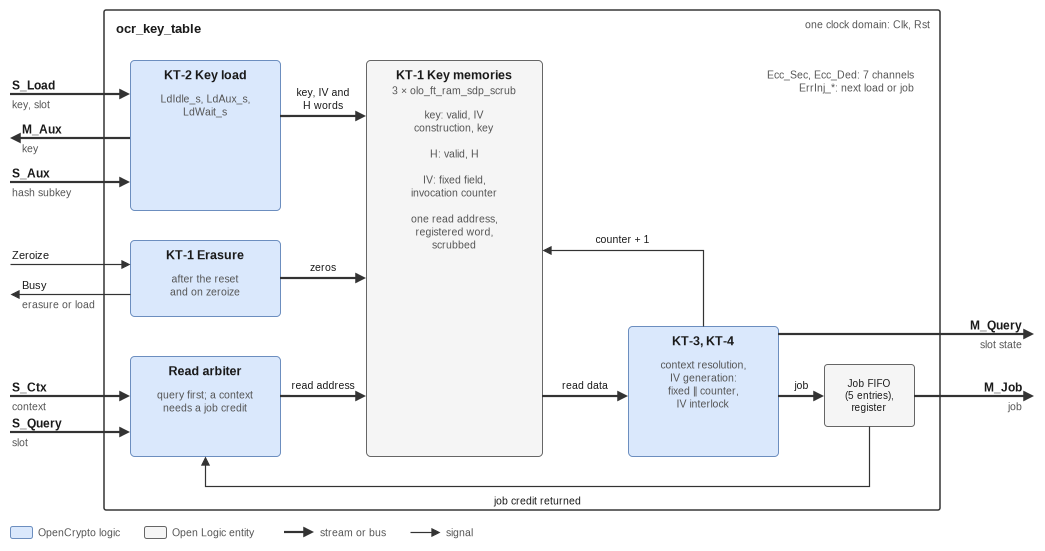
| Memory | Word | Content |
|---|---|---|
| Key RAM | KeyBits_g + 2 bits |
Valid flag, IV construction ('1' generated IVs), key |
| H RAM | 129 bits | Valid flag, hash subkey |
| IV RAM | 96 bits | Fixed field (95:64), invocation counter (63:0) |
All three memories are olo_ft_ram_sdp_scrub with max(2, NumKeys_g) words; the valid flags are protected by the
SECDED code of their word, so a single event upset can neither activate an erased slot nor change its construction
unnoticed. The memories share one read address and read in the same cycle; each has its own write address. Each
memory registers its decoded word (EccPipeline_g = 1), so the word of a read is available two cycles after the read.
2. Erasure (KT-1)
After the reset the table writes zeros to every word of the three memories, one word per clock cycle. The zeroize
command sets a pending flag; the erasure writes start two cycles after the command, or after the end of a load in
progress, so that a load that started before the command cannot write into an erased slot. No read is accepted after
the cycle of the command. A read accepted up to then is resolved with the slot before the erasure, and its counter
write-back (section 4) falls at the latest into the first cycle of the erasure; in such a cycle the erasure takes the
write ports, so no write-back survives the erasure and an erased slot reads zero. Busy is '1' from the command (or
the reset) to the end of the erasure and during every load. Contexts, loads and queries are not accepted during the
erasure. A zeroize during an erasure is followed by a second erasure.
3. Key load (KT-2)
| State | Action | Next |
|---|---|---|
LdIdle_s |
Accept a load when no erasure is pending and no context with a generated IV is in the read pipeline (IV interlock, section 4): write the key word (valid, construction, key), the IV word and an invalid H word, keep the key | LdAux_s (slot in range), LdIdle_s (slot out of range, ignored) |
LdAux_s |
Request CIPHK(0128) on M_Aux |
LdWait_s when the request is taken |
LdWait_s |
Take the result on S_Aux, write the H word with its valid flag, clear the kept key |
LdIdle_s |
| others | Recovery | LdIdle_s |
The slot is valid only when both valid flags are set, so a context of the slot between the two writes fails with KEY and never uses the hash subkey of the previous key. The kept copy of the key is cleared as soon as the hash subkey is written.
4. Context resolution and IV generation (KT-3, KT-4)
A read serves a query or a context; a query wins. A context is read only when a job credit is available: the credit
counter starts at the depth of the job FIFO (5), a read takes one, a job that leaves the FIFO returns one. The FIFO
therefore always has room for the job of a read and needs no back-pressure on the result path. A read holds its credit
for four cycles (two read stages and two cycles of FIFO latency), so five credits sustain one context per cycle. A job
leaves the FIFO into an output register (olo_base_pl_stage), which holds up to two jobs.
The context of a read passes two stages: stage 1 in the cycle after the read, stage 2 in the cycle in which the memories deliver the registered word. The result is evaluated in stage 2:
| Condition | Job error | Job IV |
|---|---|---|
| Slot out of range, key or H word not valid | KEY | IV of the context |
| Generated IV, decryption or slot of external IVs | IV_MODE | IV of the context |
| Generated IV, counter = 264 - 1 | IV_EXHAUSTED | IV of the context |
| Generated IV, slot of generated IVs | OK | fixed field ‖ counter, IV section flag set |
| External IV, encryption on a slot of generated IVs | IV_MODE | IV of the context |
| External IV, otherwise | OK | IV of the context |
| Double error in one of the three words | ECC (wins) | as above |
A job with an error carries zeros instead of the key and the hash subkey; a job with a double error in the job FIFO is masked before the output register. A slot number out of range reads address 0 and discards the result. A generated IV writes the counter + 1 back through the write port of the IV memory in stage 2.
IV interlock: while stage 1 or stage 2 holds a context with a generated IV, the table issues no read and accepts no load, so the next read of a slot sees the updated counter and the write-back never overwrites a load. The interlock depends on the stage registers only; the written-back counter is not forwarded to a read. A context with a generated IV therefore takes three clock cycles, a context with an external IV one (KT-PF-01). A load in the cycle of a context read of the same slot is outside the interlock: the read sees the previous word, and its write-back replaces the loaded IV word. The programming sequence of the user guide excludes it (no contexts of a slot during its load).
The query response holds valid flag (both words valid and slot in range), construction, fixed field, counter, the exhausted flag (counter = 264 - 1) and the double error flag of the read; it carries no key and no hash subkey.
5. Fault tolerance
| Upset | Effect |
|---|---|
| Single error in a memory word | Corrected at the read and by the scrubber, ECC event |
| Double error in a memory word read by a context | Job with ECC, zero key and H; the counter is not written back |
| Double error read by a query | Double error flag in the response |
| Single or double error in the job FIFO | Corrected, or the job fails with ECC with zero key and H |
| Upset in a control register | Recovery state of the load state machine (when others); reset |
The error injection selects the key word (0), the H word (1) or the IV word (2) of the next load, or the next job (3). The injection into a memory is held until the load and applied with its write: the H word with the write of the hash subkey, the other words with the write at the start of the load. A scrubber write-back in between can therefore not take the injection.
6. ECC events
| Index | Source |
|---|---|
| 0, 1, 2 | Read of the key, H and IV memory |
| 3, 4, 5 | Scrubber of the key, H and IV memory |
| 6 | Job FIFO (a job leaving the FIFO) |
7. Ports
| Port | Direction | Width | Description |
|---|---|---|---|
Clk, Rst |
in | 1 | Clock, synchronous high-active reset |
S_Ctx_* |
in | Context: Decrypt, Slot, IvGen, Iv (96) with valid / ready |
|
M_Job_* |
out | Job: Decrypt, Key, H (128), Iv (96), IvOut, Err (4), Slot with valid / ready |
|
S_Load_* |
in | Load: Slot, Key, IvGen, Fixed (32), Counter (64) with valid / ready |
|
Zeroize |
in | 1 | Zeroize command (one cycle) |
Busy |
out | 1 | Erasure, zeroize or load in progress |
S_Query_*, M_Query_* |
in, out | Query of a slot and its response (KeyValid, IvGen, Exhausted, Fixed, Counter, Ded) |
|
M_Aux_*, S_Aux_* |
out, in | Hash subkey request (key) and result (block) | |
Ecc_Sec, Ecc_Ded |
out | 7 | ECC events (section 6) |
ErrInj_* |
in | Error injection: Sel (2), BitFlip (2: "01" single, "11" double error), Valid |