ocr_aes: Architecture
1. Structure
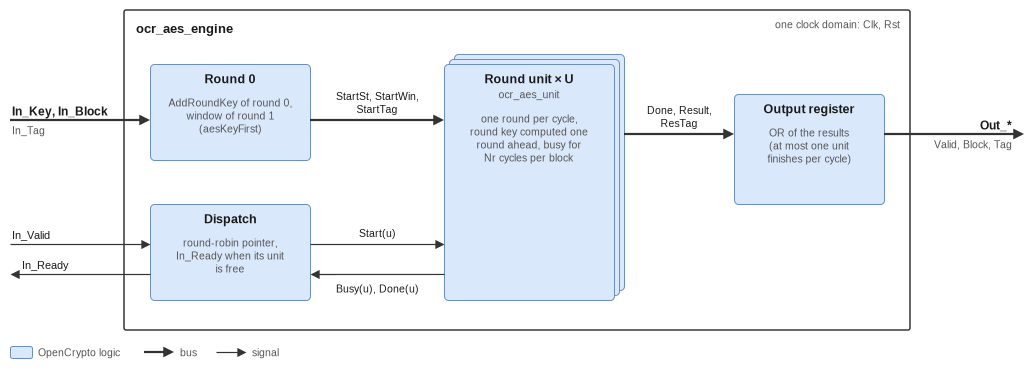
2. Round unit (ocr_aes_unit)
| Register | Width | Content |
|---|---|---|
Busy |
1 | A block is in the unit |
Round |
4 | Round that runs in this cycle, 1 to Nr |
State |
128 | State before the round |
Win |
KeyBits_g |
Window of the key expansion: its last four words are the round key of the round |
Tag |
TagWidth_g |
Tag of the request |
In every cycle with Busy set the unit computes aesRound(State, Win(127:0), Round = Nr) and, independently, the
next window with aesKeyStep(Win, KeyCtl(Round)), where KeyCtl is the constant table of the step controls of the
key length. The data path and the key path are separate register-to-register paths; the round key of a round was
computed in the previous cycle. In the last round (Done) the unit offers its result and becomes free in the same
cycle, so a new block can start in the cycle of the last round: a unit is busy for exactly Nr cycles per block.
An illegal value of Round above Nr ends the block like the last round (recovery); the reset clears Busy.
3. Dispatch and results
The pointer selects the unit of the next request in round robin; In_Ready is set when that unit is idle or runs its
last round. With round robin and a fixed latency, the units are always used in the order of the requests, and at most
one unit finishes per cycle; the results leave in the order of the requests. The output register takes the OR of the
results of the units that finish (one at most).
Latency: a request accepted at clock edge t is in round 1 in the following cycle and in round Nr in the cycle that ends at edge t + Nr; the output register holds the result after edge t + Nr, so the result is sampled at edge t + Nr + 1.
4. Resources
Per unit: 16 S-boxes of the round, 4 S-boxes of the key step, MixColumns, 128 + KeyBits_g + 5 + TagWidth_g
registers. The round-0 AddRoundKey and aesKeyFirst exist once in front of the units.