ocr_gcm: Architecture
1. Structure
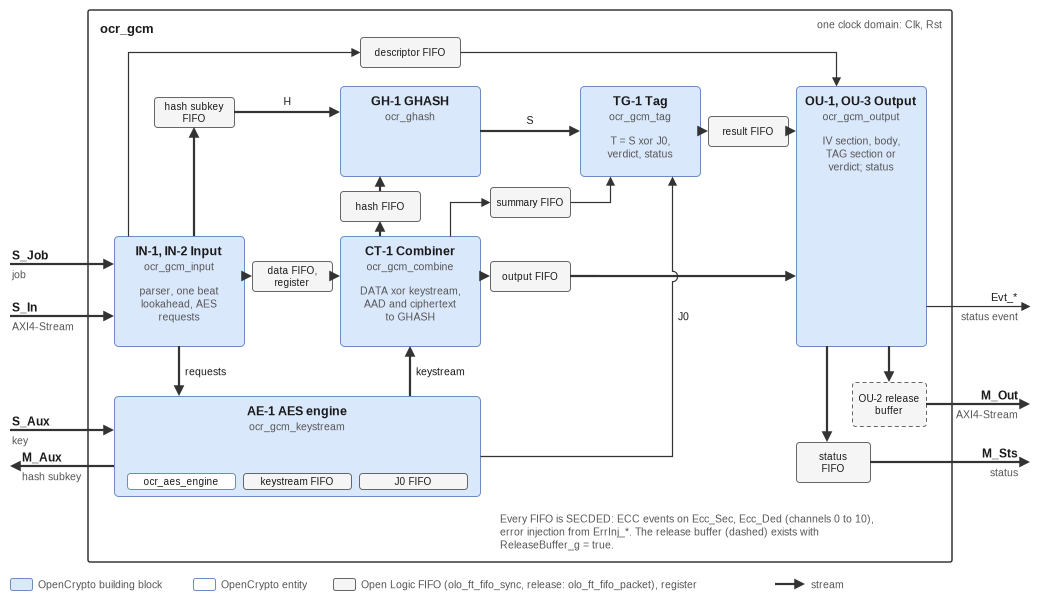
All FIFOs are olo_ft_fifo_sync (SECDED); the release buffer is an olo_ft_fifo_packet. An output register
(olo_base_pl_stage) between the data FIFO and the combiner carries the entry and its double error flag, so that the
read and ECC decoding of the FIFO and the combiner fall into different cycles.
| Buffer | Entry | Depth |
|---|---|---|
| Data FIFO | Beat with section, beat index in its block and the flags of the input parser | 32 |
| Keystream FIFO | Keystream block | 32 |
| J0 FIFO | CIPHK(J0) of a message | 16 (W of 16 and 32 bits), 32 |
| Hash subkey FIFO, descriptor FIFO, summary FIFO, result FIFO | One entry per message | as the J0 FIFO |
| Output FIFO | Body beat (AAD, data) | 32 |
| Hash FIFO | AAD or ciphertext beat | 16 |
| Status FIFO | Status of a message | 16 |
2. Input parser (ocr_gcm_input)
The parser holds two jobs: the job of the current message and the next job, which arrives with its hash subkey into
the hash subkey FIFO and its descriptor (direction, IV section flag, IV, slot, context error) into the descriptor
FIFO. It holds one beat back: the successor of a beat shows whether the beat ends its section (other section or
Last), whether it is the last body beat (the successor is a TAG beat) and whether a partial beat lies inside a
section. A beat is processed when its successor is known.
For every beat the parser checks the format (GC-IN-02). A correct beat goes to the data FIFO with its flags:
| Flag | Meaning |
|---|---|
K |
Beat of a DATA beat within its block |
KsPop |
The keystream block is used up after this beat (last beat of a block or of the DATA section) |
SecLast, BodyLast, MsgLast |
Last beat of its section, of the body (AAD and data), of the message |
NoBody |
First TAG beat of a message without AAD and DATA beat |
FmtErr, Rej, Dec |
Format error, marker of a rejected message, direction |
The first beat of every non-empty DATA block issues the AES request of its counter block IV ‖ [i + 1]32; the
request and the beat are accepted in the same cycle. J0 of a message is requested in any cycle without keystream
request, at the latest before the first beat of the next message; J0 of the next job may be requested once J0 of the
current job is requested. A message with a format error is cut at the error: the rest of the message is dropped and
a marker entry (no byte, MsgLast, FmtErr, and KsPop when a keystream block of the cut block is pending) ends it.
A rejected message is dropped completely and replaced by one marker entry with Rej.
3. Keystream (ocr_gcm_keystream)
The AES engine has no back-pressure, so every destination has credits: the keystream FIFO and the J0 FIFO have a credit counter each (their depth), the hash subkey result register one credit. A request is accepted only when its destination has a credit; the credit returns when the result leaves the FIFO. Hash subkey requests of the key table have priority. Separate FIFOs for keystream and J0 avoid head-of-line blocking: the tag stage takes J0 at the end of a message, while the combiner needs the keystream of the following messages.
4. Combiner (ocr_gcm_combine)
One data FIFO entry per cycle, taken from the output register of the data FIFO. A DATA beat is XORed with lanes K · B
to K · B + B - 1 of the keystream block at the head of the keystream FIFO (B bytes per beat), which is popped with
KsPop. Lanes without byte enable are zero. A body beat goes to the output FIFO and to the hash FIFO (the ciphertext of
a decryption is its input, of an encryption its result); a TAG beat fills the received tag; an entry with NoBody adds
an empty body beat. The last entry of a message writes the summary (direction, rejection, format error, ECC error of the
data and keystream FIFOs, received tag).
5. Tag stage (ocr_gcm_tag)
When S, the summary and (unless rejected) J0 of a message are available, the stage computes T = S ⊕ J0, compares it with the received tag of a decryption and merges the status code (D11). One message per cycle; the result goes to the result FIFO.
6. Output assembly (ocr_gcm_output)
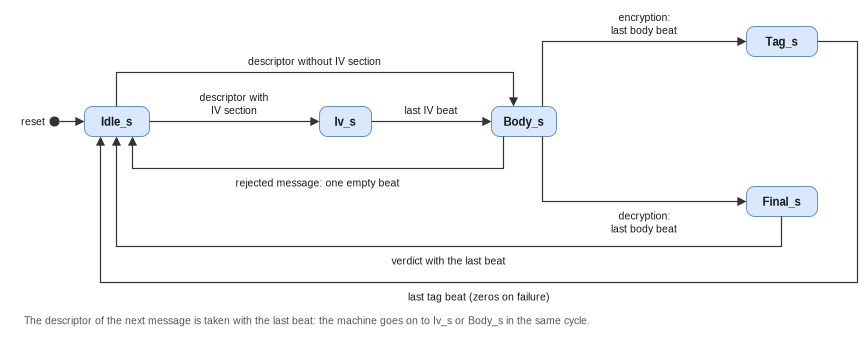
The stage loads one beat per cycle into its output register. An encryption emits its body beats directly and then the
16 tag bytes (zeros on failure, D12). A decryption holds one body beat back, so that the last beat with bytes carries
Last and the verdict; a decryption without any byte emits one empty beat. The descriptor of the next message is
taken in the cycle of the last beat of the previous message, so consecutive messages leave without a gap. The status
travels with the last beat in the output register and enters the status FIFO when the beat leaves; with the release
buffer, a message whose status is not OK is dropped (In_Drop with the last beat), and a message that the buffer
dropped because of its size reports OVERFLOW. The when others branch of the state machine returns to Idle_s.
7. Throughput
At 128 bits a message of n data blocks needs n + 1 AES blocks (J0), A + n + 1 GHASH blocks (the length block) and A + n + 1 output beats (the tag), so all three are balanced; the buffers between the stages absorb the latencies, and the bottleneck side transfers a beat in every cycle after an initial latency (GC-PF-01). At smaller widths the default numbers of AES units and the default GHASH digit leave room for the short and partial blocks of short messages (architecture D4, D5).