ocr_framer: Architecture
1. Structure
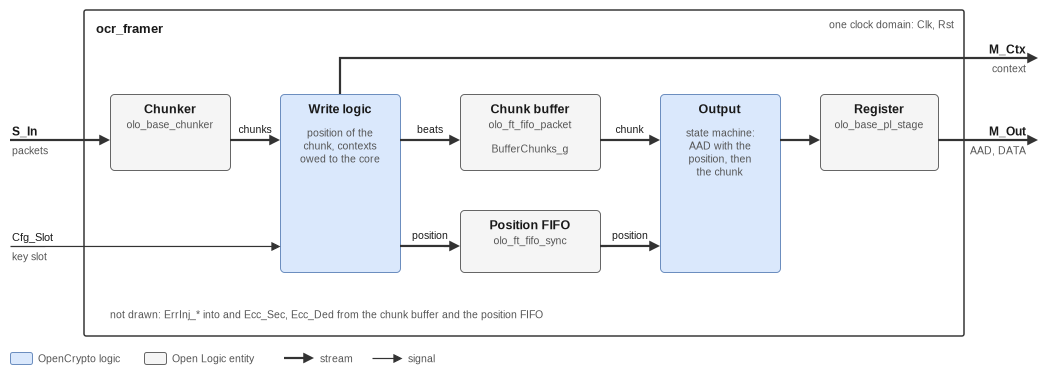
| Part | Function | Open Logic |
|---|---|---|
| Chunker | Cuts the input packets into chunks of ChunkBytes_g / B beats (B = DataWidth_g / 8): Last at the end of every chunk, InLast at the end of the packet; pass-through without latency |
olo_base_chunker |
| Write logic | Writes the beats with their byte enables into the chunk buffer and, with the last beat of a chunk, its position into the position FIFO; counts the contexts owed to the core | none |
| Chunk buffer | Store and forward of complete chunks: data and byte enables per word, BufferChunks_g chunks (power of two of words), up to 4 · BufferChunks_g chunks |
olo_ft_fifo_packet (SECDED) |
| Position FIFO | One position per complete chunk | olo_ft_fifo_sync (SECDED) |
| Output state machine | AAD beats with the position, then the beats of the chunk as DATA section | none |
| Output register | Cuts the path from the RAM and the ECC decoder of the buffer to the core | olo_base_pl_stage |
2. Chunk position
The position is known when the last beat of a chunk is written: the chunk is the first one of its packet when the
previous chunk ended a packet (or after the reset), and the last one when its last beat carries InLast. The
position is written into the position FIFO in the same cycle as the last beat into the chunk buffer, so a chunk is
complete in the buffer when its position is in the FIFO. Encoding (CCSDS sequence flags), bits 7:6 of AAD byte 0:
| First | Last | Position |
|---|---|---|
| yes | no | "01" |
| no | no | "00" |
| no | yes | "10" |
| yes | yes | "11" |
Because the AAD precedes the DATA section (GCM 7.1, input format of the core) and the last chunk of a packet is only known at its end, the framer cannot stream a chunk through: it buffers every chunk completely (FR-FN-04).
3. Output state machine
| State | Output | Next |
|---|---|---|
Idle_s |
none | Aad_s when the position FIFO holds a position (taken in this cycle) |
Aad_s |
AadBeats beats of the AAD section: position in bits 7:6 of byte 0, bytes 1 to 3 zero, byte enables of the 4 bytes | Data_s after the last AAD beat |
Data_s |
The beats of the chunk from the buffer as DATA section, Last with the last beat of the chunk |
Aad_s of the next chunk in the same cycle when its position is there, else Idle_s |
The when others branch returns an illegal state to Idle_s (D13).
4. Contexts
A context is owed to the core when the first beat of a chunk is written. M_Ctx_Valid is '1' while contexts are
owed; the core takes them ahead of the messages (it pairs the n-th context with the n-th message). The counter of
owed contexts is bounded: a chunk starts only when the counter has room (it never limits in operation, since the
core takes a context before it processes the message). The context is an encryption (M_Ctx_Decrypt = '0') with a
generated IV (M_Ctx_IvGen = '1', M_Ctx_Iv zero) of the slot Cfg_Slot.
5. Fault tolerance
| Location | Upset | Effect |
|---|---|---|
| Chunk buffer word | Single error | Corrected, Ecc_Sec(0) |
| Double error | The word leaves with the section code IV; the core fails the message (FORMAT), its tag is zero and its last beat carries the error flag; Ecc_Ded(0) |
|
| Position FIFO entry | Single error | Corrected, Ecc_Sec(1) |
| Double error | The AAD leaves with the section code IV; the core fails the message (FORMAT); Ecc_Ded(1) |
|
| Packet boundaries of the chunk buffer, state machine, counters | Any | Registers: protected by the TMR of the synthesis tool (D13, user guide, section 6); the reset recovers from any state |
The IV of a failed chunk is consumed, so a receiver sees a gap in the invocation counters of the correct chunks.
6. Timing and throughput
The output carries AadBeats more beats per chunk than the input. With the default buffer of two chunks the buffer frees a chunk only after it has been read completely, which costs about one more cycle per chunk; the input pauses at most AadBeats + 2 cycles per chunk while the outputs are always ready (FR-PF-01). A buffer of more chunks absorbs bursts but does not change the steady state, which the output rate sets. A chunk leaves after its last beat has been written (store and forward), behind its AAD beats and the output register.
In front of ocr_core the core sets the pace: it adds the IV and the tag to every chunk, so a chunk of n bytes
takes C(n) = ceil(12 / B) + AadBeats + ceil(n / B) + 16 / B cycles (plus one when n is not a multiple of B), and the
buffer of two chunks is enough to keep the core busy (FR-IN-02, user guide, section
7.2).