ocr_pkg: Architecture
1. Contents
| Group | Declarations |
|---|---|
| Types | Byte_t, Word_t, Block_t (bits 127:120 are byte 0), Section_t, Status_t |
| Codes | SecData_c "00", SecAad_c "01", SecTag_c "10", SecIv_c "11"; StsOk_c 0 to StsOverflow_c 8 |
| Precedence | stsPrio, stsMerge |
| AES parameters | aesNk, aesNr, aesDefaultUnits, aesMinUnits, ghashDefaultDigit |
| AES transformations | aesSbox, aesSubBytes, aesShiftRows, aesXtime, aesMixColumns, aesRound, aesSubWord, aesRotWord, aesRcon |
| Key expansion | AesKeyCtl_t, aesKeyCtl, aesKeyCtlTable, aesKeyStep, aesKeyFirst |
| GF(2128) | gfMulDigit, gfMul |
| Byte order | blockByte, blockToBeat, beatToBlock, keepOf |
2. AES
The S-box is a constant table of 256 bytes (FIPS 197 Figure 7); synthesis maps it to logic or ROM. ShiftRows is a
fixed permutation of the 16 bytes, MixColumns four instances of the column multiplication with aesXtime.
aesRound composes one round; the round units of the AES engine call it once per clock cycle.
3. Key expansion on the fly
A window holds the last Nk words of the expansion, the oldest word in the leftmost bits; its last four words are the round key of the next round.
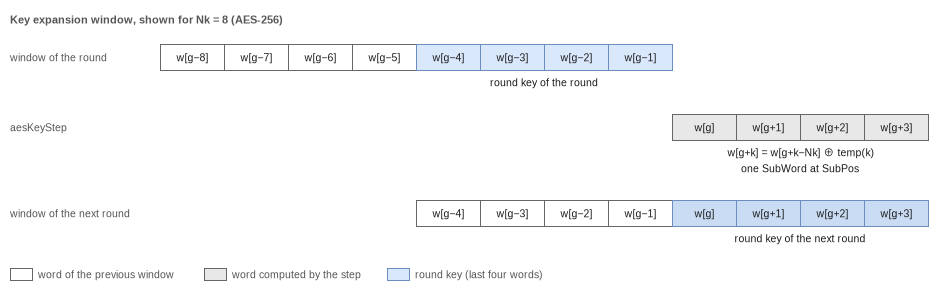
aesKeyStep first chains the four words with XOR only. The one SubWord of the step adds a difference at position
SubPos; because every following word XORs its predecessor, the same difference appears in all later words of the
step. The step therefore needs one SubWord (four S-boxes) and a 4:1 multiplexer for its input. aesKeyCtl(Nk, g)
gives the position, the RotWord flag and the Rcon value of the step that produces w[g] to w[g + 3];
aesKeyCtlTable tabulates them for the rounds, so that a round unit selects the control of its round from a constant
table. aesKeyFirst returns the window of round 1: for Nk = 4 one step, for Nk = 6 the two words w[6] and w[7], for
Nk = 8 the key itself.
4. GF(2128)
gfMulDigit works on polynomials with the coefficient of ui at index i (the block seen with an ascending
range). It adds z · uD and the product of the D-bit digit with h, then reduces the coefficients of degree
128 to 127 + D from the top with u128 = u7 + u2 + u + 1. A product X · H with
digits of D bits is the Horner scheme over the digits of X from the highest degree (the rightmost D bits of the block)
to the lowest; gfMul is the case D = 128.
5. Byte order
Byte lane j of beat k of a stream with B bytes per beat holds byte k · B + j of a block. blockToBeat and
beatToBlock are wiring only.