ocan_pdo: Architecture and Design Description
1. Block diagram
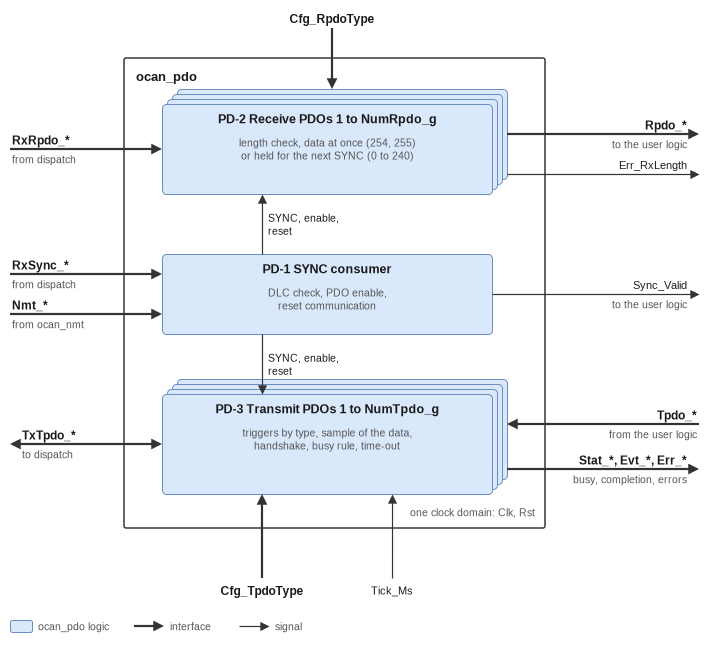
ocan_pdo is one entity with a two-process design. The SYNC check is shared; each receive PDO has an output register
and a register for the data held for the next SYNC; each transmit PDO has its own trigger, data register and transmit
state machine. Every event is processed in the clock cycle in which it arrives, so that an event is taken in any
cycle (D11). The vectors of the ports carry PDO n (1 to 4) in bit n - 1 and in bits 64 n - 1 downto 64 (n - 1), as
the ports of ocan_dispatch; the bits of the PDOs above NumRpdo_g and NumTpdo_g are outputs at 0 and inputs
that are not used.
2. SYNC (PD-1)
SyncOk is RxSync_Valid with RxSync_Dlc 0 or 1 (PD-SY-01). The register SyncEvt is SyncOk of the previous
cycle and is the port Sync_Valid (PD-SY-02). The counter byte of a SYNC is not an input of ocan_pdo.
Nmt_EnaPdo and Nmt_ResetComm act in the cycle in which they are present. Stat_PdoEnabled is Nmt_EnaPdo
of the same cycle (a register output of ocan_nmt), so that a request of the user logic in a cycle with
Stat_PdoEnabled = '0' is one without effect (PD-IF-07, PD-RS-01):
Nmt_EnaPdo= '0': no receive PDO is processed, no transmit PDO requested, the held data and the waiting requests of transmission type 0 are cleared in every such cycle (PD-RS-01, PD-RS-02). The SYNC counts continue.Nmt_ResetComm= '1': the SYNC counts and the type registers restart, the held data and the waiting requests are cleared, and a receive PDO event of the cycle is not processed (PD-RS-03).
3. Receive PDOs (PD-2)
Registers per receive PDO n: RxOut (64 bits, the port Rpdo_Data), RxEvt (the port Rpdo_Valid), Hold
(64 bits) and HoldV (data held for the next SYNC).
A receive PDO event with the number of PDO n is processed with the transmission type T of Cfg_RpdoType in that
cycle (PD-RX-06), when Nmt_EnaPdo is '1' and Nmt_ResetComm is '0':
| Condition | Action |
|---|---|
RxRpdo_Dlc below 8, for every T |
Err_RxLength of PDO n (PD-RX-02) |
| T = 254 or 255 | RxOut := the data, RxEvt := '1' (PD-RX-03) |
| T = 0 to 240 | Hold := the data, HoldV := '1' (PD-RX-04) |
| T = 241 to 253 | None (PD-RX-05) |
At SyncOk with Nmt_EnaPdo = '1' and Nmt_ResetComm = '0', every receive PDO with HoldV = '1' takes
RxOut := Hold and RxEvt := '1', and HoldV is cleared, whatever its type is now (PD-RX-04). The SYNC acts
before the receive PDO event of the same cycle, so that such an event is held for the next SYNC (PD-RX-06); an
event-driven PDO of that cycle overwrites the data passed at the SYNC. A held PDO that a further PDO of the same
number replaces before the SYNC is lost without an event: the last value is passed.
RxOut keeps its value until the next pass of its PDO and at the NMT resets (PD-RX-07, PD-RS-03); the hardware
reset clears it (PD-RS-04).
4. Transmit PDOs (PD-3)
4.1 Triggers
Registers per transmit PDO n: SyncCnt (8 bits), TypeReg (8 bits, the type of the previous cycle) and ReqPend (a
request of the user logic that waits for the SYNC). T is the transmission type of Cfg_TpdoType.
| T | The PDO falls due | Data sampled |
|---|---|---|
| 1 to 240 | At SyncOk with SyncCnt >= T - 1, which also clears SyncCnt; any other SyncOk increments SyncCnt (PD-TX-02) |
Tpdo_Data in the cycle of the SYNC event |
| 0 | At SyncOk with ReqPend = '1' (PD-TX-03) |
Tpdo_Data in the cycle of the SYNC event |
| 254, 255 | At Tpdo_Req = '1' (PD-TX-04) |
Tpdo_Data in the cycle of the request |
| 241 to 253 | Never (PD-TX-05) | - |
SyncCntandReqPendare cleared after the hardware reset, atNmt_ResetCommand when T differs fromTypeReg; a SYNC in the cycle of one of these events is not counted and makes no PDO due (PD-TX-02). The compare with >= ends a count above T - 1 after an upset at the next SYNC.Nmt_ResetCommand a change of T clear only the state of the previous cycles: aTpdo_Reqof the same cycle acts with T of that cycle, so that with T = 0 it setsReqPendand with T = 254 or 255 the PDO falls due (PD-TX-03). A request withStat_PdoEnabled= '1' is therefore never lost without an event.ocan_timediffers here: a request in the cycle of these events has no effect there (architecture ofocan_time, section 5.1), a known difference. In the system the reset communication is without a request in any case:ocan_nmtclears the PDO enable in that cycle.ReqPendis set byTpdo_Reqwith T = 0 andNmt_EnaPdo= '1'. In the cycle of aSyncOkthe PDO falls due with theReqPendof the previous cycles, and aTpdo_Reqof that cycle setsReqPendfor the next SYNC (PD-TX-03).ReqPendis cleared when the PDO falls due, when T is not 0 and whileNmt_EnaPdois '0'.- A PDO that falls due while
Nmt_EnaPdois '0' is not requested and raises no event (PD-RS-01).
4.2 Request and handshake
Registers per transmit PDO n: the state TxSt, the frame data TxData (64 bits, the port TxTpdo_Data) and the
tick count TxTmo (8 bits). TxTpdo_Dlc is 8 (PD-TX-01).
TxSt |
TxTpdo_Valid |
Exit |
|---|---|---|
TIdle_s |
'0' | The PDO falls due: TxData := the sampled data, to TReq_s |
TReq_s |
'1' | TxTpdo_Ready with TxTpdo_Aborted (reject path of ocan_dispatch): Evt_TpdoAborted, to TIdle_s. TxTpdo_Ready alone: TxTmo := 0, to TWait_s |
TWait_s |
'0' | TxTpdo_Done: Evt_TpdoSent, to TIdle_s. TxTpdo_Aborted: Evt_TpdoAborted, to TIdle_s. At a tick with TxTmo >= 255: Err_TxTimeout, to TIdle_s (PD-TX-08); at another tick TxTmo is incremented |
- A request is pending from
TReq_suntil the completion or the time-out;Stat_TpdoBusyis '1' outsideTIdle_s. A PDO that falls due while its request is pending is not requested and pulsesErr_TxBusy; one that falls due in the cycle of the completion (the reject path included) goes toTReq_swith the new data (PD-TX-07). - In
TReq_sneitherTxTpdo_ValidnorTxDatachange untilTxTpdo_Ready(PD-TX-07). The wait is bounded byocan_dispatch: a pending request is granted after at most one frame of each other source (DS-TX-06), and is completed as aborted when the PDO enable clears (DS-TX-04) or the controller of the active bus stops (DS-TX-08). ocan_dispatchdoes not grant a source in the cycle of its own completion (DS-TX-03): the late completion of a timed-out frame arrives inTIdle_s, or inTReq_swithoutTxTpdo_Ready, and is ignored. An aborted PDO and a PDO after the time-out are not repeated (PD-TX-08, PD-TX-09).- The
when othersbranch ofTxStleads toTIdle_s.
Each transmit PDO has its own TxTmo, so that a lost completion of one PDO does not affect another one, whatever
ocan_dispatch holds.
5. Protection
ocan_pdo holds no parameter of its own: the transmission types are protected in ocan_od (two copies, OD-PR-03)
and the COB-IDs in ocan_dispatch (DS-CP-01). It has therefore no test inputs. Its registers are covered by the
protection scope of the user guide (TMR of the synthesis tool). Without that TMR an upset of a register gives at
most:
TxSttoTWait_s: the time-out of PD-TX-08 ends the wait; toTReq_s: one frame with the content ofTxData; to an unused code:TIdle_s(when others);SyncCntabove T - 1: the PDO falls due at the next SYNC (>=);HoldV,ReqPend: one pass ofHoldor one PDO at the next SYNC;TxTmo: an earlier end of the wait.
No upset of a single register silences ocan_pdo: every state ends by itself or at the next event.
6. Ports of ocan_pdo
| Signal | Direction | Width | Default | Description |
|---|---|---|---|---|
Clk, Rst |
In | 1 | - | Clock and synchronous high-active reset |
Tick_Ms |
In | 1 | - | Tick every millisecond |
RxSync_Valid, RxSync_Dlc |
In | 1, 4 | - | SYNC of ocan_dispatch |
RxRpdo_Valid, RxRpdo_Num, RxRpdo_Dlc, RxRpdo_Data |
In | 1, 2, 4, 64 | - | Receive PDO of ocan_dispatch (number n - 1) |
TxTpdo_Valid, TxTpdo_Ready, TxTpdo_Dlc, TxTpdo_Data, TxTpdo_Done, TxTpdo_Aborted |
Out, In, Out, Out, In, In | 4, 4, 16, 256, 4, 4 | - | Transmit PDOs to ocan_dispatch |
Cfg_RpdoType, Cfg_TpdoType |
In | 32, 32 | - | Transmission types of ocan_od, PDO n in bits 8 n - 1 downto 8 (n - 1) |
Nmt_EnaPdo, Nmt_ResetComm |
In | 1 | - | From ocan_nmt |
Sync_Valid |
Out | 1 | - | SYNC event to the user logic (PD-SY-02) |
Rpdo_Valid, Rpdo_Data |
Out | 4, 256 | - | Receive PDOs to the user logic: the event and the data last passed |
Tpdo_Req, Tpdo_Data |
In | 4, 256 | 0 | Transmit PDOs of the user logic: the request and the data |
Stat_TpdoBusy |
Out | 4 | - | A request of the transmit PDO is pending (PD-TX-07) |
Stat_PdoEnabled |
Out | 1 | - | The PDO enable as ocan_pdo uses it (PD-IF-07) |
Evt_TpdoSent, Evt_TpdoAborted |
Out | 4 | - | Completion of a transmit PDO (PD-TX-09) |
Err_RxLength, Err_TxBusy, Err_TxTimeout |
Out | 4 | - | Events of PD-RX-02, PD-TX-07 and PD-TX-08 |
7. Timing and behaviour
| Operation | Duration |
|---|---|
Receive PDO event (types 254, 255) to Rpdo_Valid |
1 clock cycle |
SYNC event to Rpdo_Valid of the held data, to Sync_Valid |
1 clock cycle |
SYNC event to TxTpdo_Valid (types 0 to 240) |
1 clock cycle |
Tpdo_Req to TxTpdo_Valid (types 254, 255) |
1 clock cycle |
| Taken transmit PDO without completion | 256 ticks to Err_TxTimeout |
With the fixed latency of ocan_link and ocan_dispatch (DS-RX-05) the data of the synchronous receive PDOs reach
the user logic, and the data of the synchronous transmit PDOs are sampled, a fixed time after the end of the SYNC
frame, the same on both buses.