olo_base_arb_prio
Status Information
VHDL Source: olo_base_arb_prio
Description
This entity implements a priority arbiter. The left-most bit (highest bit) of the request vector that was asserted is granted (i.e. asserted in the grant vector). The arbiter is implemented using the very logic-and timing-efficient parallel prefix computation approach.
The arbiter can be implemented with or without an output registers. The waveform below shows its implementation with and without output register (Latency_g = 0 resp. 1).

Generics
| Name | Type | Default | Description |
|---|---|---|---|
| Width_g | positive | - | Number of requesters (number of bits in In_Req and Out_Grant vectors) |
| Latency_g | natural | 1 | Number of output registers (0 means combinatorial output) |
Interfaces
Control
| Name | In/Out | Length | Default | Description |
|---|---|---|---|---|
| Clk | in | 1 | - | Clock |
| Rst | in | 1 | - | Reset input (high-active, synchronous to Clk) |
Input Data
| Name | In/Out | Length | Default | Description |
|---|---|---|---|---|
| In_Req | in | Width_g | - | Request vector. The highest (left-most) bit has highest priority. |
Output Data
| Name | In/Out | Length | Default | Description |
|---|---|---|---|---|
| Out_Grant | out | Width_g | N/A | Grant output signal |
Architecture
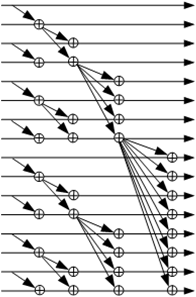
Parallel prefix computation is used to calculate a vector that contains a '1' on the highest-priority bit that was asserted and on all bits with lower priority. The vector then looks for example like this "0001111". The bit to assert in the Grant output can then be determined by finding the 0-1 edge inside that vector.
The figure below shows the parallel prefix computation graphically.