olo_base_pl_stage
Status Information
VHDL Source: olo_base_pl_stage
Description
This entity implements multiple pipeline stages with handshaking (AXI-S Ready/Valid). The pipeline stage ensures all signals are registered in both directions (including Ready). This is important to break long logic chains that can occur in the Ready paths because Ready is often forwarded asynchronously.
olo_base_pl_stage is used for two main cases:
- Breaking long logic paths into several sections, each one having a propagation time shorter than the clock period. In this case olo_base_pl_stage usually is configured for Stages_g=1.
- Adding multiple register stages for long routing paths. In this case olo_base_pl_stage usually is configured for Stages_g>1.
Generics
| Name | Type | Default | Description |
|---|---|---|---|
| Width_g | positive | - | Number of bits per FIFO entry (word-width) |
| Stages_g | natural | 1 | Number of register stages to implement |
| UseReady_g | boolean | true | Support for backpressure only is implemented if this generic is set to true |
Interfaces
Control
| Name | In/Out | Length | Default | Description |
|---|---|---|---|---|
| Clk | in | 1 | - | Clock |
| Rst | in | 1 | - | Reset input (high-active, synchronous to Clk) |
Input Data
| Name | In/Out | Length | Default | Description |
|---|---|---|---|---|
| In_Data | in | Width_g | - | Input data |
| In_Valid | in | 1 | '1' | AXI4-Stream handshaking signal for In_Data |
| In_Ready | out | 1 | N/A | AXI4-Stream handshaking signal for In_Data |
Output Data
| Name | In/Out | Length | Default | Description |
|---|---|---|---|---|
| Out_Data | out | Width_g | N/A | Output data |
| Out_Valid | out | 1 | N/A | AXI4-Stream handshaking signal for Out_Data |
| Out_Ready | in | 1 | '1' | AXI4-Stream handshaking signal for Out_Data |
Architecture
The architecture for UseReady_g=false is straightforward. The figure below shows an example for 3 stages.
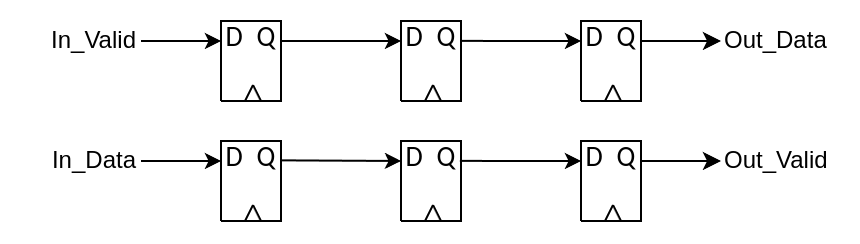
Note that synthesis attributes are set to avoid registers being merged into shift-registers. Implementation as FFs is guaranteed.
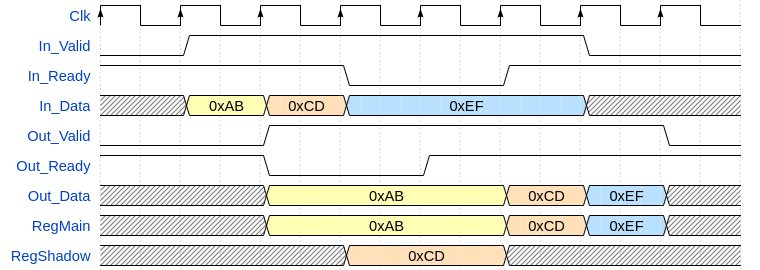
For UseReady_g=true, the architecture is less straightforward. In this case, the registering of the Ready path makes a shadow register (red) required for each stage. This shadow register is used for absorbing one more word of data during the additional clock-cycle of delay on the Ready path being added by the register in case the main register (blue) already contains data. Once the main register becomes free, data is transferred back from the shadow register to the main register.
The presence of a shadow register makes the pipeline stage not only a register stage but actually a two entries FIFO. The architecture chosen ensures that every output is directly driven by a FF to ensure optimal timing performance.
The figure below shows an example for 1 stage. The logic is then replicated per stage.

The requirement for a shadow register is depicted by below waveform.