olo_ft_fifo_sync
Status Information
VHDL Source: olo_ft_fifo_sync
Description
This component implements an ECC-protected synchronous FIFO using SECDED (Single Error Correction, Double Error Detection) Hamming code. The interface and behavior match olo_base_fifo_sync.
The ECC is transparent to the user: data is automatically encoded on write and decoded/corrected on read. Error status flags indicate whether a single-bit error was corrected or a double-bit error was detected.
Generics
| Name | Type | Default | Description |
|---|---|---|---|
| Width_g | positive | - | Number of data bits per FIFO entry. The internal FIFO is wider to accommodate ECC parity bits. |
| Depth_g | positive | - | Number of entries the FIFO has |
| AlmFullOn_g | boolean | false | Enable almost-full flag |
| AlmFullLevel_g | natural | 0 | Almost-full threshold level |
| AlmEmptyOn_g | boolean | false | Enable almost-empty flag |
| AlmEmptyLevel_g | natural | 0 | Almost-empty threshold level |
| RamStyle_g | string | "auto" | Controls the RAM implementation resource |
| RamBehavior_g | string | "RBW" | Controls the RAM behavior. "RBW" or "WBR" |
| ReadyRstState_g | std_logic | '1' | Value of In_Ready during reset. Behaves exactly as in olo_base_fifo_sync. |
Interfaces
Clock and Reset
| Name | In/Out | Length | Default | Description |
|---|---|---|---|---|
| Clk | in | 1 | - | Clock |
| Rst | in | 1 | - | Reset (high-active, synchronous to Clk). Empties the FIFO and clears the internal error-injection latch. |
Input Data
| Name | In/Out | Length | Default | Description |
|---|---|---|---|---|
| In_Data | in | Width_g | - | Input data |
| In_Valid | in | 1 | '1' | Input valid (AXI-S handshaking) |
| In_Ready | out | 1 | N/A | Input ready (AXI-S handshaking) |
| In_Level | out | ceil(log2(Depth_g+1)) | N/A | Input-side fill level |
Output Data
| Name | In/Out | Length | Default | Description |
|---|---|---|---|---|
| Out_Data | out | Width_g | N/A | Output data (corrected if a single-bit error was detected) |
| Out_Valid | out | 1 | N/A | Output valid (AXI-S handshaking) |
| Out_Ready | in | 1 | '1' | Output ready (AXI-S handshaking) |
| Out_Level | out | ceil(log2(Depth_g+1)) | N/A | Output-side fill level |
| Out_EccSec | out | 1 | N/A | Single error corrected flag. Time-aligned with Out_Data. |
| Out_EccDed | out | 1 | N/A | Double error detected flag. Read data is unreliable. Time-aligned with Out_Data. |
Status
| Name | In/Out | Length | Default | Description |
|---|---|---|---|---|
| Full | out | 1 | N/A | FIFO is full |
| AlmFull | out | 1 | N/A | FIFO is almost full |
| Empty | out | 1 | N/A | FIFO is empty |
| AlmEmpty | out | 1 | N/A | FIFO is almost empty |
Error Injection (optional)
These ports drive the internal olo_ft_ecc_encode instance. Leave them unconnected for normal operation; see Open Logic Fault-Tolerance Principles - Error Injection for the latched-strobe semantics shared across the ft area.
| Name | In/Out | Length | Default | Description |
|---|---|---|---|---|
| In_ErrInj_BitFlip | in | eccCodewordWidth(Width_g) | all 0 | Codeword-wide flip pattern. Each '1' bit XORs (flips) the corresponding bit of the stored codeword. Popcount 1 = SEC-correctable, popcount 2 = DED-detectable. |
| In_ErrInj_Valid | in | 1 | '0' | Strobe that latches In_ErrInj_BitFlip into the encoder's pending-injection register. The latched pattern is applied to the next accepted input beat. |
Detailed Description
Architecture
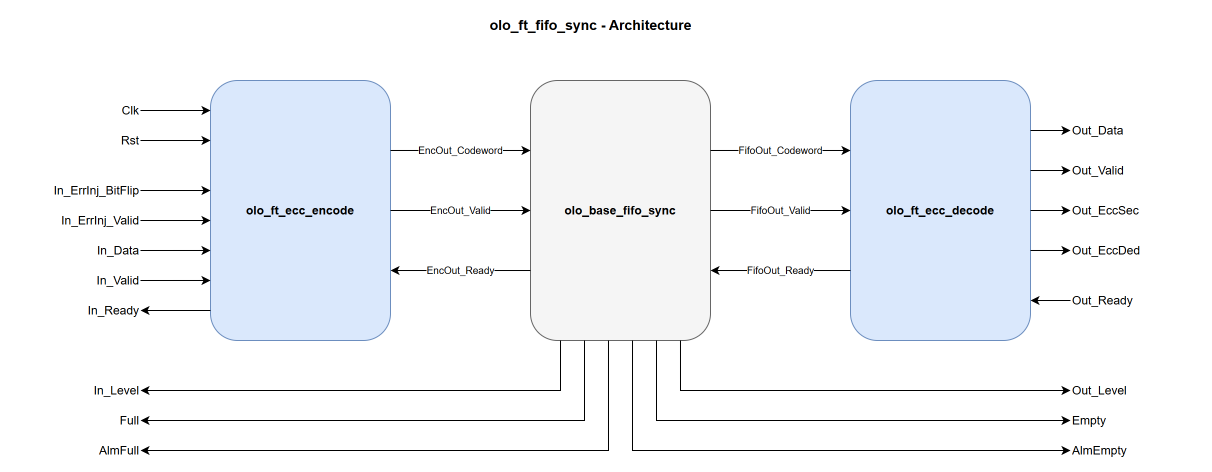
The entity is composed of three Open Logic entities:
- olo_ft_ecc_encode encodes each accepted input beat into a SECDED codeword.
- olo_base_fifo_sync stores the codeword (entity configured with a codeword-wide word). All levels and status flags come directly from it.
- olo_ft_ecc_decode decodes and corrects each beat on the read side and drives Out_EccSec / Out_EccDed time-aligned with Out_Data.
The codeword is protected end-to-end while it is inside the FIFO: encoding happens before, and decoding after, all storage elements.
See olo_base_fifo_sync for detailed FIFO behavior.
Note that the ECC FIFOs deliberately come without a scrubber, unlike the ECC RAMs (olo_ft_ram_sp_scrub, olo_ft_ram_sdp_scrub). A FIFO does not store data permanently, so as long as it is drained regularly, errors do not accumulate in a word over time and there is nothing for a background scrubber to repair.
Combinational ECC Encoder and Decoder
Both codecs are instantiated with Pipeline_g = 0. The datapath to and from the internal FIFO is
therefore combinational, and the ft entity behaves exactly like its
olo_base_fifo_sync counterpart.
The ECC decode lies between the RAM output and the output ports and is the critical path of the entity. Where it limits the clock frequency, use olo_base_fifo_sync directly and place registered olo_ft_ecc_encode / olo_ft_ecc_decode instances around it in the surrounding design. The levels and status flags of the base FIFO then do not account for the beats held in the codec pipelines.
ECC Overhead, Error Injection and Status Flags
See the corresponding sections in Open Logic Fault-Tolerance Principles:
- ECC Overhead - internal storage width vs. data width
- Error Injection - semantics of In_ErrInj_BitFlip / In_ErrInj_Valid
- Error Status Flags - meaning of Out_EccSec / Out_EccDed
Constraints
See
Open Logic Fault-Tolerance Principles - Constraints That Apply Across the Area
for the constraints that apply across the ft area. No additional olo_ft_fifo_sync-specific constraints
apply.