olo_base_crc_check
Status Information
VHDL Source: olo_base_crc_check
Description
This component does check the CRC contained in AXI4-Stream packets as last word. It is meant to be used together with olo_base_crc_append to CRC protect any data stream.
olo_base_crc_check has two modes of operation (Mode_g). In Mode_g="DROP" any packets with CRC errors are dropped
(i.e. they do not appear on the output). In this mode the component contains a packet FIFO. In Mode_g="FLAG", all
packets appear at the output but packets with CRC errors are flagged (with Out_CrcErr in the last data beat).

The CRC appended to the packet must be smaller or equal to the width of the data stream (DataWidth_g).
CRC settings are identical to olo_base_crc, please refer to the documentation of olo_base_crc for details. The CRC is calculated over all data words except the last one which contains the CRC itself.
Important Note: Packets without any data, only containing a CRC, are not handled and might lead to undefined behavior.
Below waveform shows an example use-case in DROP mode without any CRC errors.
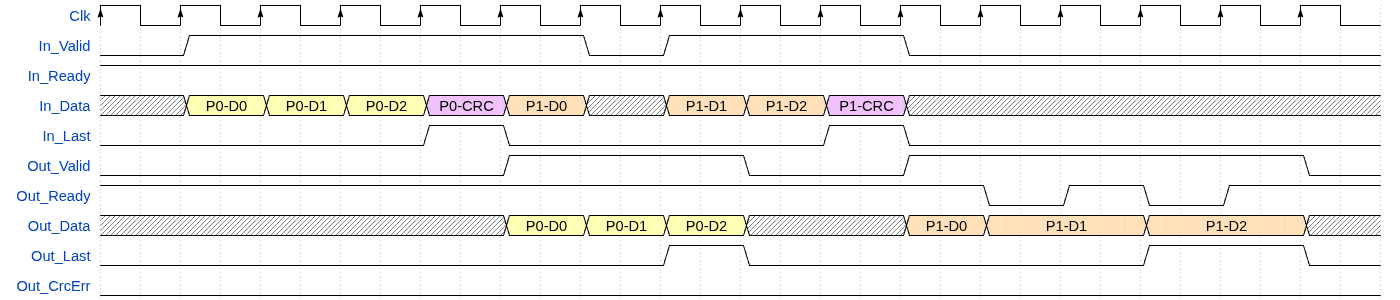
Note that the exact latency might be different (this applies to all figures). The important point in the figure are:
- There is one bubble cycle per packet in the output stream (when CRC is checked)
- There are no bubble cycles in the input stream
- Input and output support full AXI4-Stream handshaking (Ready/Valid)
- The packet is only presented to the output after it wass fully received and the CRC check was successful
Details about DROP mode
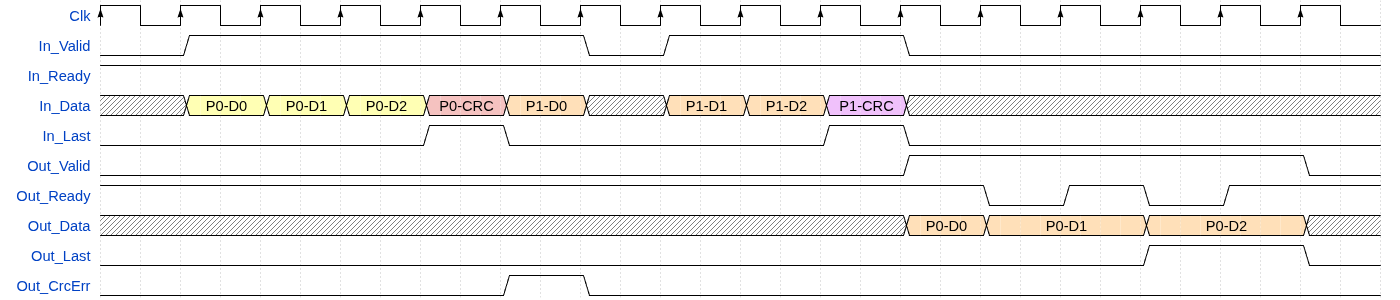
In DROP mode a olo_base_fifo_packet is used to drop packets with CRC errors. Because the CRC can only be checked once it arrived, the first word of a packet is only presented on the output once the full packet was received. Hence the latency is higher compared to the FLAG mode.
The presence of the FIFO also implies that backpressure is forwarded to the input only once the FIFO is full.
Failed CRC checks (red CRC in below figure) lead to the whole packet being dropped and Out_CrcErr being pulsed high for exactly one clock cycle.
Important: Out_CrcErr in this mode is NOT handshaked with Out_Ready and Out_Valid but a single cycle pulse.
Details about FLAG mode
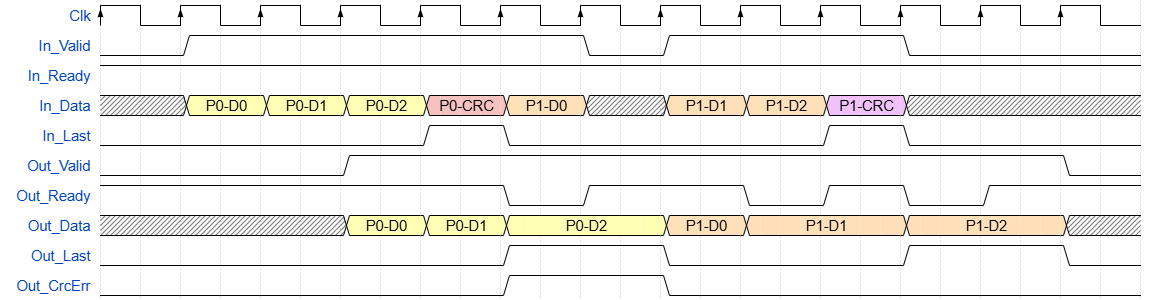
Failed CRC checks (red CRC in below figure) lead to the last word of the packet being flagged with _Out_CrcErr.
Note that in FLAG mode, the packet is presented at the output while it still is received, because no packet FIFO is present.
Out_CrcErr in this mode IS handshaked with Out_Ready and Out_Valid but a single cycle pulse.
Generics
| Name | Type | Default | Description |
|---|---|---|---|
| DataWidth_g | positive | - | Data width of the data stream |
| Mode_g | string | "DROP" | DROP - drop packets with CRC errors FLAG keep, but flag packets with CRC errors |
| FifoDepth_g | positive | 1024 | Depth of the internal packet FIFO (in number of data words). Must be at least 2 x maximum packet size for optimal performance. Not used for Mode_g=FLAG. |
| FifoRamStyle_g | string | "auto" | Resource to use for packet FIFO RAM implementation in DROP mode. For details refer to the description in olo_base_ram_sdp. Not used for Mode_g=FLAG. |
| FifoRamBehavior_g | string | "RBW" | Behavior of the packet FIFO RAM in DROP mode. For details refer to the description in olo_base_ram_sdp. Not used for Mode_g=FLAG. |
| CrcPolynomial_g | std_logic_vector | - | See olo_base_crc |
| CrcInitialValue_g | std_logic_vector | all '0' | See olo_base_crc |
| CrcBitOrder_g | string | "MSB_FIRST" | See olo_base_crc |
| CrcByteOrder_g | string | "NONE" | See olo_base_crc |
| CrcBitflipOutput_g | boolean | false | See olo_base_crc |
| CrcXorOutput_g | std_logic_vector | all '0' | See olo_base_crc |
Note: For cases where no exact CRC specification must be followed (for user defined protocols) it is suggested to leave the following generics on their default value. These generics are only used to match exact CRC specifications
- CrcXorOutput_g
- CrcBitflipOutput_g
- CrcByteOrder_g
- CrcBitOrder_g
- CrcInitialValue_g
Interfaces
Control
| Name | In/Out | Length | Default | Description |
|---|---|---|---|---|
| Clk | in | 1 | - | Clock |
| Rst | in | 1 | - | Reset input (high-active, synchronous to Clk) |
Input Data
| Name | In/Out | Length | Default | Description |
|---|---|---|---|---|
| In_Data | in | DataWidth_g | - | Input data |
| In_Valid | in | 1 | '1' | AXI4-Stream handshaking signal for In_Data |
| In_Ready | out | 1 | N/A | AXI4-Stream handshaking signal for In_Data |
| In_Last | in | 1 | - | AXI4-Stream packet end signaling for In_Data |
Output Data
| Name | In/Out | Length | Default | Description |
|---|---|---|---|---|
| Out_Data | out | DataWidth_g | N/A | Output data |
| Out_Valid | out | 1 | N/A | AXI4-Stream handshaking signal for Out_Data |
| Out_Ready | in | 1 | '1' | AXI4-Stream handshaking signal for Out_Data |
| Out_Last | out | 1 | N/A | AXI4-Stream packet end signaling for Out_Data |
| Out_CrcErr | out | 1 | N/A | Asserted on CRC errors. See Description. |
Architecture
The architecture is relatively trivial thanks to the already existing olo_base_crc and olo_base_fifo_packet components. Note that the packet FIFO is operated in DROP_ONLY mode for minimal resource usage and to avoid any limitation of the maximum packet count supported.
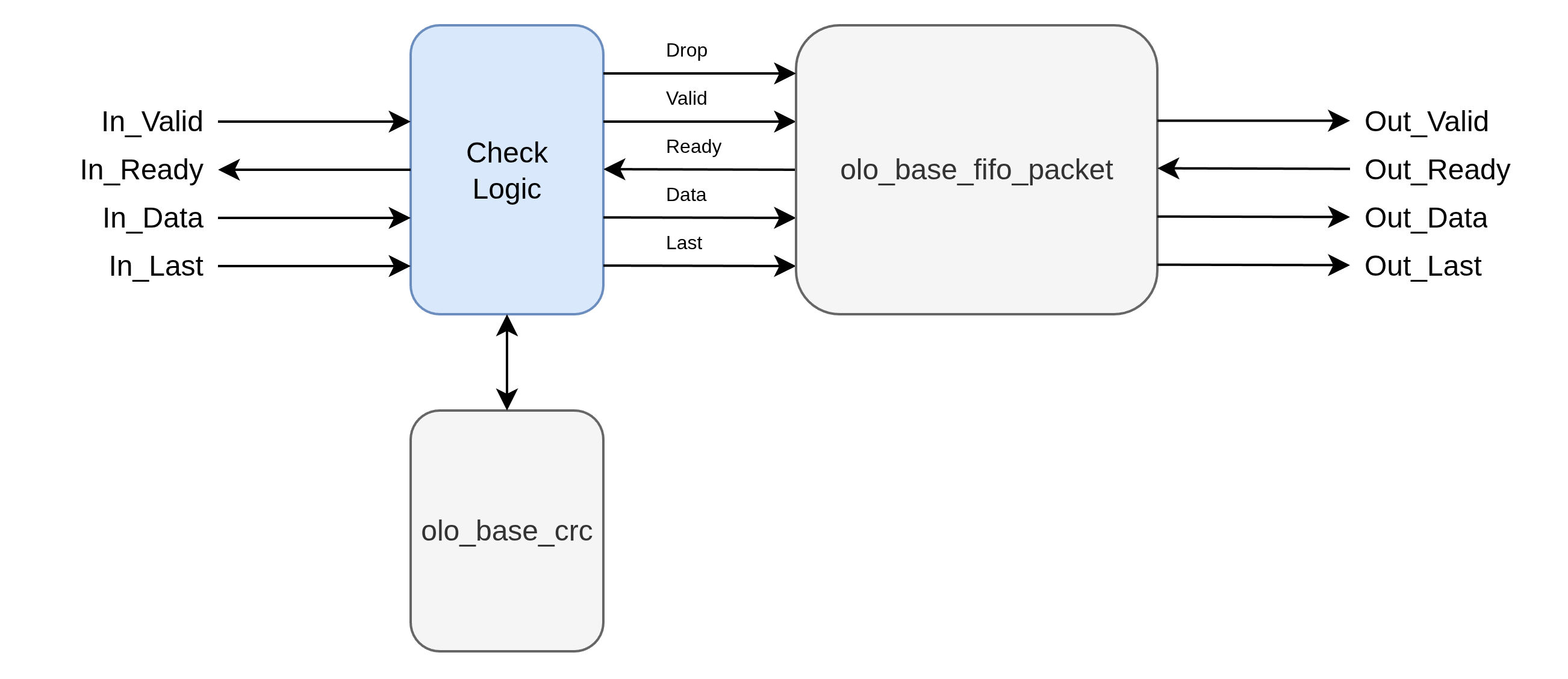
The check logic simply asserts the Drop signal to the packet FIFO when the CRC at the end of a packet does not match the CRC calculated by olo_base_crc.
Above figure applies for the DROP mode. In FLAG mode, the olo_base_fifo_packet is simply replaced by a olo_base_pl_stage and the drop signal is not used to drop packets but as data-flag (CrcErr) and forwarded to the output.