olo_base_stream_join
Status Information
VHDL Source: olo_base_stream_join
Description
This entity packs the valid bytes of an AXI4-Stream. An input beat may carry fewer bytes than the bus width; the output carries the bytes of each packet in their order without gaps. Every output beat is full except the last beat of a packet.
Usage examples:
- Joining the buffers of a DMA packet: each buffer is read starting in lane 0 with a partial last beat, the entity closes the gaps between the buffers.
- Removing the empty lanes of a stream whose beats are only partly filled.
olo_base_stream_split is the counterpart that cuts packets into segments.
Byte Enables
In_Be marks the valid bytes of every input beat. They must be contiguous from lane 0 (bit 0 first, no gaps), and any number from 0 to Width_g/8 is allowed. Unlike the Trailing-Only Byte-Enable convention (see Conventions), any beat may be partial or empty. An empty beat with In_Last only ends the packet (closing beat).
The output follows the Trailing-Only Byte-Enable convention with one exception: a packet without any byte (only empty beats) gives one beat with Out_Be all '0' and Out_Last = '1', so that every input packet results in one output packet. Data lanes with Out_Be = '0' are zero.
Timing
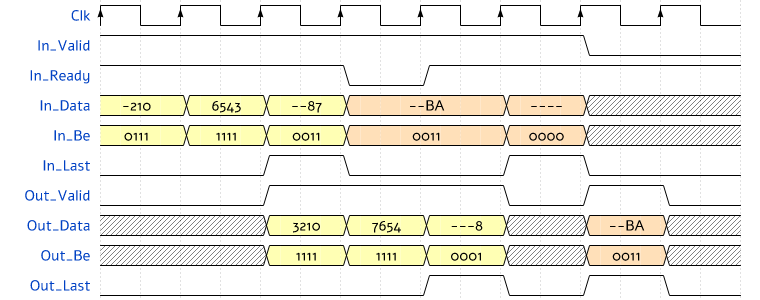
The entity takes one input beat per clock cycle. When the last beat of a packet leaves more bytes than fit into one output beat, the entity outputs two beats and inserts one clock cycle with In_Ready = '0'. So at most one cycle is inserted per packet.
An output beat is sent only when more than one beat of bytes is available or the packet ends. Up to Width_g/8 bytes are held until the next input beat shows whether the packet continues. This keeps the last output beat of a packet non-empty even if the packet ends with an empty closing beat. On an aligned stream (full input beats), an output beat therefore follows one input beat later.
The outputs are registered. In_Ready depends on Out_Ready within the clock cycle. Rst clears the held bytes at any time.
The example below (Width_g = 32) shows a packet of 9 bytes in beats of 3, 4 and 2 bytes, then a packet of 2 bytes closed by an empty beat. Digits and letters stand for the bytes (lane 3 left), '-' for lanes without a valid byte.
Generics
| Name | Type | Default | Description |
|---|---|---|---|
| Width_g | positive | - | Data width in bits, a multiple of 8 (8 to 1024) |
Interfaces
Control
| Name | In/Out | Length | Default | Description |
|---|---|---|---|---|
| Clk | in | 1 | - | Clock |
| Rst | in | 1 | - | Reset input (high-active, synchronous to Clk) |
Input Data
| Name | In/Out | Length | Default | Description |
|---|---|---|---|---|
| In_Data | in | Width_g | - | Input data |
| In_Be | in | Width_g/8 | all '1' | Valid bytes of the beat, contiguous from lane 0 (all '0' allowed) |
| In_Valid | in | 1 | '1' | AXI4-Stream handshaking signal for In_Data |
| In_Ready | out | 1 | N/A | AXI4-Stream handshaking signal for In_Data |
| In_Last | in | 1 | '0' | AXI4-Stream end of packet signaling for In_Data |
Output Data
| Name | In/Out | Length | Default | Description |
|---|---|---|---|---|
| Out_Data | out | Width_g | N/A | Output data (lanes without a valid byte are zero) |
| Out_Be | out | Width_g/8 | N/A | Output byte enables (Trailing-Only, all '0' only for an empty packet) |
| Out_Valid | out | 1 | N/A | AXI4-Stream handshaking signal for Out_Data |
| Out_Ready | in | 1 | '1' | AXI4-Stream handshaking signal for Out_Data |
| Out_Last | out | 1 | N/A | AXI4-Stream end of packet signaling for Out_Data |
Architecture
The entity keeps the bytes not yet output in a carry register (up to Width_g/8 bytes, from lane 0). For every input beat, the carry and the valid input bytes form a sequence of up to two beats of bytes: the input is shifted by the number of held bytes. If the sequence holds more than one beat of bytes, its first beat is output and the rest stays in the carry; otherwise all bytes stay in the carry. At the end of a packet all bytes are output, in one or two beats.
The shifter is a multiplexer per byte lane with up to Width_g/8 + 1 inputs, so the logic grows with the square of the number of byte lanes.