olo_fix_sin
Status Information
VHDL Source: olo_fix_sin
Bit-true Model: olo_fix_sin
Description
This entity calculates sine and - optionally - cosine of a phase given in rotations, where 0.0 corresponds to 0 degrees and 1.0 corresponds to 360 degrees:
Out_Sin = sin(2*pi*phase) * peak
Out_Cos = cos(2*pi*phase) * peak
Driven by a phase accumulator (a plain counter incremented by the frequency word), this entity forms a table based NCO/DDS. Compared to olo_fix_cordic_rot it trades memory for latency and logic: it needs a ROM but has a constant latency of 12 clock cycles instead of one iteration per output bit.
olo_fix_sin implements the range reduction. The approximation of one quadrant is done by an internal table based piecewise linear approximation (see Architecture). Because the quarter phase is expressed in the same unit (rotations), the in-quadrant part of the phase word is passed on without any rescaling. The quarter phase and its mirrored version are applied to the two read ports of the approximation - which of the two belongs to the sine and which one to the cosine depends on the quadrant.
Latency of this entity is 12 clock cycles. The entity is fully pipelined, hence it accepts one input sample per clock cycle. As a result, back-pressure is not supported.
For details about the fixed-point number format used in Open Logic, refer to the fixed point principles.
Output Format and Scaling
OutFmt_g must be (1, 0, N) or (1, 1, N) with N between 10 and 20 (22 supported formats in total). The number
of integer bits selects the scaling:
| OutFmt_g | Peak value | Description |
|---|---|---|
(1, 0, N) |
1.0 - 1 LSB |
The wave is scaled so that its peak is the largest representable value |
(1, 1, N) |
1.0 |
The wave is unscaled. One integer bit is required to represent the peak value |
Input Format
Any input format is allowed. The phase is interpreted modulo one rotation, which the entity implements by simply dropping everything above the binary point (pure wiring, no logic):
| InFmt_g | Behavior |
|---|---|
(0, 0, M) |
The natural case - the input covers exactly one rotation |
(S, I, M), I > 0 |
The integer bits are dropped, i.e. the phase wraps (the sine is periodic) |
(1, I, M) |
Negative values wrap as well, e.g. -0.25 gives the same result as 0.75 |
(S, I, M), I < 0 |
Only a part of the wave is reachable. The full table is still instantiated - this is the accepted cost of the flexible input format |
M (the number of fractional bits) must be at least 3, so that the two quadrant bits and at least one bit of in-quadrant phase are available. To keep the phase quantization below half an LSB of the output, M should be at least N+4. If M-2 is smaller than the number of table index bits, the quarter phase is zero padded at the LSB end so that the table can still be addressed - the entity works, but the accuracy is limited by the phase resolution instead of by the table.
Note that the full input resolution goes into the multiplier for linear approximation. Hence it is suggested to not needlessly extend the input format. In most cases the number of fractional bits in InFmt_g should be in the same range as for OutFmt_g or slightly higher (1-2 bits more).
Critical Angles
The values at 0, 90, 180 and 270 degrees are exact:
| Phase | 0.0 | 0.25 | 0.5 | 0.75 |
|---|---|---|---|---|
| Out_Sin | 0 | +peak | 0 | -peak |
| Out_Cos | +peak | 0 | -peak | 0 |
Accuracy
The overall error stays below one LSB of the output over the full rotation, for both outputs.
Generics
| Name | Type | Default | Description |
|---|---|---|---|
| OutFmt_g | string | - | Output format. Must be (1, 0, 10..20) or (1, 1, 10..20). |
| InFmt_g | string | - | Phase input format (in rotations). Any format with at least three fractional bits. |
| CosOutput_g | boolean | false | If true, Out_Cos is calculated. If false, Out_Cos is driven with zeros and port B of the approximation (second table read port plus second calculation) is omitted. |
| MemStyle_g | string | "auto" | Resource control for the table (auto, block or distributed) |
| Round_g | string | "NonSymPos_s" | Rounding mode of the output stage |
| Saturate_g | string | "Sat_s" | Saturation mode of the output stage |
Interfaces
Control
| Name | In/Out | Length | Default | Description |
|---|---|---|---|---|
| Clk | in | 1 | - | Clock |
| Rst | in | 1 | - | Reset input (high-active, synchronous to Clk) |
Input Data
| Name | In/Out | Length | Default | Description |
|---|---|---|---|---|
| In_Valid | in | 1 | '1' | AXI4-Stream handshaking signal for In_Data |
| In_Data | in | width(InFmt_g) | - | Phase in rotations (0.0 = 0 degrees, 1.0 = 360 degrees) Format: InFmt_g |
Output Data
| Name | In/Out | Length | Default | Description |
|---|---|---|---|---|
| Out_Valid | out | 1 | N/A | AXI4-Stream handshaking signal for Out_Sin and Out_Cos |
| Out_Sin | out | width(OutFmt_g) | N/A | Sine of the phase Format: OutFmt_g |
| Out_Cos | out | width(OutFmt_g) | N/A | Cosine of the phase (zeros if CosOutput_g = false) Format: OutFmt_g |
Details
Architecture
The two MSBs of the phase select the quadrant, the remaining bits are the in-quadrant phase. Because the wave is symmetric around the quadrant boundaries, the quarter phase is mirrored in the odd quadrants and the results are negated depending on the quadrant.
The approximation of one quadrant is implemented by the internal entity olo_fix_private_lin_approx_qsin. It contains a quarter-sine table (one table per supported output format, so that no memory is wasted) and instantiates olo_fix_lin_approx_calc for the piecewise linear interpolation. Both the quarter phase and its mirrored version are calculated, and each of them is applied to one of the two read ports of the approximation. Port A delivers the sine and port B the cosine, hence the two swap in the odd quadrants. If CosOutput_g is false, the second read port and the second interpolation are removed, which roughly halves the resource usage.
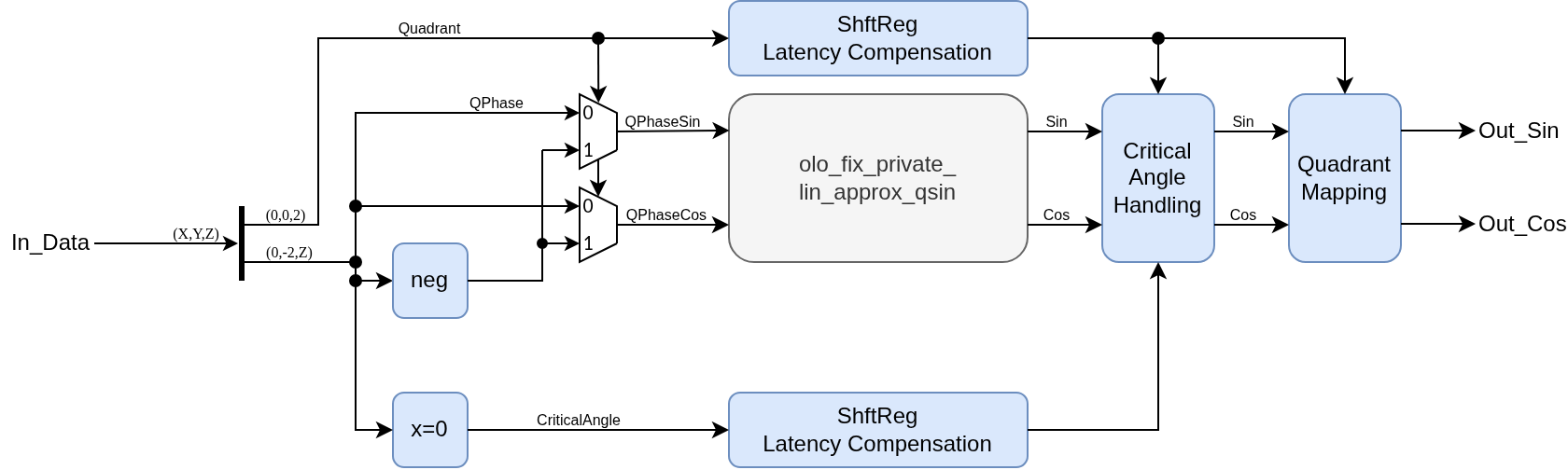
The critical angles (0, 90, 180, 270 degree) are handled separately for the angle that reaches its peak value because the approximation does only cover the range from 0 degree to just below 90°, hence the point where the cosine reaches the exact peak value is not contained.