olo_base_wconv_n2m
Status Information
VHDL Source: olo_base_wconv_n2m
Description
This component implements a width conversion between arbitrary word widths. It can handle continuous or packetized data-streams and optionally supports the usage of byte-enable signals (for input and output widths being a multiple of 8-bits only).
The width conversion implements AXI-S handshaking signals to handle back-pressure.
The with conversion supports back-to-back conversions (In_Valid can stay high all the time). It also handles the last-flag correctly according to AXI-S specification. If In_Last is asserted, all data is flushed out and Out_Last is asserted accordingly.
Usage examples:
- Conversion from 8-bit (byte oriented) data to 7-bit for the usage with 7-bit LVDS serializers
- Conversion from 24-bit to 32-bit in order to write 24-bit video pixel-data efficiently to a 32-bit wide memory
Note that for integer ratio width conversions, olo_base_wconv_n2xn and olo_base_wconv_xn2n shall be used because they are more resource efficient and timing optimal.
The entity does little-endian data alignment as shown in the figures below (the first word received on the input is packet into the output bits with the lowest index).
Byte Oriented Traffic and Byte-Enables
Below example shows a conversion from 16 to 24 bit. Backpressure (Out_Ready going low) is not depicted for simplicity reasons (but fully supported by the implementation).

Interesting is the last packet (blue) which contains an all zero word at the end, because without byte enable from the input data 0x0066 it cannot be known if the zeros represent a data byte being zero or if it is a padding byte. Similarly in the last output word of the orange packet, two padding bytes are inserted (0x0000DD) but to a receiver this might not be clear due to the missing byte enables.
Below example is similar but uses byte enables to indicate padding bytes on the input as well as on the output. The blue packet is now also shorter by one cycle because padding bytes at the end of the packet are removed.
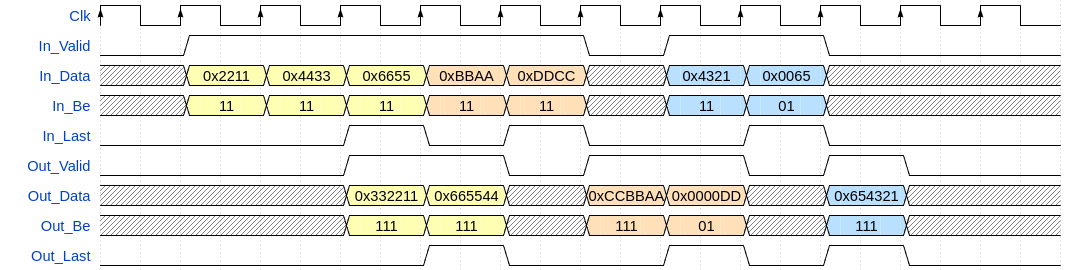
Byte enables (UseBe_g=true) are only supported when both, InWidth_g and OutWidth_g, are multiples of 8. For inputs or outputs not being mutiples of bytes, the behavior of In_Be and Out_Be byte-enable signals is undefined.
The usage of byte-enables is limited to indicating that not all bytes are used in the last beat of a packet. Any In_Be being low in any other word of a packet than the last one (In_Last='1') are not allowed and will lead to error messages in simulations as well as undefined behavior in synthesis.
Non-Byte Oriented Traffic
olo_Base_wconv_n2m can be used for non-byte-aligned data as well. In this case byte enables are not supported, otherwise the block behaves the same as for byte-oriented data.
Backpressure (Out_Ready going low) is not depicted for simplicity reasons (but fully supported by the implementation).
Below example shows a 8-bit to 7-bit conversion, as required for 7-bit LVDS serializers.

And of course the conversion into the other direction (7-bit to 8-bit) is possible as well:$

Generics
| Name | Type | Default | Description |
|---|---|---|---|
| InWidth_g | positive | 16 | Input width in bits. |
| OutWidth_g | positive | 24 | Output width in bits. |
| UseBe_g | boolean | false | true: Use In_Be and Out_Be, only allowed for InWidth_g/OutWidth_g being multiples of 8 false: In_Be and Out_Be are un |
Interfaces
Control
| Name | In/Out | Length | Default | Description |
|---|---|---|---|---|
| Clk | in | 1 | - | Clock |
| Rst | in | 1 | - | Reset input (high-active, synchronous to Clk) |
Input Data
| Name | In/Out | Length | Default | Description |
|---|---|---|---|---|
| In_Data | in | InWidth_g | - | Input data |
| In_Be | in | InWidth_g/8 | all '1' | Input byte enables Only used for UseBe_g=true |
| In_Valid | in | 1 | '1' | AXI4-Stream handshaking signal for In_Data |
| In_Ready | out | 1 | N/A | AXI4-Stream handshaking signal for In_Data |
| In_Last | in | 1 | '0' | AXI4-Stream end of packet signaling for In_Data |
Output Data
| Name | In/Out | Length | Default | Description |
|---|---|---|---|---|
| Out_Data | out | OutWidth_g | N/A | Output data |
| Out_Be | out | OutWidth_g/8 | N/A | Output byte enables Only used for UseBe_g=true |
| Out_Valid | out | 1 | N/A | AXI4-Stream handshaking signal for Out_Data |
| Out_Ready | in | 1 | '1' | AXI4-Stream handshaking signal for Out_Data |
| Out_Last | out | 1 | N/A | AXI4-Stream end of packet signaling for Out_Data |
Architecture
The architecture is based on a shift register. The position to insert new input data into the shift register is determined by a counter that wraps around after as many input words being required to inject least common multiple (LCM) bits of the input and the output word width.
The insertion position is selected in a multiple of chunks, a chunks being the greatest common factor (GCF) of the input an output width in bits.
The position of the last chunk is determined by a separate shift register containing one bit per chunk (LastChunk). A one in this shift register masks the last chunk of a packet.

This architecture is versatile and supports any width to any width conversions.