olo_fix_sim_stimuli
Status Information
VHDL Source: olo_fix_sim_stimuli
VUnit Variant: olo_test_fix_stimuli_vc
Bit-true Model: N/A
Python co-simulation file writer: olo_fix_cosim
Description
This entity reads content of a co-simulation file writen by olo_fix_cosim from Python and applies the data to a DUT in a simulation as shown below.
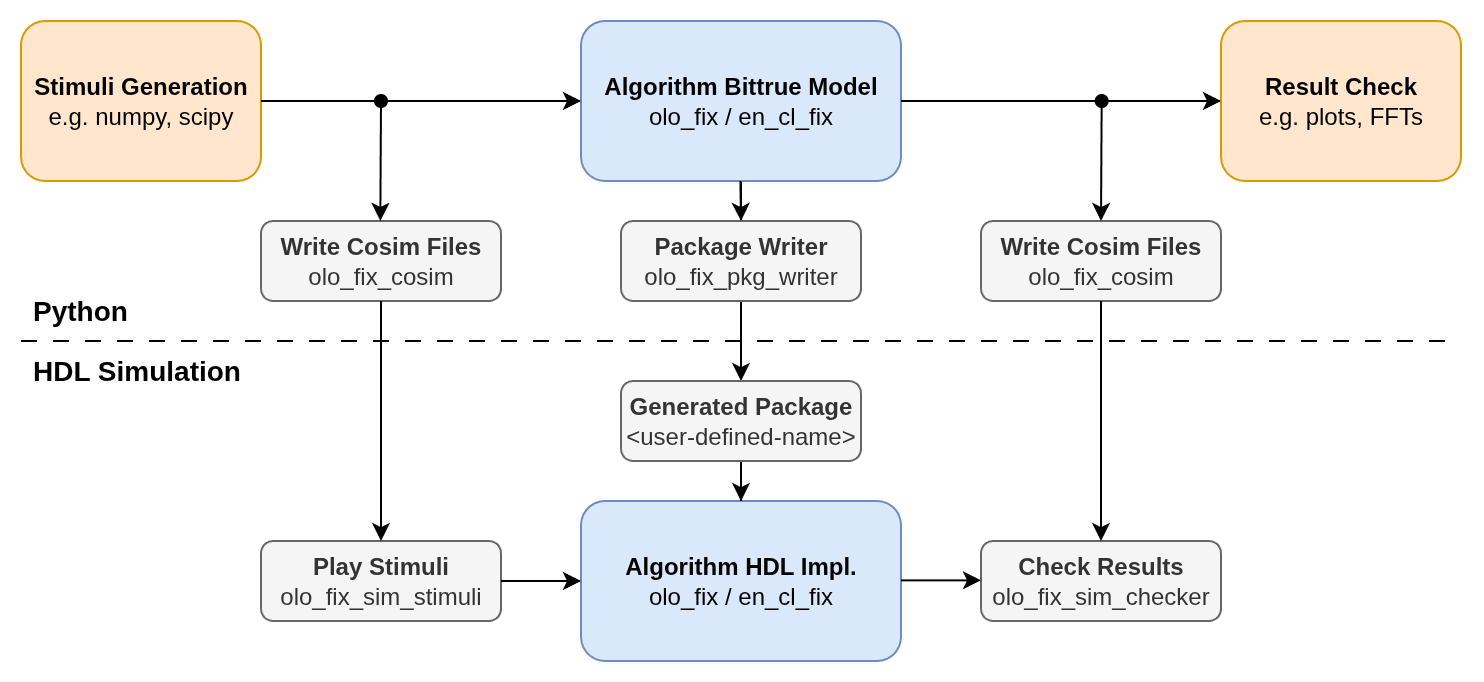
The file to play as well as the stalling pattern (optional) can be configured through generics.
The component can work as timing-master (driving the stalling pattern by pulling Valid low) or timing-slave (apply data according to the activity on Ready/Valid driven by other components). This feature is used when a DUT has multiple data inputs. A test-bench then usually contains one olo_fix_sim_stimuli component per input. one configured as timing-master and all others configured as timing-slave.
Note: The pure VHDL componend olo_fix_sim_stimuli does play the file selected once and then wait. If you need more options, consider switching to VUnit.
For details about the fixed-point number format used in Open Logic, refer to the fixed point principles.
VUnit Variant
For VUnit users, a more elaborate variant of this component exists: olo_test_fix_stimuli_vc
The VUnit variant of the component allows to trigger the playback of files through a procedure call. As a result, multiple files can be played one after the other or the same file can be played several times. For every playback run the stalling pattern can be configured individually.
Generics
| Name | Type | Default | Description |
|---|---|---|---|
| FilePath_g | string | - | Path of the file to read |
| IsTimingMaster_g | boolean | true | true: Component acts as timing-master false: Component acts as timing-slave |
| Fmt_g | string | - | Fixed point format of the signal to generate. Must match the format written into the co-simulation file on the Python side. String representation of an en_cl_fix Format_t (e.g. "(1,1,15)") |
| StallProbability_g | real | 0.0 | Stall probability (0.0 = never stall, 1.0 = always stall). Only used for IsTimingMaster_g=true |
| StallMaxCycles_g | positive | 1 | Maximum number of clock-cycles to pull Valid low when stalling. Only used for IsTimingMaster_g=true |
| StallMinCycles_g | positive | 1 | Minimum number of clock-cycles to pull Valid low when stalling. Only used for IsTimingMaster_g=true |
Interfaces
Control
| Name | In/Out | Length | Default | Description |
|---|---|---|---|---|
| Clk | in | 1 | - | Clock |
| Rst | in | 1 | - | Reset input (high-active, synchronous to Clk) |
Output Data
| Name | In/Out | Length | Default | Description |
|---|---|---|---|---|
| Data | out | width(Fmt_g) | N/A | Data Format Fmt_g |
| Valid | inout | 1 | N/A | AXI-S handshaking signal for Data Acts as output for IsTimingMaster_g=true Acts as input for IsTimingMaster_g=false |
| Ready | in | 1 | '1' | AXI-S handshaking signal for Data |
Note: In Timing-Slave mode, the Valid signal MUST be connected to the Valid signal generated by the Timing-Master. It cannot be left unconnected.
Detail
No detailed description required. All details that could be mentioned here are already covered by fixed point principles.