Open Logic Fixed-Point Principles
Based on en_cl_fix
All fixed-point mathematics related functionality in Open Logic is based on the en_cl_fix library provided by Enclustra and maintained by Dr. Harry Commin. It is strongly recommended to read through en_cl_fix documentation before using any Open Logic fixed-point related components.
Note that Open Logic refers to a fork of en_cl_fix which is under control of Open Logic.
The best starting point is watching the related Webinar. It explains the concepts of en_cl_fix well, which are to be found everywhere in olo_fix.

Instantiation from Verilog and VHDL
en_cl_fix is targeted to VHDL only. Open Logic olo_fix - like all other Open Logic content - aims to be fully usable from Verilog and VHDL, which leads to a few changes.
Components vs. Functions
The core functionality provided by en_cl_fix are a set of functions provided by en_cl_fix pkg, which allow to implement fixed-point mathematics in a very concise and well-readable way. Functionally they are exactly what is needed but unfortunately functions from VHDL packages cannot be called from Verilog.
Therefore Open Logic wraps all basic functions like resize, add or multiply into entities. In contrast to VHDL functions, entities can be instantiated from Verilog easily.
Beyond simply wrapping the functions, the entities allow to add pipeline registers where needed.
Verilog users are limited to using the entities provided by Open Logic. VHDL users are free to either use those entities or to write their own processes using the en_cl_fix pkg directly. Both options are fully supported and allow direct interfacing with fixed-point related Open Logic components.
String Generics
The en_cl_fix pkg defines a number of custom types:
- FixFormat_t
- Fixed point number format defined as record
- Form (\<S>, \<I>, \<F>) where S=Sign, I=Integer-Bits, F=Fractional-Bits (e.g. (1, 8, 23))
- FixRound_t
- An enum type defining different rounding options
- Options: Trunc_s, NonSymPos_s, NonSymNeg_s, SymInf_s, SymZero_s, ConvEven_s, ConvOdd_s
- Most common: Trunc_s (truncate) and NonSymPos_s (nearest rounding)
- FixSaturate_t
- An enum type defining different saturation options
- Options: Sat_s, None_s, SatWarn_s, Warn_s
Custom types are generally not supported when instantiating VHDL from Verilog. Some tools allow it to some extent but no common ground is present between all the tools supported by Open Logic. Hence using those types on interfaces of Open Logic components is avoided to ensure all Open Logic components can be instantiated in Verilog.
Instead of using custom types for generics/parameters, they are passed as strings. The notation is exactly the same as in VHDL natively, just with quotes around it.
Verilog:
// String representing FixFormat_t (1,8,23)
localparam string fmt = "(1,8,23)";

// String representing Round_t for Truncation (Trunc_s)
localparam string round = "Trunc_s";

// String representing Saturation (Sat_s)
localparam string saturate = "Sat_s";
VHDL:
-- String representing FixFormat_t (1,8,23)
constant fmt : string := "(1,8,23)";

-- String representing FixRound_t for Truncation (Trunc_s)
constant round : string := "Trunc_s";

-- String representing FixSaturate_t (Sat_s)
constant saturate : string := "Sat_s";
Note that in VHDL it is easily possible to convert the custom types defined in en_cl_fix pkg to their string representation using the to_string() function as shown below. This is especially useful when working in VHDL and using en_cl_fix functions and types in your custom code for converting the types to string for instantiating Open Logic entities.
-- Convert FixFormat_t to string
constant typed_fmt  : FixFormat_t := (1,8,23);
constant string_fmt : string      := to_string(typed_fmt);

-- Convert FixRound_t to string
constant typed_round  : FixRound_t := Trunc_s;
constant string_round : string     := to_string(typed_round);

-- Convert FixSaturate_t to string
constant typed_sat  : FixSaturate_t := Sat_s;
constant string_sat : string        := to_string(typed_sat);
Pipeline Registers
Open Logic basic-functions allow to configure pipeline registers in a common way.
All basic functions allow the user to define the input and output format as well as the way to convert from the format the operation naturally produces to the result format (if rounding and saturation is applied). This splits a basic functions into three steps - explained on the example of an addition:

Executing all three steps in one clock cycle very often can be limiting to the clock speed. Therefore the user can configure pipeline registers.
For rounding and saturation the user can configure pipelining through a string parameter for each of them (rounding/saturation) and choose between three options:
- "YES"
- A pipeline register is added after the corresponding step in all cases
- The pipeline register is also added if there is no logic (e.g. when converting from (0,3,4) to (1,5,6) which does neither require rounding nor saturation)
- Advantage: High clock speed and fixed latency (independent of number formats)
- Disadvantage: Needless latency for cases where there is no rounding/saturation logic needed
- This is the default option because it allows for fastest clock-speeds, which often is critical in typical fixed-point mathematics applications like video processing or digital signal processing
- "NO"
- No pipeline register is implemented
- Advantage: low and constant latency (independent of number formats)
- Disadvantage: Long combinatorial paths may limit clock-speed
- "AUTO"
- A pipeline register is added only if rounding/saturation logic is required
- Advantage: High clock speed and not needless latency
- Disadvantage: Latency depends on number formats
For the operation the user can specify how many pipeline registers shall be added after the operation. For most operations only the settings 0 and 1 make sense. However, other numbers can be used to compensate for latency on other paths. Complex operations (e.g. multipliers or very wide adders) may benefit from adding 2 or more pipeline registers - therefore the option to configure the number freely is provided.
Co-Simulation
All Open Logic fixed-point components come with Python models. This principle is inherited from en_cl_fix and allows analyzing the behavior of an algorithm in Python before any effort is invested into an HDL implementation. Python offers powerful toolboxes for analyzing algorithms (e.g. printing FFTs, using NumPy/SciPy, various plotting libraries) and therefore is a much more productive environment for developing the algorithm and an HDL simulator.
Open Logic also provides python and HDL components to exchange inputs and expected outputs between Python and the HDL simulation. This allows easily verifying if the HDL implementation of an algorithm really exactly matches its Python model. olo_fix_cosim can be used to write data from python into co-simulation files. olo_fix_sim_stimuli can be used to read the data from the co-simulation files and apply it as stimulus in the HDL simulation and olo_fix_sim_checker can be used to read the expected output from the co-simulation files and compare it with the actual output from the HDL simulation.
Additionally, Open Logic provides olo_fix_pkg_writer to generate the HDL package with all key design parameters defined in Python. This allows to automatically transfer things like constants, filter coefficients or number formats from Python to HDL which significantly reduces the risk for errors and inconsistencies between the Python model and HDL implementation.
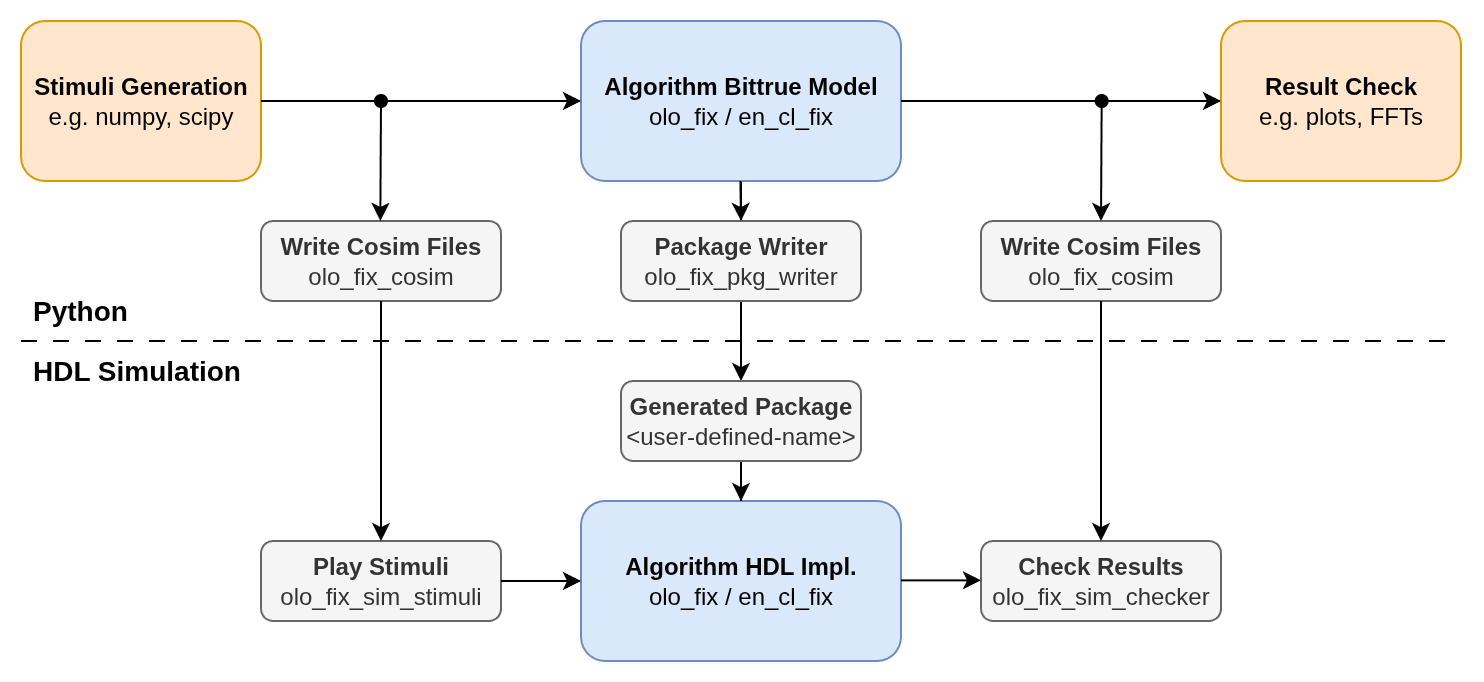
Note that Python models only model the mathematical behavior but not the timing (e.g. latency or maximum sample rate).
Again, en_cl_fix functions can be used - independently of whether in HDL basic operations are coded as en_cl_fix functions or by using the olo_fix components.
All Open Logic components (including the ones for basic operations) come with object oriented models that have a common set of functions:
- Constructor
- All formats and configuration values are passed to the constructor
- Process()
- Processes a signal. Arrays can be passed.
- The state of the object (e.g. accumulators) is reset before the signal is processed
- Use case: Calculate the response of a filter to various different signals independently.
- Next()
- Processes the next sample(s) of a signal. Arrays can be passed.
- The state of the object is not reset before the signal is processed.
- Use case: Calculate a filter sample by sample
Python to HDL Worklow
Instead of defining the very same number formats in Python and HDL, it is strongly suggested to use the olo_fix_pkg_writer to generate the HDL package with all the formats defined and constants defined in Python.
This way Python is the single source of truth and all definitions are automatically transferred to HDL which significantly reduces the risk for errors and inconsistencies between the Python model and HDL implementation.
Complex Numbers Representation
Many Open Logic fixed-point components that support complex numbers implement two interface options:
- Parallel I/Q handling
- In this case the in-phase and quadrature-phase parts of the complex number are handled separately and arrive in parallel on separate ports (e.g. InA_I and InA_Q).
- TDM I/Q handling
- In this case the in-phase and quadrature-phase parts of the complex number are arriving on the same port (e.g. InA_IQ) in a time-division multiplexed way.
- In-phase is transmitted first, quadrature-phase second.
- The Last signal can be used to indicate quadrature-phase samples - this allows resynchronization in case of a lost sample or starting the stream at an arbitrary point.
- In many cases reduces resource consumption to around 50% of the Parallel I/Q handling version
Conversion between the two can be achieved by the entities commonly used for TDM/parallel conversion:
| Entity | Description |
|---|---|
| olo_base_wconv_n2xn | Convert from TDM to parallel (see Conventions) This is not a pure TDM entity but it can be used for TDM purposes. |
| olo_base_wconv_xn2n | Convert from parallel to TDM (see Conventions) This is not a pure TDM entity but it can be used for TDM purposes. |
The TDM handling follows the TDM Conventions.
Below is an example waveform for TDM I/Q handling. Note that Last is only applied for every second sample which is perfectly fine according to TDM Conventions.

Note that complex number handling only is implemented for operations where the separate handling of in-phase and quadrature-phase does not lead to the same result as handling complex numbers. Operations that can be applied to in-phase and quadrature-phase separately (e.g. FIR filters, CIC filters) do not have a complex number handling option.