olo_fix_sim_checker
Status Information
VHDL Source: olo_fix_sim_checker
VUnit Variant: olo_test_fix_checker_vc
Bit-true Model: N/A
Python co-simulation file writer: olo_fix_cosim
Description
This entity reads content of a co-simulation file writen by olo_fix_cosim from Python and checks the output of a DUT in a HDL simulation against it. If the output does not contain exactly the expected data, an error is thrown.
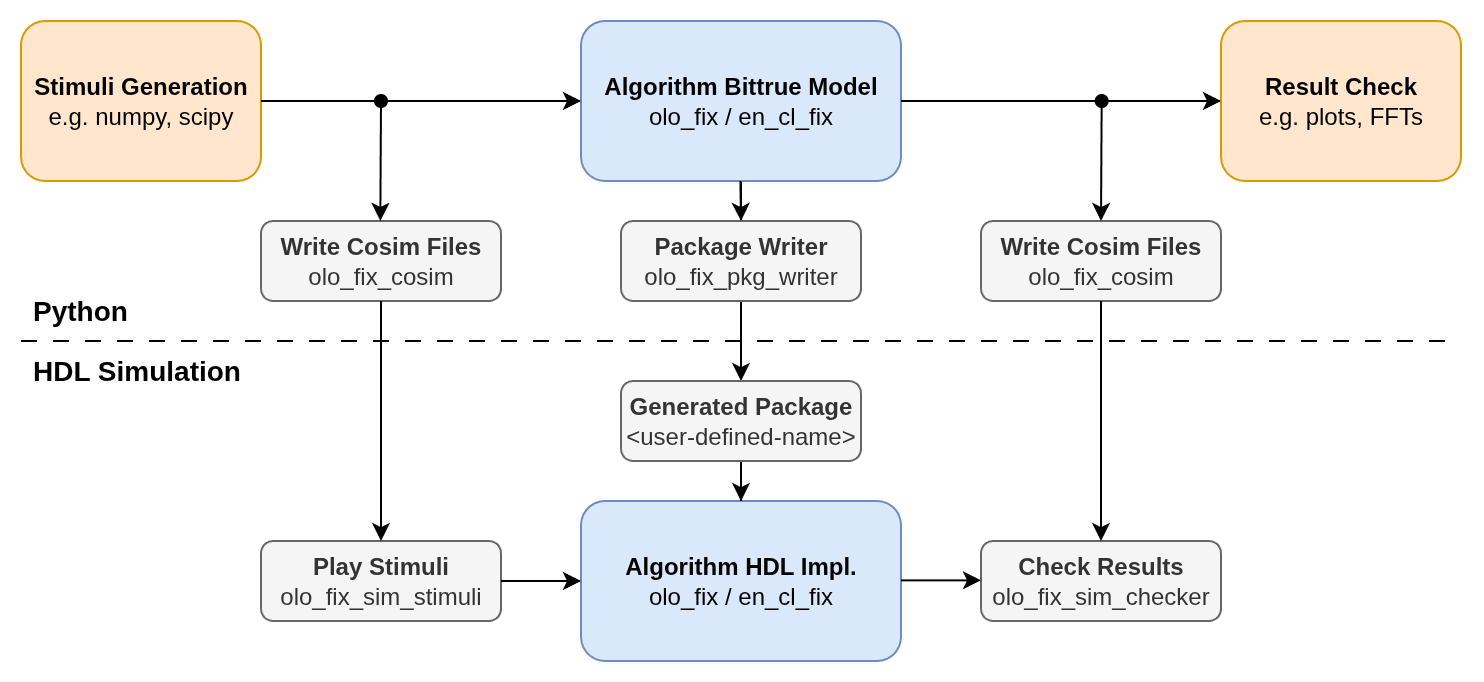
The file to check against as well as the stalling pattern (optional) can be configured through generics.
The component can work as timing-master (driving the stalling pattern by pulling Ready low) or timing-slave (check data according to the activity on Ready/Valid driven by other components). This feature is used when a DUT has multiple data outputs. A test-bench then usually contains one olo_fix_sim_checker component per output. One configured as timing-master and all others configured as timing-slave.
Note: The pure VHDL componend olo_fix_sim_checker does check the file selected once and then wait. If you need more options, consider switching to VUnit.
For details about the fixed-point number format used in Open Logic, refer to the fixed point principles.
VUnit Variant
For VUnit users, a more elaborate variant of this component exists: olo_test_fix_checker_vc
The VUnit variant of the component allows to trigger the check against files through a procedure call. As a result, multiple files can be checked against one after the other or the same file can be checked against several times. For every check run the stalling pattern can be configured individually.
Generics
| Name | Type | Default | Description |
|---|---|---|---|
| FilePath_g | string | - | Path of the file to read |
| IsTimingMaster_g | boolean | true | true: Component acts as timing-master false: Component acts as timing-slave |
| Fmt_g | string | - | Fixed point format of the signal to generate. Must match the format written into the co-simulation file on the Python side. String representation of an en_cl_fix Format_t (e.g. "(1,1,15)") |
| StallProbability_g | real | 0.0 | Stall probability (0.0 = never stall, 1.0 = always stall). Only used for IsTimingMaster_g=true |
| StallMaxCycles_g | positive | 1 | Maximum number of clock-cycles to pull Ready low when stalling. Only used for IsTimingMaster_g=true |
| StallMinCycles_g | positive | 1 | Minimum number of clock-cycles to pull Ready low when stalling. Only used for IsTimingMaster_g=true |
Interfaces
Control
| Name | In/Out | Length | Default | Description |
|---|---|---|---|---|
| Clk | in | 1 | - | Clock |
Output Data
| Name | In/Out | Length | Default | Description |
|---|---|---|---|---|
| Data | in | width(Fmt_g) | - | Data Format Fmt_g |
| Valid | in | 1 | - | AXI-S handshaking signal for Data |
| Ready | inout | 1 | N/A | AXI-S handshaking signal for Data Acts as output for IsTimingMaster_g=true Acts as input for IsTimingMaster_g=false |
Note: In Timing-Slave mode, the Ready signal MUST be connected to the Ready signal generated by the Timing-Master. It cannot be left unconnected.
Detail
No detailed description required. All details that could be mentioned here are already covered by fixed point principles.