olo_fix_limit
Status Information
VHDL Source: olo_fix_limit
Bit-true Model: olo_fix_limit
Description
This entity limits a signal to a specified range. The range can be given through generics (at compile-time) or through ports (at runtime).
Latency of this entity is two clock cycles plus optional rounding and saturation registers. The default generics lead to a latency of 4 clock cycles.
For details about the fixed-point number format used in Open Logic, refer to the fixed point principles.
Generics
| Name | Type | Default | Description |
|---|---|---|---|
| InFmt_g | string | - | Data input format String representation of an en_cl_fix Format_t (e.g. "(1,1,15)") |
| LimLoFmt_g | string | "(1,1,1)" | Lower limit format String representation of an en_cl_fix Format_t (e.g. "(1,1,15)") Default given only for the user not having to assign the generic if UseFixedLimits_g=true |
| LimHiFmt_g | string | "(1,1,1)" | Upper limit format String representation of an en_cl_fix Format_t (e.g. "(1,1,15)") Default given only for the user not having to assign the generic if UseFixedLimits_g=true |
| ResultFmt_g | string | - | Format of the result String representation of an en_cl_fix Format_t (e.g. "(0,1,15)") |
| Round_g | string | "Trunc_s" | Rounding mode String representation of an en_cl_fix FixRound_t. |
| Saturate_g | string | "Warn_s" | Saturation mode String representation of an en_cl_fix FixSaturate_t. |
| UseFixedLimits_g | boolean | false | true: Use FixedLimLo_g and FixedLimHi_g as limits. false: Use ports In_LimLo and In_LimHi as limits. |
| FixedLimLo_g | real | 0.0 | Compile time set lower limit (only used if UseFixedLimits_g=true) |
| FixedLimHi_g | real | 0.0 | Compile time set upper limit (only used if UseFixedLimits_g=true) |
| RoundReg_g | string | "YES" | Presence of rounding pipeline stage "YES": Always implement register "NO": Never implement register "AUTO": Implement register if rounding is needed according to the formats chosen |
| SatReg_g | string | "YES" | Presence of saturation pipeline stage "YES": Always implement register "NO": Never implement register "AUTO": Implement register if saturation is needed according to the formats chosen |
Interfaces
Control
| Name | In/Out | Length | Default | Description |
|---|---|---|---|---|
| Clk | in | 1 | - | Clock |
| Rst | in | 1 | - | Reset input (high-active, synchronous to Clk) |
Input Data
| Name | In/Out | Length | Default | Description |
|---|---|---|---|---|
| In_Data | in | width(InFmt_g) | - | Input data Format: InFmt_g |
| In_LimLo | in | width(LimLoFmt_g) | 0 | Input lower limit Only used if UseFixedLimits_g=false Format: LimLoFmt_g |
| In_LimHi | in | width(LimHiFmt_g) | 0 | Input upper limit Only used if UseFixedLimits_g=false Format: LimHiFmt_g |
| In_Valid | in | 1 | '1' | AXI4-Stream handshaking signal for In_A and In_B |
Output Data
| Name | In/Out | Length | Default | Description |
|---|---|---|---|---|
| Out_Result | out | width(ResultFmt_g) | N/A | Result data Format ResultFmt_g |
| Out_Valid | out | 1 | N/A | AXI-S handshaking signal for Out_Result |
Detail
Below figure shows the implementation of olo_fix_limit
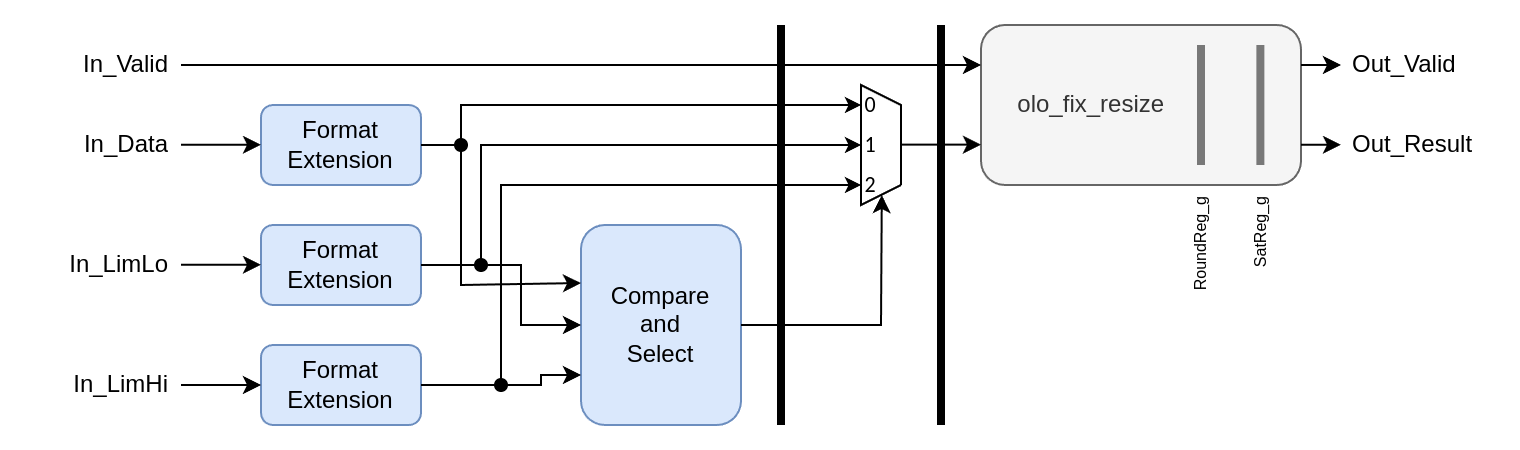
First, all inputs are extended to the maximum common format that allows fully representing them all. Then the data is compared to the limits and based on the result either one of the limits or the data is selected. And at the very output the result is resized to ResultFmt_g.
From the structure it is obvious that rounding and saturation are not required if InFmt_g, LimLoFmt_g, LimHiFmt_g and ResultFmt_g are all the same.
Because the logic does never increase the range of the signal, saturation may only be required because of rounding in case of LimLoFmt_g or LimHiFmt_g having more fractional bits than InFmt_g. For Round_g="Trunc_s" no saturation is required.
For static limiting (i.e. UseFixedLimits_g=true), neither rounding nor saturation are required. The internal format is equal to InFmt_g in this case for obvious reasons.
As described in above paragraphs, in most cases no rounding and saturation is required. If they are not required (and disabled by generics) the corresponding registers can be omitted as well.
Example Dynamic Limit
Below code shows an example of dynamic limiting, i.e. limits that change at runtime.
i_limit : entity olo.olo_fix_limit
    generic map (
        InFmt_g          => "(1,8,8)",
        LimLoFmt_g       => "(1,8,8)",
        LimHiFmt_g       => "(1,8,8)",
        ResultFmt_g      => "(1,8,8)"
    )
    port map (
        Clk        => Clk,
        Rst        => Rst,
        In_Valid   => X_Valid,
        In_Data    => X_Data,
        In_LimLo   => X_LimLo, -- e.g. from register bank
        In_LimHi   => X_LimHi, -- e.g. from register bank
        Out_Valid  => Y_Valid,
        Out_Result => Y_Data
    );
Example Static Limit
Below code shows an example of static limiting, i.e. limits that change at compile-time.
i_limit : entity olo.olo_fix_limit
    generic map (
        InFmt_g          => "(1,8,8)",
        ResultFmt_g      => "(1,8,8)",
        UseFixedLimits_g => true,
        FixedLimLo_g     => -100.75,
        FixedLimHi_g     => 200.125
    )
    port map (
        Clk        => Clk,
        Rst        => Rst,
        In_Valid   => X_Valid,
        In_Data    => X_Data,
        Out_Valid  => Y_Valid,
        Out_Result => Y_Data
    );