olo_fix_inv
Status Information
VHDL Source: olo_fix_inv
Bit-true Model: olo_fix_inv
Description
This entity calculates the inverse of the input:
Out_Result = 1/In_Data
The absolute value of the input is normalized (blue) into the range [1, 2), inverted through a table based
piecewise linear approximation (red) and the normalization is reverted on the result (green):
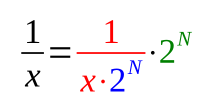
Compared to olo_fix_bin_div it requires less LUT logic and its latency does not grow with the output width, but it requires a ROM and a multiplier.
Because the normalization covers the full input range, the approximation only has to cover one octave. Hence a relatively small table delivers accurate results over the full range of any input format. The precision of the approximation is selected through PrecisionBits_g, see Precision.
Latency of this entity is constant, see Latency. The entity is fully pipelined, hence it accepts one input sample per clock cycle. As a result, back-pressure is not supported.
For details about the fixed-point number format used in Open Logic, refer to the fixed point principles.
Corner Cases
Inputs that are powers of two are inverted exactly (as far as the result is representable in OutFmt_g). Their normalized value is exactly 1.0, for which the approximation returns exactly 1.0.
An input of zero delivers the same result as the smallest non-zero input, which is the largest result the
entity can produce. No error is flagged. With the default Saturate_g = "Sat_s" and an output format that cannot
represent 2^InFmt_g.F, this result saturates to the maximum value of OutFmt_g.
Latency
Latency is not guaranteed to be constant across different versions. It's therefore best to design user logic to be independent of the latency of this block (e.g. through olo_base_latency_comp).
In the current version the latency is 21 clock cycles, independently of the input format.
Generics
| Name | Type | Default | Description |
|---|---|---|---|
| OutFmt_g | string | - | Output format. Must be signed if InFmt_g is signed. |
| InFmt_g | string | - | Input format. Any format that is at least two and at most 256 bits wide. |
| PrecisionBits_g | positive | 18 | Number of fractional bits of the inversion approximation. Must be 10, 14, 18 or 20. |
| MemStyle_g | string | "auto" | Resource control for the table (auto, block or distributed) |
| Round_g | string | "NonSymPos_s" | Rounding mode of the output stage |
| Saturate_g | string | "Sat_s" | Saturation mode of the output stage |
Interfaces
Control
| Name | In/Out | Length | Default | Description |
|---|---|---|---|---|
| Clk | in | 1 | - | Clock |
| Rst | in | 1 | - | Reset input (high-active, synchronous to Clk) |
Input Data
| Name | In/Out | Length | Default | Description |
|---|---|---|---|---|
| In_Valid | in | 1 | '1' | AXI4-Stream handshaking signal for In_Data |
| In_Data | in | width(InFmt_g) | - | Input data Format: InFmt_g |
Output Data
| Name | In/Out | Length | Default | Description |
|---|---|---|---|---|
| Out_Valid | out | 1 | N/A | AXI4-Stream handshaking signal for Out_Result |
| Out_Result | out | width(OutFmt_g) | N/A | Inverse of In_Data Format: OutFmt_g |
Details
Architecture
The figure below shows the architecture of the entity. The colors of the signal labels match the formula given in the Description.
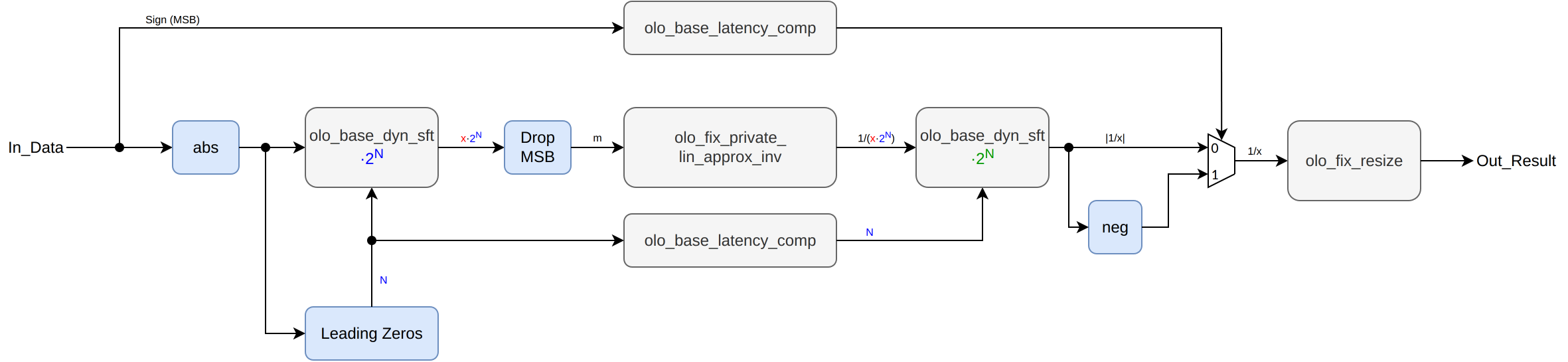
The normalization shift N is the number of leading zeros of the absolute value of the input. Normalization and its reversal are both implemented by olo_base_dyn_sft, which spreads the barrel shifter over two pipeline stages to achieve good timing. The shift count and the sign of the input are delayed to the point where they are needed by olo_base_latency_comp.
The leading one of the normalized value 1+m is known, hence it is dropped and only the mantissa fraction m
in the range [0, 1) is passed on. The function approximated is 1/(1+m), which covers the range (0.5, 1.0].
As a result the whole range of the approximation is used.
The approximation is implemented by the internal entity olo_fix_private_lin_approx_inv. It contains the inversion tables (one per supported PrecisionBits_g value) and instantiates olo_fix_lin_approx_calc for the piecewise linear interpolation.
Reverting the normalization shifts the result left by N. The remaining constant factor (which depends only on the number of integer bits of the input format) is applied by reinterpreting the number format of the shifted result, hence it is pure wiring and does not cost any logic. Finally the result is negated for negative inputs and rounded/saturated to OutFmt_g by olo_fix_resize.
Precision
PrecisionBits_g selects the number of fractional bits the inversion approximation delivers. One table exists per supported value, hence only the values listed below are allowed - any other value leads to an error:
| PrecisionBits_g | Table size |
|---|---|
| 10 | 32 x 22 bit |
| 14 | 128 x 29 bit |
| 18 | 512 x 36 bit |
| 20 | 1024 x 35 bit |
Because the normalization makes the accuracy independent of the magnitude of the input, the error is defined relative to the absolute value of the result:
